
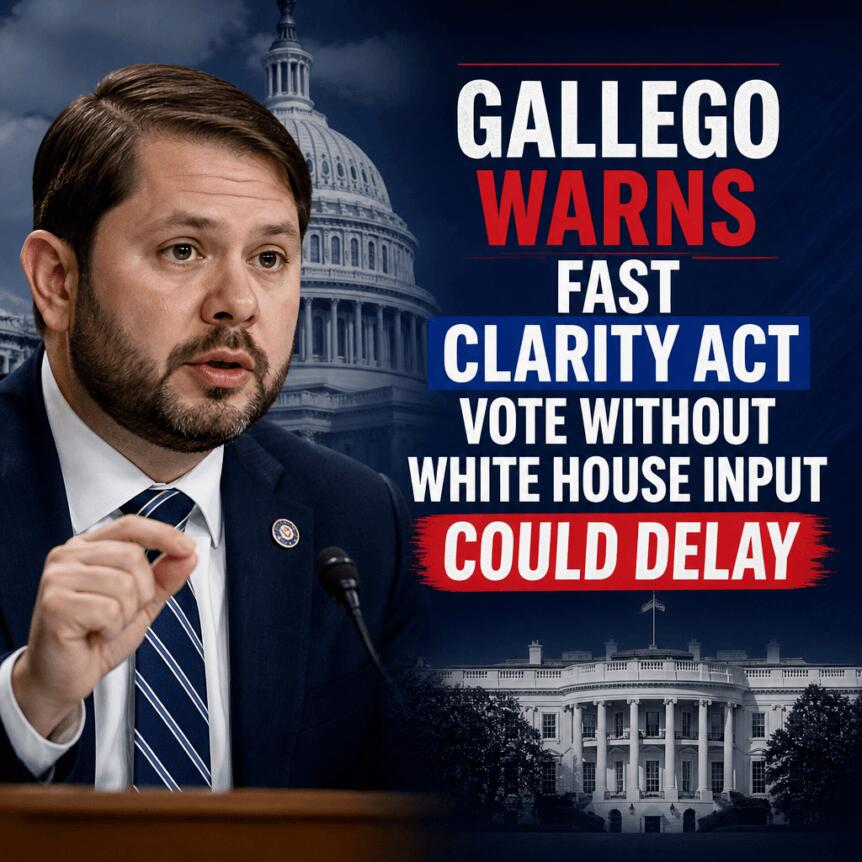
Senator Ruben Gallego has urged U.S. lawmakers to slow down the push to put the CLARITY Act on the Senate floor, warning that moving too quickly—before remaining disputes over ethics and stablecoin yield are resolved—could derail the bill’s chances of ultimately clearing Congress.
Speaking at the SALT Wyoming Blockchain Symposium on Wednesday, Gallego said the industry should encourage continued negotiations among Senate Democrats and Republicans rather than forcing an immediate vote. He also pointed to unresolved procedural work needed to package the measure—including committee handling and logistics for sending it to the House.
Key takeaways
- Sen. Ruben Gallego warned that a “fast vote” on the CLARITY Act could produce an outcome that lawmakers do not want, potentially setting the legislation back.
- He said Democratic support depends on establishing “sufficiently strong” ethics restrictions, and that the White House has not provided a detailed response to compromise language.
- The concern aligns with broader pressure from the Trump administration to move toward swift passage, including calls to pass a “fair version” of the bill.
- Gallego’s comments also reflect the practical reality that Senate leadership expects to delay action until September, suggesting negotiations may still be unfinished.
Why Gallego says timing matters for the CLARITY Act
Gallego’s intervention frames the CLARITY Act not just as a policy debate, but as a coalition-building challenge. He argued that legislators still must complete multiple steps before a vote can happen in a way that stands a realistic chance of meeting the Senate’s threshold for passage.
While the Senate could, in theory, take up legislation immediately, Gallego emphasized that lawmakers are still working through outstanding components. He said Congress has to address the bill’s Agriculture Committee portion, assemble the broader package, and determine how the legislation would move to the House.
In his remarks, Gallego urged colleagues not to “go for a fast vote,” explaining that rapid action can lead to a quick result without delivering the desired final outcome. He added that premature movement could “set it back further,” underscoring his view that the political process is still unsettled.
Tillis and Gallego say White House hasn’t answered ethics proposal
A central point in Gallego’s warning was ethics. He said he and Republican Senator Thom Tillis submitted compromise ethics language to the White House ahead of the congressional recess, but that the administration has not responded point-by-point.
Gallego described a pattern of outreach that, in his account, has produced no clear engagement: he said the proposals were repeatedly sent and returned “blank,” returned with language that was not as forward-moving, or were met with no response. He argued that if ethics restrictions are not strong enough, it will be difficult to attract Democratic support—support he views as necessary to move the bill forward.
Cointelegraph attempted to obtain comment from the White House but did not receive a response before publication.
Administration pressure contrasts with Senate procedural delays
Gallego’s comments come as the administration continues to press for progress on the CLARITY Act. Earlier this week, Trump urged Congress to pass a “fair version” of the bill during a White House appearance with crypto executives.
At the same time, Senate leaders have indicated that the chamber will not push for immediate action. Reporting from Cointelegraph said that Senate Majority Leader John Thune confirmed on Aug. 7 that the Senate was “punting” the vote and that the bill would be queued up “first thing” after lawmakers returned from recess—language that effectively sets the focus on a September timeframe rather than an immediate floor push.
White House crypto adviser Patrick Witt previously indicated that the administration would continue negotiating with Democrats until the September vote, while also adding that it “can’t afford to wait forever.” This creates a narrow window in which ethics language and other unresolved elements must be settled enough for negotiators to build a coalition capable of reaching the Senate’s 60-vote threshold.
Gallego’s remarks suggest a tension between that timeline pressure and what he believes still needs to be resolved. In his view, if lawmakers prematurely force a vote before disputes are resolved and the coalition is assembled, the bill risks failing—or winning only in a form that satisfies fewer members than required.
What remains unclear, and what to watch next
Gallego’s warning turns attention to the mechanics of getting from draft policy to final legislation that can actually clear the Senate and proceed to the House. His comments highlight that even if the CLARITY Act is broadly backed in principle, the details—especially around ethics and how stablecoin yield issues are treated—may be decisive for Democratic support.
Going forward, observers should watch whether the White House provides the point-by-point engagement Gallego says it has not yet delivered, and whether Senate leadership’s September timeline is matched by measurable progress in assembling the bipartisan coalition needed for passage. If negotiations remain unresolved, Gallego’s core concern is likely to take center stage: that rushing the process could reduce the odds of a durable legislative outcome rather than improving them.
https://www.cryptobreaking.com/gallego-warns-fast-clarity-act/?utm_source=blogger%20&utm_medium=social_auto&utm_campaign=Gallego%20Warns%20Fast%20CLARITY%20Act%20Vote%20Without%20White%20House%20Input%20Could%20Delay%20
Comments
Post a Comment