
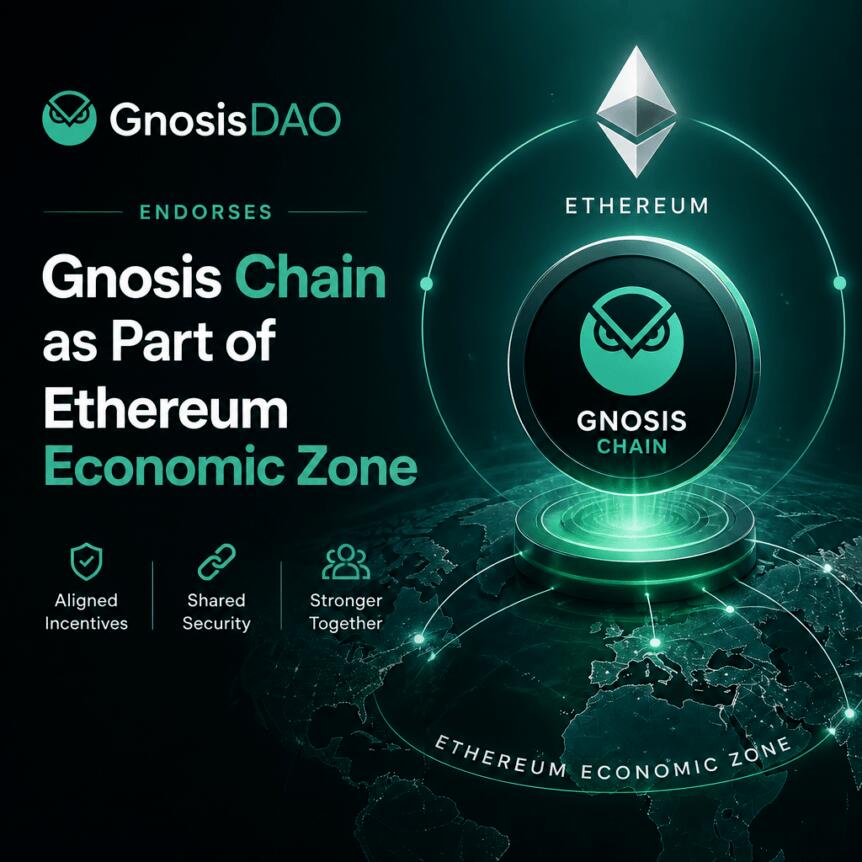
GnosisDAO has approved a major change for Gnosis Chain, clearing the way for the network to transition from a standalone layer-1 into a ZK-proven Ethereum Economic Zone (EEZ) rollup. The vote centered on GIP-153, which would effectively retire the existing validator set and move transaction settlement to Ethereum.
According to Gnosis Chain, the proposal passed with 123,158 GNO in support, 115 against, and 151 abstaining across 54 voters. Turnout totaled 123,425 GNO, surpassing the 75,000 GNO quorum threshold.
Key takeaways
- GIP-153 clears governance approval to transition Gnosis Chain into an EEZ rollup settled on Ethereum.
- Existing validator infrastructure would be retired, shifting settlement responsibilities to Ethereum validators.
- Target timing is late 2026 or early 2027, contingent on EEZ technology readiness.
- The EEZ concept aims to reduce fragmentation by enabling cross-rollup smart contract execution without bridges.
- Standard Chartered expects fewer bridge dependencies and improved on-chain usability, which could increase Ethereum activity.
What GIP-153 approved and what it changes for users
In the proposal, Gnosis Chain outlined a pathway to make Gnosis Chain “Ethereum-aligned” by converting it into a rollup instance under the EEZ framework. The core mechanics are straightforward: the current validator set would be retired, and transactions would settle on Ethereum. In that structure, Gnosis Chain becomes a layer-2 that relies on Ethereum for settlement, while still supporting “Gnosis Chain-native smart contracts.”
The proposal also points to functionality changes intended to matter for developers and dApps: Gnosis Chain contracts would be able to call Ethereum and use the result within the same transaction. If implemented as described, that design is meant to provide tighter integration with Ethereum mainnet assets and liquidity than what the proposal claims is currently available on existing L2 deployments.
Gnosis Chain further states it would preserve key user-facing continuity, including keeping its existing applications and balances, along with the xDAI gas token.
The EEZ framework: aligning rollups to address L2 fragmentation
The EEZ concept is not limited to one network. It is described as a framework for building Ethereum-aligned rollups developed by Gnosis and ZisK, with funding from the Ethereum Foundation. The intent is to unify parts of Ethereum’s currently fragmented scaling landscape.
Ethereum’s scaling reality today is defined by the proliferation of multiple rollups, each with its own liquidity pools, infrastructure choices, and user access patterns. That separation can reduce composability—especially when applications want to interact with state or assets across different rollups. The EEZ approach targets one of the most persistent scaling trade-offs: improved throughput at the cost of fragmentation.
Under the proposal’s vision, the first production EEZ instance would be deployed through Gnosis Chain while still keeping its existing ecosystem. The broader objective is to enable smart contracts across different participating rollups to execute synchronously without relying on bridges, which the proposal presents as a structural weakness in today’s cross-chain interactions.
This argument fits into an earlier critique of L2 designs. Ethereum co-founder Vitalik Buterin previously raised concerns about centralized sequencers and trusted bridging mechanisms as potential vulnerabilities, writing in a Feb. 3 X post that “the original vision of L2s and their role in Ethereum no longer makes sense, and we need a new path.”
For context, L2Beat data cited by the Gnosis-related reporting indicates that 22 Ethereum rollups are currently “secure” with $27.82 billion in value secured. When expanded to include validiums, optimiums, and other scaling networks, the total tracked value secured rises to $34.88 billion.
Why reduced bridge reliance is a key selling point
Bridge risk is a frequent topic in Ethereum scaling discussions because bridges are often the point of failure in major cross-chain incidents. Standard Chartered’s Geoffrey Kendrick, global head of digital assets research, argued that EEZ could help reduce reliance on those vulnerable components.
In a May 28 report shared with Cointelegraph, Kendrick wrote that the EEZ “will have the benefit of reducing the need for bridges (where hacks tend to occur) and increasing the usability of assets in EVM chains.” He added that both factors are “likely to lead to greater activity in the Ethereum ecosystem.”
Kendrick’s view also emphasized composability. He suggested that EEZ could allow smart contracts on different participating networks to interact within the same transaction. For investors, traders, and users, that distinction matters because better composability can translate into smoother execution paths for complex DeFi operations—potentially reducing the friction that users face when assets must move across ecosystems before a transaction can complete.
Still, the practical timeline remains dependent on development readiness. Gnosis Chain says an initial launch is targeted for late 2026 or early 2027, subject to the required EEZ technology being ready. Until then, many questions—especially around performance, finality characteristics, and integration details—will likely remain in the realm of documentation and engineering milestones rather than lived production behavior.
What to watch as Gnosis Chain moves toward EEZ
The governance vote is a significant milestone, but it is not the final word on execution. Readers should watch for how Gnosis Chain and its partners operationalize the EEZ transition: whether settlement on Ethereum is implemented in the intended manner, how the ability for contracts to call Ethereum within a single transaction is achieved, and how users experience the migration while keeping existing apps, balances, and the xDAI gas token.
The next critical signals will likely come in the form of engineering updates leading up to the late-2026/early-2027 target—especially benchmarks or test deployments that clarify what “ZK-proven” and “Ethereum Economic Zone” mean in day-to-day performance and developer tooling. If the EEZ thesis holds, the broader impact could be a more cohesive Ethereum environment where interoperability is handled by design rather than bridged after the fact.
https://www.cryptobreaking.com/gnosisdao-endorses-gnosis-chain-as/?utm_source=blogger%20&utm_medium=social_auto&utm_campaign=GnosisDAO%20Endorses%20Gnosis%20Chain%20as%20Part%20of%20Ethereum%20Economic%20Zone%20
Comments
Post a Comment