
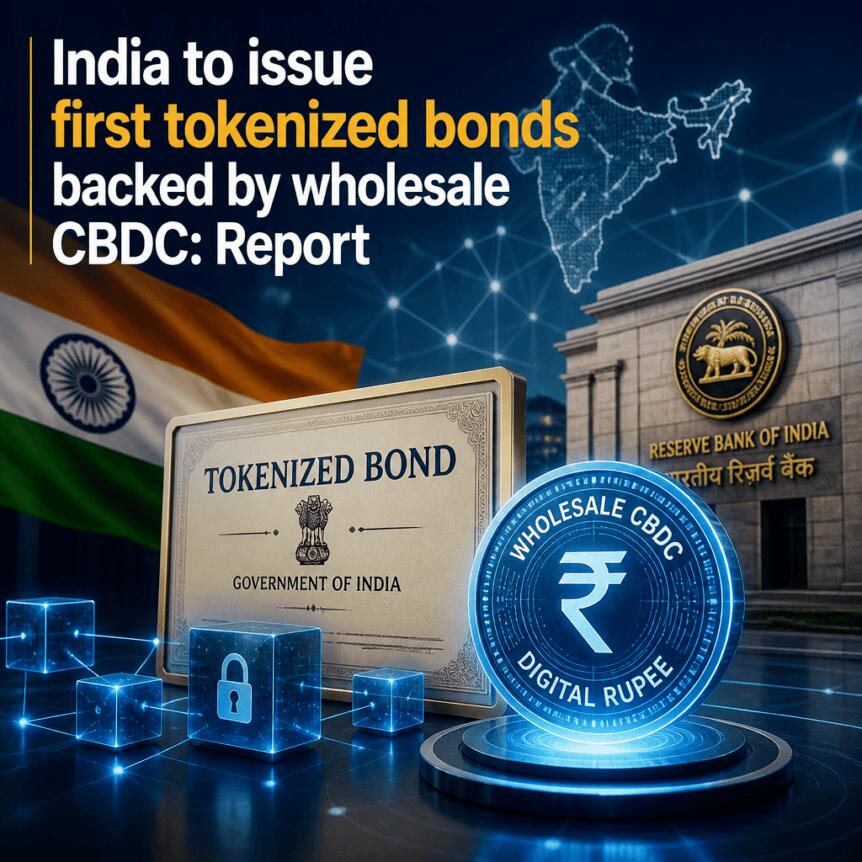
India is reportedly preparing to test the issuance of tokenized corporate bonds, with a pilot expected to begin as early as September. The initiative centers on blockchain-based bond transactions that would be settled using India’s central bank digital currency (CBDC), according to Reuters.
REC Limited, a state-controlled power infrastructure finance company, is said to plan an initial bond issuance of less than 5 billion Indian rupees (about $57 million). Reuters reported the figure after consulting three sources familiar with the plans.
Key takeaways
- REC Limited is reportedly preparing India’s first tokenized corporate bond issuance as part of a September pilot.
- The pilot is expected to use India’s central bank digital currency for purchasing the tokenized bonds.
- Investors may need two separate digital accounts: a wholesale CBDC wallet and a new electronic securities wallet.
- India’s securities depositories are developing “DEMAT 2.0” to track bond ownership using distributed ledger technology.
- An initial three-month lockup is expected, with secondary-market trading targeted for development by December.
A pilot designed around CBDC settlement
Reuters says the tokenized bonds would be bought using India’s central bank digital currency, with participating investors required to hold two digital accounts. One would be a wholesale CBDC wallet provided by a bank, while the other would be a new electronic securities wallet that supports ownership records for the tokenized instruments.
This structure matters because it aims to connect two distinct parts of the financial plumbing: settlement (via CBDC) and securities ownership tracking (via a securities wallet built for tokenized assets). If the pilot proceeds as described, it would provide a practical test of whether wholesale CBDC can be used smoothly to move funds in tandem with tokenized bond transfers.
DEMAT 2.0 and the move toward distributed ownership records
A key component of the plan is the development of “DEMAT 2.0,” according to Reuters. The upgrade is being built by Indian securities depositories to record bond holdings using distributed ledger technology.
While tokenization is often discussed as a technical upgrade, the operational question is whether existing depository infrastructure can be adapted to manage tokenized securities reliably. The reported creation of DEMAT 2.0 suggests Indian market infrastructure providers are focusing on a more direct, ledger-based approach to tracking ownership—potentially reducing friction between issuance, transfer, and settlement workflows.
Reuters also reported that India’s central bank and securities regulator are involved: the Reserve Bank of India (RBI) and the Securities and Exchange Board of India (SEBI) are working with relevant stakeholders on the initiative.
Who will participate and how trading could evolve
The Reuters report indicates the initial pilot may be limited to a select group of investors, and that details could be unveiled during an annual financial technology event in Mumbai in September.
In addition, Reuters says the tokenized bonds would carry a three-month lockup period at the start. It also reports that exchanges are expected to develop a secondary market for the tokenized bonds by December.
That timeline points to a phased approach. First comes controlled issuance and settlement for a narrow group of investors, followed later by efforts to enable broader liquidity through secondary-market trading. For market participants, secondary-market availability is often the difference between a tokenized instrument that remains largely experimental versus one that can become a functional part of credit markets. Investors will likely watch whether secondary trading is implemented as expected and whether it supports price discovery comparable to traditional bond venues.
Regulators and the next checkpoint
Reuters reported that Cointelegraph contacted the RBI, SEBI, and REC for comment on the plans but had not received responses at the time of publication. That leaves some specifics—such as eligibility criteria for participating investors beyond “a select group,” and the precise mechanics of the secondary market—unclear.
Even so, the core framework described by Reuters is clear: tokenized corporate bonds would be issued by a major state-controlled finance entity, settled using wholesale CBDC, and tracked through a new ledger-enabled securities wallet (DEMAT 2.0). The next question for investors and builders is whether the pilot demonstrates operational readiness at each step—issuance, settlement, custody/recordkeeping, and eventual transfer into a secondary market.
For readers following crypto’s relationship with regulated finance, the key watch items are whether India’s pilot launches on schedule in September, how tightly the lockup/secondary-trading plan is executed, and what the RBI and SEBI ultimately confirm about the infrastructure and investor access requirements.
https://www.cryptobreaking.com/india-to-issue-first-tokenized/?utm_source=blogger%20&utm_medium=social_auto&utm_campaign=India%20to%20issue%20first%20tokenized%20bonds%20backed%20by%20wholesale%20CBDC:%20Report%20
Comments
Post a Comment