
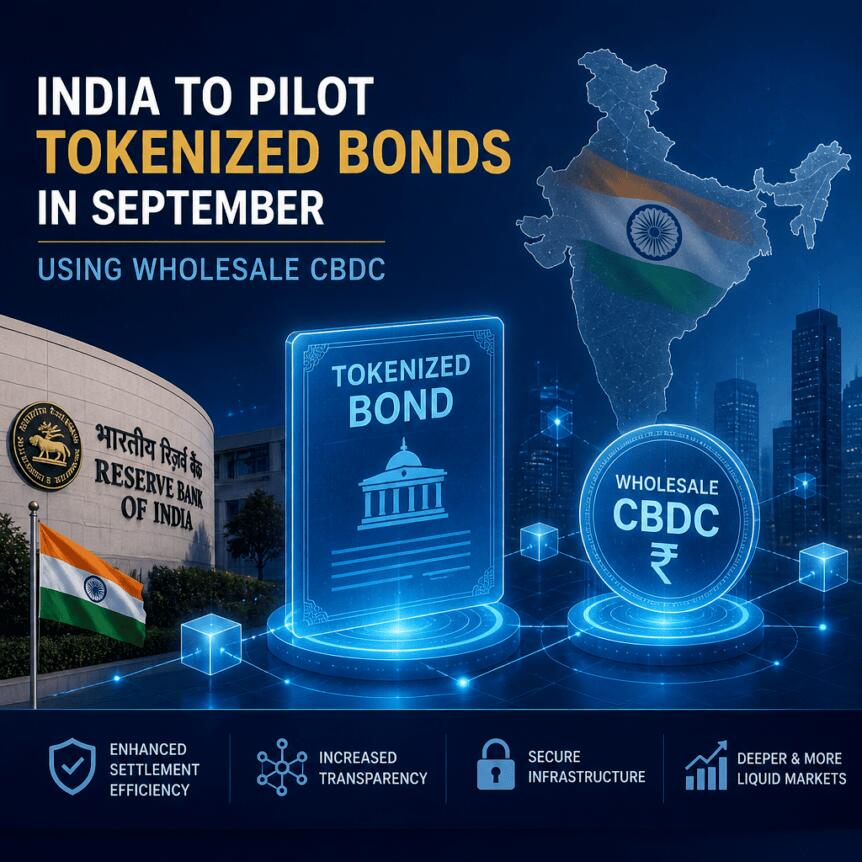
India is reportedly preparing to test its first tokenized corporate bond issuance in September, linking blockchain settlement with the country’s central bank digital currency (CBDC). The initiative is expected to be piloted through a limited group of investors before any broader market rollout.
According to Reuters, REC Limited—an Indian, state-controlled power infrastructure finance company—plans to issue less than 5 billion Indian rupees (about $57 million) in tokenized bonds. The report, published Monday and based on three sources familiar with the plans, says the pilot could be announced at an annual financial technology event in Mumbai in September.
Key takeaways
- REC Limited is reportedly planning an initial tokenized corporate bond issue of under 5 billion rupees, with timing pointing to September.
- The pilot is expected to use India’s CBDC for purchasing the bonds, tying tokenized securities directly to central bank settlement.
- Participation may require two separate digital accounts: a wholesale CBDC wallet and a dedicated electronic securities wallet.
- Depositories are developing “DEMAT 2.0” to track bond holdings using distributed ledger technology.
- A short initial lockup of three months is expected, with plans for secondary trading to emerge by December.
A tokenized bond pilot built around the CBDC
Reuters reports that India’s central bank digital currency will be used to buy the tokenized bonds during the pilot. That design matters because it targets end-to-end integration—where tokenized securities are not merely recorded on a ledger, but also settled through a central bank-backed digital payment rail.
Under the reported setup, investors would need two digital accounts to participate. One is described as a wholesale CBDC wallet provided by a bank, while the other is a new electronic securities wallet intended to hold and record tokenized bond positions.
This approach differs from earlier tokenized asset experiments that often focused on issuance and recordkeeping while relying on traditional payment and settlement mechanisms for transfers. If implemented as described, India’s pilot would aim to reduce settlement friction by bringing securities settlement and payment settlement into a more unified flow.
DEMAT 2.0 and the push for blockchain-based securities records
The securities wallet at the center of the pilot is being developed by India’s securities depositories. Reuters refers to the project as “DEMAT 2.0,” which is expected to record bond holdings using distributed ledger technology.
Reuters also reports that India’s central bank (the Reserve Bank of India, RBI) and securities markets regulator (SEBI) are working with depositories on the initiative, highlighting how the regulator-led infrastructure is being shaped to support tokenized issuance.
From an investor and market-structure perspective, the reliability and legal enforceability of the securities record is crucial. DEMAT 2.0’s role—tracking ownership and balances—would likely determine how easily tokenized bonds can interface with existing compliance requirements, custody practices, and settlement processes.
Timeline: lockup, limited access, and a possible secondary market
Reuters says the pilot will initially be open only to a select group of investors. It also suggests that the program may be unveiled at an annual financial technology event in Mumbai in September, implying a tightly scoped launch designed for controlled testing rather than immediate broad distribution.
The tokenized bonds are reported to have an initial three-month lockup period. After that, exchanges are expected to develop a secondary market for the tokenized bonds by December, according to Reuters.
For participants, these milestones shape the practical use of the instrument. A lockup period can limit liquidity in early phases, while plans for secondary trading by December indicate the project’s intent to move beyond issuance-only pilots. Whether the secondary market will be actively traded, what market-making or trading rules may apply, and how price discovery will function remain key questions observers will be watching.
Regulators yet to comment
Cointelegraph reached out to India’s RBI and SEBI, as well as REC, for comment on the reported plans, but did not receive responses at the time of publication.
The lack of official confirmation means investors should treat the details—amount, access, wallet architecture, and exchange timeline—as reported developments rather than finalized policy. Still, the fact that multiple regulators and market infrastructure providers are described as working together suggests the pilot is part of a broader effort to operationalize tokenized securities within existing regulated frameworks.
As the September pilot approaches, the most important signals will likely come from whether DEMAT 2.0 is ready for real bond positions, how the wholesale CBDC wallet integration is handled for participating banks, and what guidance SEBI and the RBI ultimately publish on market conduct, settlement finality, and secondary trading rules.
https://www.cryptobreaking.com/india-to-pilot-tokenized-bonds/?utm_source=blogger%20&utm_medium=social_auto&utm_campaign=India%20to%20Pilot%20Tokenized%20Bonds%20in%20September%20Using%20Wholesale%20CBDC%20
Comments
Post a Comment