
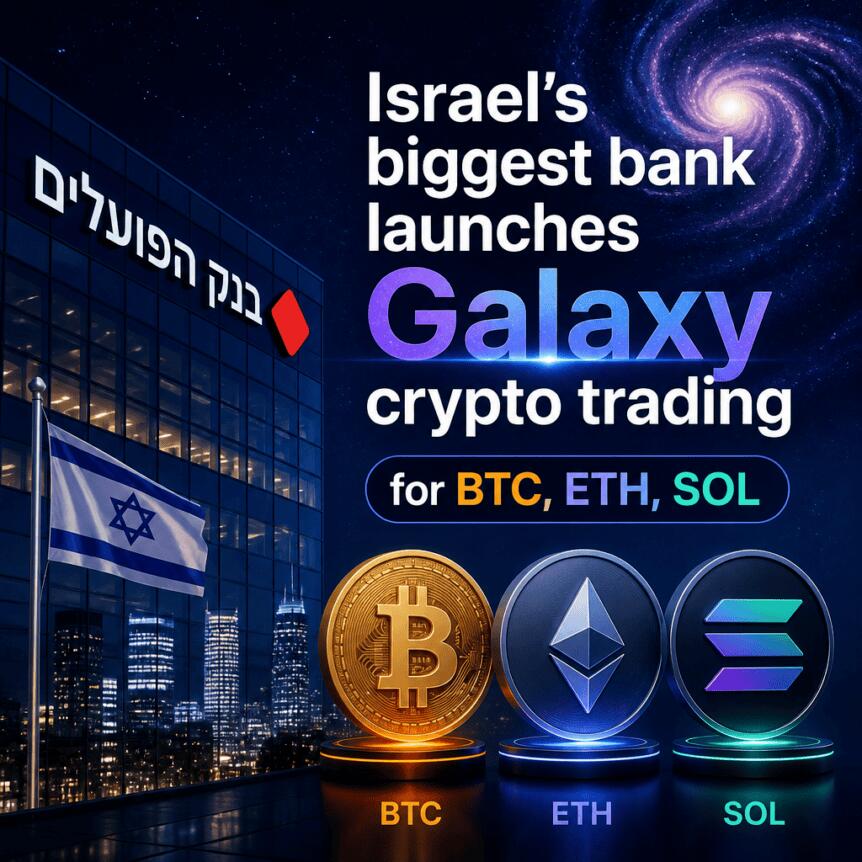
Israel’s Bank Leumi is partnering with Galaxy Digital to bring crypto trading to its banking app, expanding digital asset access beyond institutions and into mainstream retail finance. The service is expected to launch in early 2027, allowing customers to buy, hold, and sell Bitcoin, Ether, and Solana directly through Leumi’s trading interface.
Leumi said customers of the bank and its Pepper mobile banking arm will be able to use a dedicated section within the Leumi Trade app for the three cryptocurrencies. The companies also framed the rollout as a first for an Israeli bank, while detailing how Galaxy will provide both trading capabilities and custody support.
Key takeaways
- Leumi and Galaxy Digital plan to offer crypto trading for Bitcoin, Ether, and Solana through the Leumi Trade app.
- Launch timing: early 2027, according to the companies’ announcement.
- GalaxyOne Institutional will be used for trading and related services, with Galaxy custody infrastructure supporting the setup.
- Leumi says it will be the first Israeli bank to provide digital asset trading to retail customers.
Leumi brings crypto trading into its retail app
Under the agreement announced Friday, Leumi will enable customers to access crypto markets for three major assets—Bitcoin (BTC), Ether (ETH), and Solana (SOL)—via a dedicated section of the Leumi Trade application. The functionality is designed around three common user actions: buying, holding, and selling.
Leumi positioned the integration as an industry milestone in Israel, stating that it expects to be the first Israeli bank to offer digital-asset trading services to customers. The bank also emphasized its customer footprint, noting that it serves millions of clients across retail and business operations.
For market participants, the development is notable because it suggests regulated banks are continuing to build distribution channels for crypto rather than limiting participation to broker-dealers or crypto-native platforms. While the exact user experience and onboarding steps were not detailed in the announcement, the “through the bank’s app” approach is a meaningful shift in where retail crypto services are likely to be discovered and accessed.
Galaxy provides trading and custody infrastructure
The partnership is supported by two separate pillars of Galaxy’s platform. Leumi said it will use GalaxyOne Institutional for trading and related services. For custody and digital asset infrastructure, the companies said Galaxy’s custody platform—formerly known as GK8—will support the technical foundation behind the offering.
That separation matters from a risk and operations standpoint. Trading systems and custody systems typically require different controls, reporting, and security tooling, and the announcement indicates Leumi will be leveraging Galaxy’s established infrastructure rather than building a complete stack internally. For investors and users watching the space, this approach is often associated with faster deployment timelines and more consistent institutional-grade operational standards.
However, until closer to launch, key details remain unclear—such as whether the service will operate with specific regional restrictions, what user limits or compliance requirements will apply, and how the platform will handle order routing and settlement. Those elements could influence both customer demand and operational risk management when the service goes live.
Why the timing and partnership structure matter
The stated target—early 2027—places the Leumi rollout well into the future, giving the banks time to complete integration, compliance procedures, and security hardening. From an editorial perspective, the duration is also a reminder that bank-led crypto products are often slower-moving than crypto-native services, particularly when custody, reporting, and regulatory frameworks must be aligned.
Galaxy Digital’s role as the technology and liquidity partner also highlights how large crypto firms are increasingly positioning themselves as infrastructure providers to traditional finance. Rather than building standalone consumer exchanges, these collaborations aim to turn crypto market access into a feature inside existing banking channels.
That shift could be important for adoption. Bank apps typically come with established customer onboarding, payment rails, and support workflows. If Leumi’s offering proves smooth and reliable, it could reduce friction for mainstream users who want exposure to major cryptocurrencies but prefer the familiar interface of a regulated bank.
Galaxy’s recent performance underscores a volatile backdrop
The announcement arrives after Galaxy reported a challenging period for its broader business. According to Cointelegraph’s earlier coverage linked in the original report, Galaxy posted an $85 million net loss in Q2, which it attributed largely to declining digital asset prices. Despite the net loss, Galaxy’s digital assets segment generated $66 million in adjusted gross profit, reported as up 34% quarter-over-quarter.
This matters because it frames the partnership against a backdrop where the crypto market’s direction can swing profitability. Even so, the fact that Galaxy continued to report positive adjusted gross profit in the digital assets business suggests that trading and infrastructure services may remain comparatively resilient during down cycles—especially if counterparties and institutional users continue to operate.
For readers tracking Galaxy’s broader strategy, the Leumi deal reinforces an angle that the company has been pursuing for some time: using institutional infrastructure and market services to gain access to distribution partners. Galaxy Digital, founded and led by Mike Novogratz, began trading on the Nasdaq under the ticker GLXY in May 2025. Yahoo Finance data showed the stock at $21.38 on Friday morning, up about 2% on the day but down roughly 25% over the past year.
What to watch next
With an early-2027 launch horizon, the most important developments for customers and the market will be regulatory approvals, product design details inside Leumi Trade, and how Galaxy’s trading and custody components are integrated for a bank-grade user experience. Until then, investors should watch for additional partner announcements and any operational disclosures that clarify how Leumi plans to scale crypto access while managing custody, compliance, and liquidity requirements.
https://www.cryptobreaking.com/israels-biggest-bank-launches-galaxy/?utm_source=blogger%20&utm_medium=social_auto&utm_campaign=Israel’s%20biggest%20bank%20launches%20Galaxy%20crypto%20trading%20for%20BTC,%20ETH,%20SOL%20
Comments
Post a Comment