
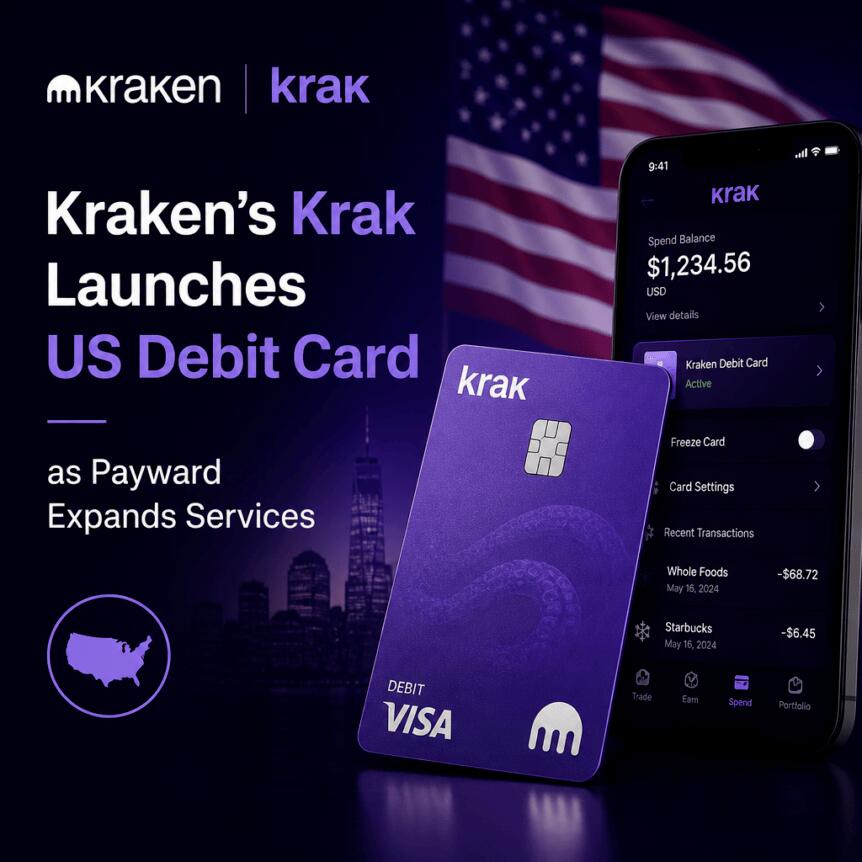
Kraken’s consumer payment app, Krak, has rolled out a multi-asset debit card in the United States, letting customers pay with crypto and fiat while earning cashback. The card supports spending from more than 600 assets and currencies, converting holdings into US dollars at the point of sale, according to an announcement on Tuesday.
The move expands Kraken’s push toward everyday finance products that sit alongside trading. It also positions a rewards model that depends on asset balances rather than credit-based payments—an angle aimed at consumers who are wary of accumulating monthly credit-card debt.
Key takeaways
- Krak launched a US multi-asset debit card that can draw from 600+ assets/currencies and converts them into USD at checkout.
- Users can choose the order in which balances are spent, allowing multiple holdings to contribute to a single purchase.
- Cashback can be earned up to 2%, paid in US dollars or Bitcoin, with rates tied to average assets held across Krak, Kraken, and Kraken Pro.
- The cards are issued by Lead Bank on Visa and powered by Stripe Issuing, with physical and virtual options for eligible US customers.
- Kraken says it has already issued 135,000 multi-asset cards in the UK and EEA since a December 2025 launch.
A debit card built for crypto and fiat spending
Krak’s new card is designed to work like a conventional debit instrument, but with a key difference: the funding sources can include both traditional currencies and crypto assets. When users make a purchase, holdings are converted into US dollars at the point of sale.
Rather than forcing customers to pick a single wallet or balance up front, the card can pull from multiple assets during one transaction. Krak says users will be able to set the order of assets that get spent first, giving customers control over how their portfolio is applied at checkout.
For investors and traders considering real-world utility, the practical takeaway is that Krak is trying to remove friction between “holding” and “spending.” Instead of treating crypto as a separate ecosystem from everyday commerce, the card aims to make it operationally comparable to a multi-currency payment tool—though users still need to understand that conversion happens at the moment of purchase.
Cashback up to 2%—but tied to average balances
Krak says the cashback program can reach 2% and is delivered either in dollars or Bitcoin. The determining factor is not simply transaction behavior; the company says cashback rates depend on the average assets held across Krak, Kraken, and Kraken Pro.
This structure mirrors a broader trend among crypto payment products: loyalty incentives increasingly target longer-term account engagement rather than short-term promotional activity. It also helps explain Krak’s emphasis on balances across multiple Kraken properties, effectively blending “payments” with “customer stickiness” across the ecosystem.
Krak is marketing the card as an alternative to rewards programs typically offered by credit cards. In a survey of 2,001 US adults commissioned by Krak via Morning Consult, 42% of credit card holders said they worry about paying off their monthly balance. In the same survey, 60% said they would switch to a debit card offering rewards without taking on debt.
While the survey does not prove how many people will actually adopt Krak’s card, it does clarify why the company believes the debit + rewards format can resonate in a market where credit-card interest costs remain a consumer concern.
How the card works: Visa issuance and Stripe Issuing
Operationally, Krak’s card is backed by established payment infrastructure. The card is issued by Lead Bank on the Visa network, and Krak says it is powered by Stripe Issuing. The company also indicates both physical and virtual versions are available to eligible customers in the United States.
For users, that combination typically matters for practical adoption—virtual cards can be used for online spending, while physical cards cover in-store purchases. For builders and partners watching the sector, it underscores how crypto-native finance products increasingly rely on mainstream rails to scale distribution and compliance workflows, even when the “wallet logic” remains crypto-specific.
From UK/EEA rollout to US expansion
Krak did not start from scratch in payments. Kraken says it has issued more than 135,000 multi-asset cards in the UK and European Economic Area (EEA) since launching there in December 2025.
That history matters because it frames the US card as an expansion of a live product rather than a brand-new concept. It also suggests Krak is carrying operational learnings from earlier markets—such as how customers choose spending order across assets and how cashback eligibility and conversion behavior work in practice.
Still, readers should watch how US users experience the same mechanics. The US rollout may face different consumer habits, regulatory requirements, and asset availability expectations compared with UK/EEA customers, even if the core product design is similar.
Kraken’s broader push beyond trading
The card launch fits into a wider strategy at Kraken’s parent company, Payward. In remarks at the Wyoming Blockchain Symposium, Payward co-CEO Arjun Sethi discussed plans to expand the firm’s financial services offering, including pushing into additional asset classes and more traditional financial products.
Sethi said diversification across multiple asset classes could reduce dependence on any single market cycle. He also described tokenization as “a large part” of the company’s effort to broaden its financial offerings, and compared the company’s target end state to major incumbent banks—arguing it needs products and services “not too different to a JP Morgan or a financial institution.”
That message lands at a time when several large exchanges are broadening their businesses beyond spot trading. Coinbase and others have expanded into areas such as equities, derivatives, prediction markets, tokenized assets, and pre-IPO products—signaling that the competitive battleground is shifting toward multi-vertical financial platforms.
Krak’s debit card adds a consumer-facing layer to that trend. Instead of asking users to interact with crypto primarily through trading screens, Kraken is moving toward everyday financial touchpoints—spending, rewards, and balance-based incentives—that could keep customers engaged even when they are not actively trading.
Kraken is also continuing to expand its regulated offerings. Separately, the company launched trading in more than 7,000 US-listed stocks for customers in the EEA earlier this week, reinforcing the pattern of “financial services first” expansion.
Next, investors and consumers should watch how Krak’s US rollout performs against its UK/EEA track record—particularly around card issuance eligibility, cashback mechanics, and how users manage multi-asset spending order in real transactions.
https://www.cryptobreaking.com/krakens-krak-launches-us-debit/?utm_source=blogger%20&utm_medium=social_auto&utm_campaign=Kraken’s%20Krak%20Launches%20US%20Debit%20Card%20as%20Payward%20Expands%20Services%20
Comments
Post a Comment