
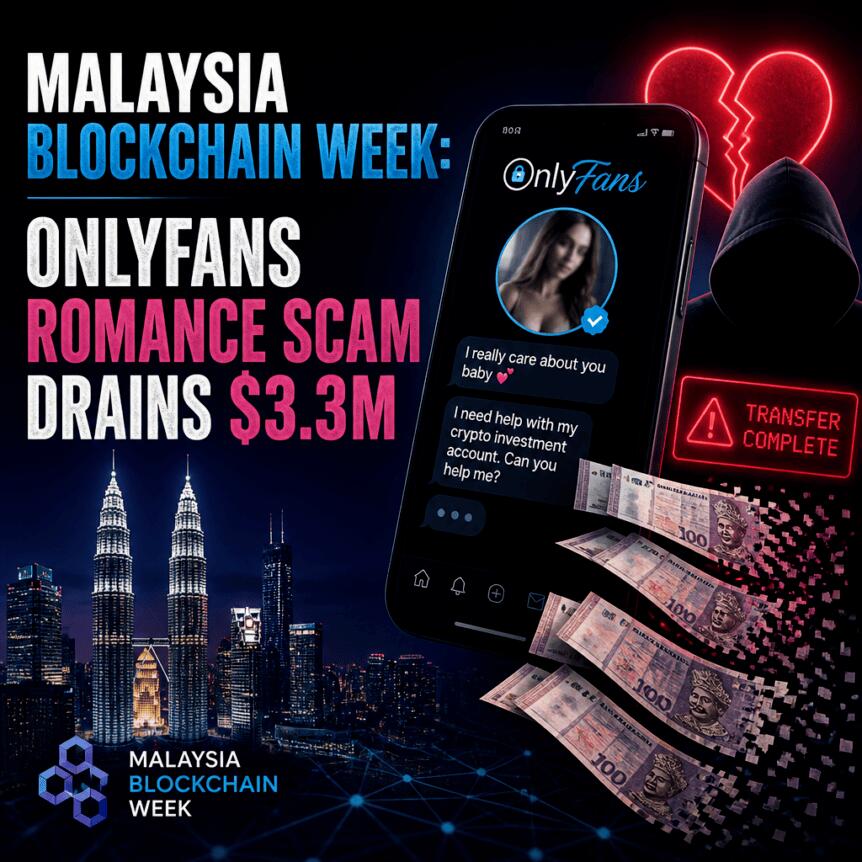
Romance scams remain a persistent threat in Asia, with Hong Kong police reporting a concentrated spike in cases tied to fake “crypto investment” schemes. Between July 24 and July 30, authorities logged 25 romance-linked fraud reports, totaling about $9 million in losses, according to the Hong Kong Police Force.
In one reported case, an insurance agent lost $3.3 million after being persuaded by a fabricated online boyfriend to invest through a fraudulent crypto application—an approach scammers have increasingly used to mimic legitimate trading platforms while manufacturing returns on screen.
Key takeaways
- Hong Kong recorded 25 romance-linked fraud cases in a single week (July 24–July 30), with combined losses near $9 million.
- Scam operators build long relationships via dating and messaging apps, then push victims toward a fake crypto trading app showing false profits.
- Hong Kong’s HashKey Exchange said JPMorgan Chase approved its move to open a client money account.
- Malaysia withdrew support for Malaysia Blockchain Week after controversy over an after-party tied to an influencer with adult-content history.
- Several regulatory and industry shifts across Asia—stablecoin rulemaking in South Korea and Bitget exiting Japan—signal continued policy tightening alongside operational changes.
Hong Kong’s romance scams: from chat rooms to fake trading apps
Hong Kong police say scammers often initiate contact through dating platforms or messaging apps, then spend weeks or months developing trust. Only after victims become emotionally invested do criminals introduce the idea of cryptocurrency investing.
Fraudsters then direct victims to a website designed to resemble a genuine trading application. The platform typically displays rising balances and “profits” to encourage additional deposits. The fraud usually becomes clear only when victims attempt to withdraw funds and find that transfers are blocked or accounts cannot be accessed.
Police reported that, in the case involving an insurance agent, the scam escalated to $3.3 million—demonstrating how quickly these schemes can move from initial persuasion to large-value transfers. The broader week-long total of $9 million suggests the pattern is not isolated, but part of an active criminal campaign.
Regional compliance signals: HashKey gets JPMorgan client money approval
While Hong Kong grappled with scam activity, the city also saw a separate development that touches on institutional readiness: HashKey Exchange said it received approval from JPMorgan Chase to establish a client money account, per statements from the company’s parent group.
HashKey framed the approval as a step forward in enabling client money handling within its regulated operating framework. For investors and counterparties, client money arrangements are often a practical building block for institutional confidence—especially for firms dealing with custody-like responsibilities and segregation expectations.
That said, the scam reports underscore a different reality for retail users: even where regulated exchanges expand capabilities, criminals can still exploit individual naivety through counterfeit apps and social-engineering tactics.
Malaysia Blockchain Week support pulled over OnlyFans-linked after-party backlash
Malaysia’s crypto sector faced reputational and administrative pressure after the government withdrew support for Malaysia Blockchain Week. Organizers said the decision followed controversy related to an after-party featuring an influencer previously known for adult content.
Earlier coverage noted that Malaysia Blockchain Week was linked to promotional materials circulating online, after which event organizers apologized to the Ministry of Digital and the Malaysia Digital Economy Corporation. Organizers then reportedly canceled the performance and removed references to the event from its website.
The episode highlights a recurring tension for blockchain conferences: while policy conversations often focus on regulation and technology, broader public scrutiny and political optics can still shape whether governments are willing to publicly back industry gatherings.
China: warning over Bitcoin extortion scams using publication name
In China, a state-affiliated outlet—reported as China Business Journal—warned that fraudsters were impersonating the publication to extort companies. According to the newspaper, scammers demanded Bitcoin payments while claiming they had uncovered damaging information through “undercover investigations.”
The warning described use of a Proton Mail address for contacting businesses, along with threats to publish alleged material unless companies paid in Bitcoin. This is another example of how crypto payments are increasingly used as a tool in non-crypto-specific crimes: the asset acts as the settlement mechanism for intimidation rather than part of a legitimate investment process.
The same broader period included other reported crypto-related developments, including police academy research claiming an AI system capable of detecting illegal crypto transactions with nearly 90% accuracy, and arrests tied to crypto money laundering connected to telecom fraud.
South Korea moving toward stablecoin regulation as tax debate continues
South Korea’s policy roadmap remains under construction, with a reported plan by the Financial Services Commission to draft a consolidated Digital Asset Basic Act alongside the ruling Democratic Party. The reported draft scope includes stablecoin issuance and circulation, digital asset business rules, exchange entry requirements, disclosures, internal controls, and standards for system resilience.
At the moment, South Korea’s Parliament is considering multiple separate bills related to digital assets and stablecoins. Disagreements have reportedly prevented the country from finalizing elements of the next-stage crypto legislation.
Separately, the opposition’s effort to repeal planned crypto taxes has moved to a committee. The government has said the changes would take effect on January 1, 2027, even though adjustments had been postponed on three prior occasions.
For market participants, the key practical takeaway is that stablecoin policy may be consolidated—but the timing and political hurdles remain uncertain. Traders and issuers should watch for how lawmakers reconcile competing approaches between regulation needs and tax policy, especially as monthly stablecoin flows have reportedly continued to move offshore.
Singapore and Japan: restructuring pressures and account exit timelines
Singapore-based prime brokerage FalconX has reportedly cut capacity amid a prolonged crypto market slump. Bloomberg reported that FalconX laid off about 10% of its global workforce while preparing for a longer downturn, including a strategic shift in Singapore toward crypto derivatives trading.
The report also said FalconX planned to withdraw its license application with the Monetary Authority of Singapore, while maintaining a broader Asian footprint and expanding its European business. The company’s reported headcount prior to layoffs—approximately 350 across the United States, the United Kingdom, Singapore, and Hong Kong—signals how consequential these decisions can be for regional market infrastructure.
In Japan, Bitget announced it would stop providing services to residents of the country and begin account restrictions on November 1. The exchange said it stopped accepting new registrations from Japan residents, and that any positions still open by December 31 would be forcibly closed.
For Japanese users, such forced-closure timelines are particularly important because they reduce the window for risk management actions like rebalancing, exit planning, and compliance checks with alternative services.
What to watch next
Across Asia, enforcement and policy developments are unfolding alongside industry reshaping—yet the Hong Kong romance-scam figures and other extortion warnings show that social-engineering fraud remains a live risk. Investors and users should stay alert to “too-good-to-be-true” returns shown inside unfamiliar apps, while tracking how stablecoin and exchange-related rules evolve in South Korea, Singapore, and Japan.
https://www.cryptobreaking.com/malaysia-blockchain-week-onlyfans-romance/?utm_source=blogger%20&utm_medium=social_auto&utm_campaign=Malaysia%20Blockchain%20Week:%20OnlyFans%20Romance%20Scam%20Drains%20$3.3M%20
Comments
Post a Comment