
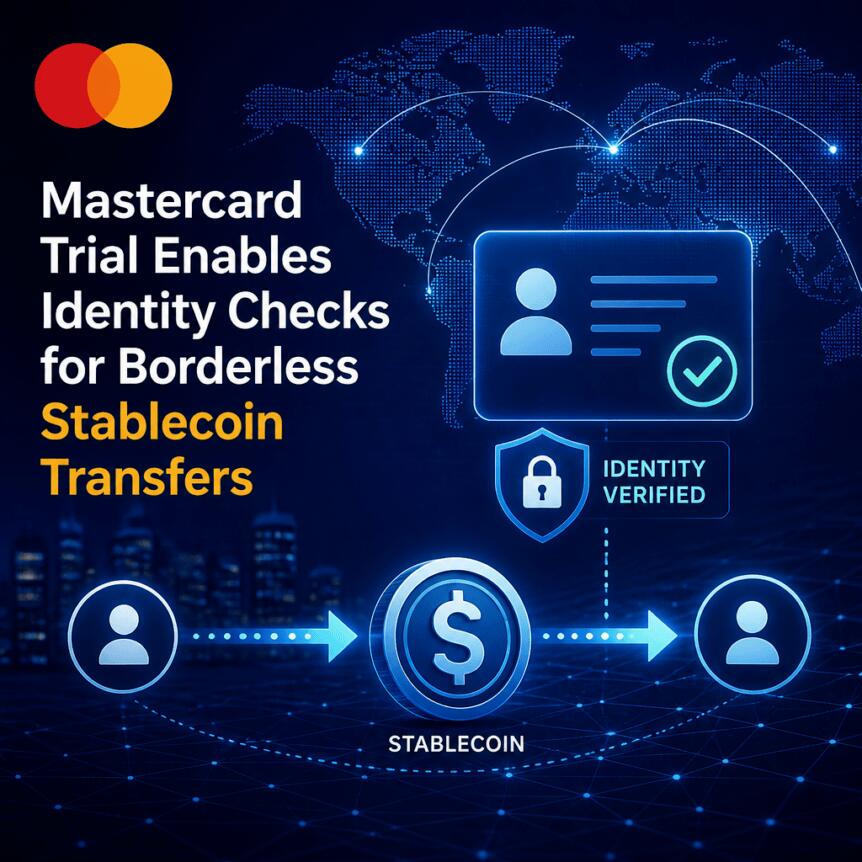
Mastercard and stablecoin orchestration network Borderless are launching a pilot focused on improving cross-border stablecoin payments using Mastercard’s Crypto Credential standards-based framework.
The initiative, announced in coordination with Cointelegraph, will test whether Mastercard’s approach can generate assurance signals that market participants can plug into their own approval, compliance, and risk workflows—potentially reducing friction where verification responsibilities often become fragmented across counterparties.
Key takeaways
- Mastercard and Borderless will trial how Crypto Credential standards can produce governance and verification signals for cross-border stablecoin payments.
- The pilot is designed to help participants incorporate assurance signals into their internal approval, compliance, and risk processes.
- Borderless frames compliance and trust between parties as the key bottleneck, comparing it to how correspondent banking historically handled assurance.
- Mastercard will not process or settle funds as part of the pilot; the project centers on the credential layer rather than payment execution.
Why “assurance signals” matter for stablecoin payments
Stablecoins can move value quickly, but cross-border usage often runs into a problem that looks less like a technology challenge and more like a governance and compliance workflow issue. According to Borderless CEO and co-founder Kevin Lehtiniitty, the main source of friction is providing the right kind of assurance across a chain of counterparties.
Lehtiniitty compares the situation to correspondent banking, which “solved this decades ago” by making trust upstream and avoiding repeated re-execution of compliance checks at each step with downstream parties. In his view, Mastercard’s Crypto Credential framework aims to apply a similar idea to digital-asset payments: instead of every participant building their own end-to-end verification logic from scratch, the system provides standardized signals that can be interpreted and used across the network.
Mastercard’s Crypto Credential framework, as described in the announcement, relies on common standards and assurance signals intended to add certainty to blockchain-related transactions. In the pilot, the partners will look specifically for governance signals that can lower operational friction in cross-border stablecoin flows.
A pilot focused on governance, not settlement
While the partnership is positioned within the broader stablecoin payments ecosystem, the pilot itself is intentionally narrower. Lehtiniitty told Cointelegraph that Mastercard’s role would be limited to the Crypto Credential governance and verification layer; Mastercard will not process or settle funds as part of this test.
That distinction matters for how investors and builders might interpret the trial. It suggests the project is primarily about interoperability—how credentialed assurance can be communicated and reused—rather than about replacing payment rails or directly competing with settlement providers in the near term.
For Borderless, the value proposition is tied to workflow integration: participants would be able to take the signals produced under Mastercard’s framework and incorporate them into their existing approval, compliance, and risk processes. The pilot therefore aims at practical adoption challenges, not just a theoretical standard.
How Mastercard’s stablecoin push is evolving
The pilot builds on Mastercard’s recent expansion in the stablecoin industry. Cointelegraph previously reported that Mastercard completed its acquisition of stablecoin infrastructure company BVNK on Monday, a deal valued at $1.8 billion.
In June, Mastercard also announced plans to expand settlement capabilities to include intraday, weekend, and holiday card settlement. That proposal included settlement through stablecoins such as Circle’s USDC, Paxos-issued PYUSD, and other dollar-linked tokens, including USDG and USDP, as well as Ripple’s RLUSD and SoFi’s SoFiUSD.
Taken together, the new pilot indicates Mastercard is pursuing a dual-track strategy: expanding where stablecoins can be used in settlement while also working on how trust and verification can be communicated in a way that fits traditional compliance expectations.
Still, the pilot’s scope leaves open some important questions. The partners have emphasized credentialing and governance signals, but they have not indicated how quickly these signals could standardize cross-border approvals across different jurisdictions, nor whether the pilot will extend beyond specific participants or networks. Those details will determine whether the program becomes a scalable template or remains a proof-of-concept.
What to watch next in the pilot
Because Mastercard and Borderless have framed the work around assurance signals that can be incorporated into compliance and risk processes, observers should watch for outcomes that reflect real operational integration—not just technical compatibility. Key areas include how participants interpret the governance signals, whether the framework meaningfully reduces the need for repeated due diligence steps, and what governance standards emerge as most effective in lowering cross-border friction.
Another practical factor is whether the credential layer can maintain consistency across counterparties without requiring each party to recreate verification logic. If the pilot succeeds, it could offer a clearer path for stablecoins to fit into existing payment and compliance infrastructures—where trust models are typically built around accountable intermediaries.
For now, the next step is the pilot’s results: how well the assurance and governance signals translate into reduced friction for cross-border stablecoin payments, and whether the approach can be expanded from a controlled test into a broader standard that participants can adopt with confidence.
https://www.cryptobreaking.com/mastercard-trial-enables-identity-checks/?utm_source=blogger%20&utm_medium=social_auto&utm_campaign=Mastercard%20Trial%20Enables%20Identity%20Checks%20for%20Borderless%20Stablecoin%20Transfers%20
Comments
Post a Comment