
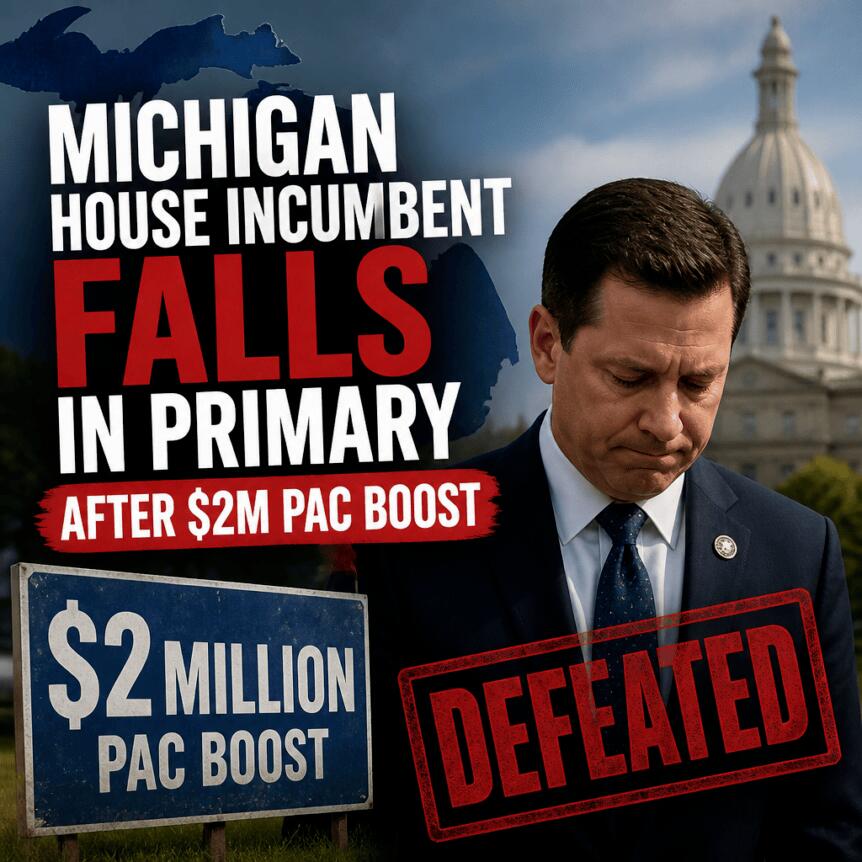
A progressive challenger, Donavan McKinney, has won the Democratic primary for Michigan’s 13th Congressional District, defeating two-term incumbent Shri Thanedar in a campaign that drew fresh accusations about cryptocurrency-linked political influence.
According to The New York Times, McKinney captured 51.9% of the vote compared with Thanedar’s 48.1% as of Wednesday. The contest became a focal point for claims of “payback” tied to the crypto industry, after a crypto-backed political action committee (PAC) reportedly spent more than $2 million on media aimed at re-electing Thanedar.
Key takeaways
- McKinney won Michigan’s 13th District Democratic primary with 51.9% versus Thanedar’s 48.1%, per NYT election results.
- A crypto-linked PAC, Protect Progress, reportedly spent over $2 million on ads to support Thanedar and oppose McKinney, raising “payback” accusations.
- Protect Progress is affiliated with Fairshake, which has received primary backing from major crypto companies such as Coinbase and Ripple, according to reporting referenced in the article.
- McKinney secured support from national progressive and Democratic groups, including the Democratic National Committee and the Democratic Socialists of America.
- McKinney is set to face Republican Taras Nykoriak in November; the campaign did not provide immediate comment when approached.
Why the crypto industry became a central campaign issue
While Michigan’s 13th District primary hinged on typical Democratic-vs-Democratic dynamics, it also turned into a referendum on the relationship between elected officials and the cryptocurrency sector.
McKinney, widely framed as a progressive challenge to Thanedar, argued during the campaign that the crypto industry was effectively “paying opponent back” for facilitating industry-friendly legislation. In his messaging, he referenced Thanedar’s voting record and said the spending was in response to policy outcomes following former President Donald Trump’s 2024 election victory—an argument aimed at tying political fundraising to legislative behavior.
The comparison was supported by the scale and direction of outside spending. As noted in coverage cited in the article, Protect Progress—described as responsible for the super PAC funding media against McKinney—spent more than $2 million on ads during the primary.
Super PAC spending and the Fairshake network
Central to the controversy is Protect Progress’ affiliation with Fairshake, a political network backed primarily by crypto businesses, including Coinbase and Ripple. The article notes that Protect Progress is part of a broader ecosystem that has repeatedly spent heavily on pro- and anti-crypto races.
According to the referenced reporting, Fairshake and related affiliates spent more than $170 million during the 2024 US election cycle on races that involved candidates with competing stances on the crypto industry. For this primary cycle, the article says these groups have again directed significant spending into state contests ahead of the November general election, extending the pattern of outside money shaping crypto policy debates.
For voters, this matters because super PAC advertising can shift how issues are framed in ways that candidates may struggle to counter with their own campaigns—especially in primaries, where turnout is often lower and persuasion through media can carry outsized weight.
Thanedar’s policy record and campaign-ethics scrutiny
Beyond advertising spending, the dispute also drew on allegations involving Thanedar’s personal financial decisions and the policy positions he supported.
The article states that Thanedar voted in favor of legislation including the GENIUS Act and the CLARITY Act. It also reports that Thanedar allegedly lost more than $600,000 in the second quarter of 2026 after investing $3.7 million of campaign funds into crypto companies, citing an investigation published by The Intercept.
That alleged juxtaposition—industry-friendly votes alongside investment activity—became part of McKinney’s broader critique that Washington prioritizes corporate interests over constituents. In a Wednesday post on X, McKinney said, “Washington has spent too long serving billionaires and corporate interests,” and added that he would “always only serve the people I represent,” as reflected in the article’s citation of his statement.
What happens next in Michigan’s 13th District
McKinney’s primary win sets up the November contest against Republican Taras Nykoriak. The article notes that Cointelegraph sought a comment from McKinney’s campaign on Wednesday but did not receive an immediate response.
Meanwhile, national party organizations and progressive groups moved quickly to back McKinney’s candidacy following the primary. The article says McKinney received support from the Democratic National Committee and the Democratic Socialists of America, citing the DNC’s announcement of his victory and framing it as part of a broader alignment with progressive priorities.
Political backers are not the only group to spend in the orbit of crypto politics. The article also references a separate effort by another Fairshake affiliate—Defend American Jobs—in Washington’s 4th Congressional District primary race, where the group reportedly funded media support for Republican candidate Amanda McKinney (no relation to the Michigan nominee). In that contest, both candidates surpassed 30% of the vote to advance to the general election, according to the article.
Across races, the pattern is consistent: crypto-linked groups are treating primary elections as a key battleground for influencing candidates who may later shape regulatory direction. With McKinney now facing a general-election challenge, attention is likely to shift to whether the “payback” narrative and the focus on legislative ethics continue to resonate with voters, and how much outside spending ramps up between now and November.
https://www.cryptobreaking.com/michigan-house-incumbent-falls-in-2/?utm_source=blogger%20&utm_medium=social_auto&utm_campaign=Michigan%20House%20Incumbent%20Falls%20in%20Primary%20After%20$2M%20PAC%20Boost%20
Comments
Post a Comment