
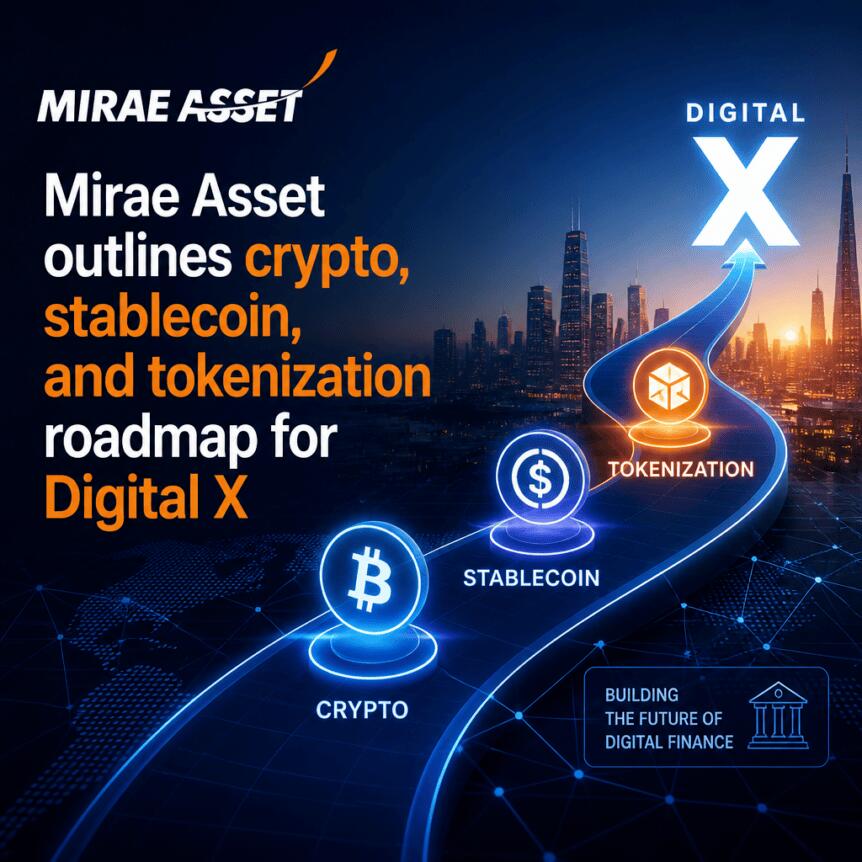
Mirae Asset—one of South Korea’s largest financial groups—wants to scale its crypto footprint into a major digital-asset business after taking control of the exchange formerly known as Korbit. According to The Korea Times, the group is aiming to build a 150 trillion won ($109 billion) digital asset platform centered on Digital X, the renamed exchange.
The reported roadmap is broad: Digital X would operate across cryptocurrencies, stablecoins, real-world assets (RWAs) and security token offerings, including plans to tokenize physical assets such as gold, silver and electricity. The strategy follows Mirae Asset Consulting’s acquisition of a controlling stake in Korbit earlier this year, positioning a traditional finance group as a direct operator of a domestic crypto exchange.
Key takeaways
- Mirae Asset plans a 150 trillion won ($109 billion) digital asset business built around Digital X, per The Korea Times.
- Digital X’s intended scope spans crypto trading, stablecoins, RWAs and security token offerings, including tokenization of physical assets like gold and silver.
- The expansion comes after Mirae Asset Consulting bought a 97.15% stake in Korbit in July and the exchange was rebranded as Digital X.
- Digital X started waiving trading fees for won-denominated assets on Monday, with the zero-fee period scheduled to run through Aug. 24, 2027.
- Despite Korbit’s long history (founded in 2013), it represented only 0.5% of South Korea’s crypto trading market in 2025, according to the Fair Trade Commission.
Mirae Asset’s digital-asset ambition and why it matters
The reported plan signals a continued shift in South Korea toward integrating digital assets into the broader financial-services ecosystem. For investors and market participants, the key point is not simply that a financial group owns an exchange—it’s the stated intention to move beyond spot trading into tokenization and regulated-style asset distribution.
By setting a large business target for “Mirae Asset 3.0,” Mirae Asset is effectively framing Digital X as a growth engine rather than a passive investment. According to The Korea Times, Mirae Asset founder and chairman Park Hyeon-joo discussed the direction at a Digital X employee event in Seoul on Wednesday, describing an initial goal of making Digital X a core pillar of “Mirae Asset 3.0.”
That positioning matters because tokenization initiatives—especially those involving real-world assets—depend on partnerships, custody and compliance frameworks, as well as market demand for new tokenized products. Whether Digital X can translate these ambitions into products that attract liquidity will likely determine how meaningful the exchange becomes within the domestic digital-asset value chain.
From Korbit to Digital X: control, rebrand, and market gap
Mirae Asset’s push is tied directly to its ownership of the exchange. The Korea Times reports that Mirae Asset Consulting completed a takeover of Korbit with a 97.15% stake in July, after accumulating a total cost of 141.4 billion won. The acquisition and subsequent rebrand are described as a notable first in South Korea: an affiliate of a financial group gaining control of a domestic crypto exchange.
Digital X began operating under the Korbit name’s successor brand after the control change. While Korbit has been active since 2013 and was described by The Korea Times as South Korea’s first cryptocurrency exchange, its scale has not matched its seniority. The Fair Trade Commission data cited by the same outlet indicated Korbit accounted for just 0.5% of South Korea’s crypto trading market in 2025.
In other words, the acquisition came with a built-in strategic challenge: Digital X will need to grow a relatively small footprint into a larger platform capable of supporting both trading activity and longer-horizon tokenization products.
Fee waivers and the push to win liquidity
One of the most immediate actions taken after the rebrand concerns trading costs. As of Monday, Digital X began waiving trading fees across all won-denominated assets, with the zero-fee initiative scheduled to run through Aug. 24, 2027. The exchange’s fee policy page lists the promotion and its coverage, including the won-denominated trading pairs the offer applies to (Digital X/Korbit fee information).
For traders, lower trading fees can improve effective returns—particularly for active users and market-makers who are sensitive to cost-per-trade. For the exchange, sustained fee reductions are often used to attract volume, increase order flow and improve overall liquidity, which can also help support new product launches.
However, fee waivers also shift business risk onto the platform: a longer period of reduced fees means revenue depends more heavily on alternative income streams (such as custody, token issuance-related services, or broader financial product distribution) that align with the company’s stated RWA and security token plans.
What’s planned beyond spot trading
According to The Korea Times, Digital X’s planned product direction includes crypto, stablecoins, RWAs and security token offerings—an expansion that aims to bring tokenized assets into a format that can be traded, held and potentially distributed like digital financial instruments.
The article’s examples of tokenization targets—physical assets such as gold, silver and electricity—highlight the core appeal of RWAs: the possibility of converting traditionally illiquid assets into blockchain-based representations that may be easier to transfer. At the same time, RWAs require robust governance around asset backing, redemption mechanics and compliance with securities-related rules where applicable.
While the plan is ambitious, the path from concept to live products typically depends on regulatory clarity, the ability to secure counterparties and the market’s appetite for new tokenized instruments. Readers should watch whether Digital X pairs its fee-driven liquidity push with concrete launches in stablecoins, RWAs and security token offerings, rather than limiting expansion to trading.
What to monitor next is how Digital X turns its ownership and fee incentives into sustained user growth and whether it can progress from a multi-category roadmap into specific tokenized asset products—particularly those tied to gold, silver and electricity—under South Korea’s evolving regulatory framework.
https://www.cryptobreaking.com/mirae-asset-outlines-crypto-stablecoin/?utm_source=blogger%20&utm_medium=social_auto&utm_campaign=Mirae%20Asset%20outlines%20crypto,%20stablecoin,%20and%20tokenization%20roadmap%20for%20Digital%20X%20
Comments
Post a Comment