
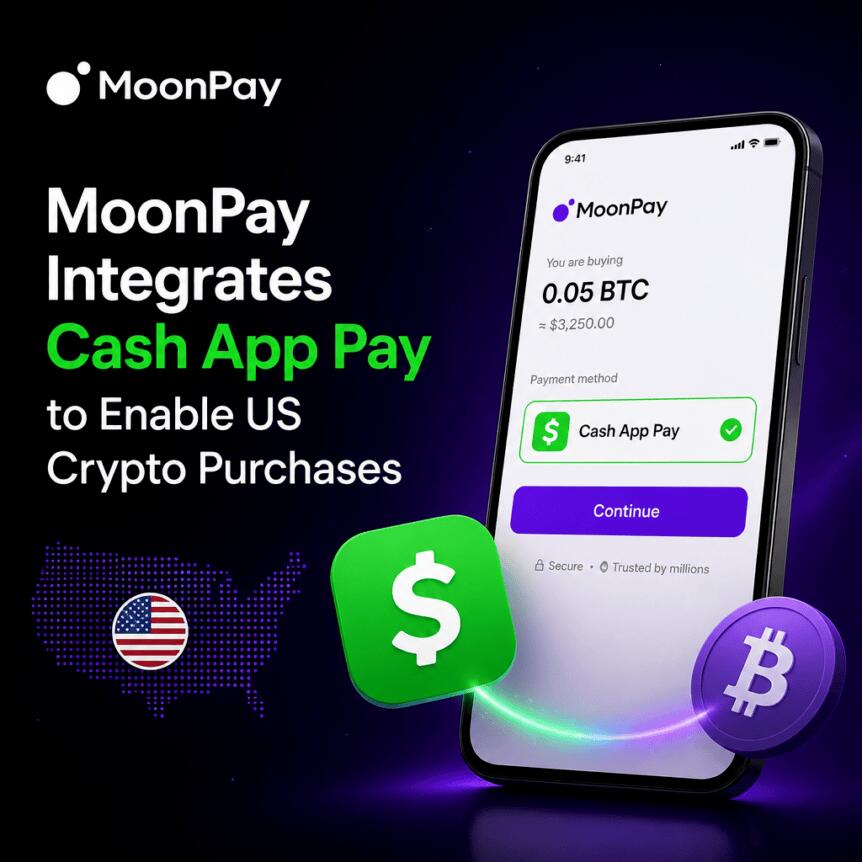
MoonPay has added Cash App Pay as a funding option for cryptocurrency purchases, enabling eligible customers in the United States to use their Cash App balances to buy crypto directly through MoonPay’s checkout. The move is intended to reduce friction by letting users complete transactions without switching between apps or performing an additional login.
In an announcement shared with Cointelegraph, MoonPay said Cash App Pay is available both on MoonPay’s own checkout and through select partner integrations. Those partners include Trust Wallet, Bitcoin.com, MetaMask, Moonshot, Ledger, BitPay, Uniswap, Tangem, LOBSTR and Edge.
Key takeaways
- MoonPay’s integration allows eligible US users to fund crypto buys using Cash App balances via Cash App Pay.
- Users can complete purchases through MoonPay checkout and partner wallets without switching apps or creating an extra login.
- Cash App is already a direct on-platform Bitcoin buyer/seller; MoonPay’s integration expands the range of assets accessible through the Cash App-funded flow.
- MoonPay is positioning itself as more than a fiat-to-crypto onramp, adding broader payment and infrastructure capabilities in 2026.
A tighter path from mainstream payments to crypto
Cash App, operated by Block, already lets users buy and sell Bitcoin inside the app. MoonPay’s new Cash App Pay option expands the practical reach of that user base by routing funding through Cash App balances into MoonPay’s crypto purchase experience, including access through multiple third-party platforms.
According to Block’s second-quarter shareholder report, Cash App reported 59 million active users in June. While that figure does not measure how many of those users will adopt Cash App Pay for non-Bitcoin crypto purchases, it highlights the scale of the audience MoonPay is trying to reach through a familiar consumer payments interface.
MoonPay co-founder and CEO Ivan Soto-Wright framed the integration around usability and trust, saying that Cash App is where “tens of millions of Americans” already manage their money and that the partnership allows those users to access a wider digital asset ecosystem funded “instantly” from an app they already know.
Available through MoonPay and multiple wallets
MoonPay said Cash App Pay can be used through its own checkout experience and with select partners, including widely used consumer wallets and on-platform payment interfaces such as MetaMask, Trust Wallet, Uniswap and BitPay. The company also named hardware and app-based ecosystems like Ledger and Tangem, as well as platforms including Edge and Bitcoin.com.
For users, the practical difference is the ability to fund a crypto purchase using Cash App’s balance while staying within the same general transaction flow—rather than jumping to a separate app to complete funding, then returning to finish a purchase elsewhere.
MoonPay also noted that Cash App Pay joins its existing payment integrations, which already include PayPal and Venmo. PayPal was added in 2024, and MoonPay later expanded support to Venmo.
Regulatory footing and MoonPay’s broader build-out
MoonPay’s announcement also comes as the company continues shifting from a straightforward onramp model toward a wider set of crypto services and infrastructure. From a compliance standpoint, MoonPay said it is licensed by the New York State Department of Financial Services via a BitLicense and Limited Purpose Trust Charter, and is authorized under the European Union’s Markets in Crypto-Assets Regulation in the Netherlands.
That regulatory posture matters because payment integrations typically require clear jurisdictional control—especially when partnering with mainstream consumer finance apps and embedding checkout or funding options across different platforms.
MoonPay has also been active on the acquisition and product-expansion front in 2026. It acquired Solana trading infrastructure provider DFlow in May, after an April deal for crypto security firm Sodot as part of a broader push into institutional services. In July, MoonPay acquired cross-chain infrastructure startup Glide and launched PayBox, a vault intended to let ChatGPT and Claude users authorize crypto transactions while keeping custody of their assets.
Taken together, the Cash App Pay integration fits into a wider theme: MoonPay is working to make crypto buying more accessible through familiar consumer payments while simultaneously building capabilities that extend beyond simple fiat-to-crypto transfers.
What to watch next
For users, the key question is rollout: which US customers are eligible for Cash App Pay inside MoonPay’s checkout and partner integrations, and whether the offering expands to more partners over time. For the market, investors and builders will likely watch whether “mainstream payments as crypto rails” continues to spread beyond Bitcoin-focused in-app buying, turning payments apps into broader gateways for multiple crypto assets.
https://www.cryptobreaking.com/moonpay-integrates-cash-app-pay-2/?utm_source=blogger%20&utm_medium=social_auto&utm_campaign=MoonPay%20Integrates%20Cash%20App%20Pay%20to%20Enable%20US%20Crypto%20Purchases%20
Comments
Post a Comment