
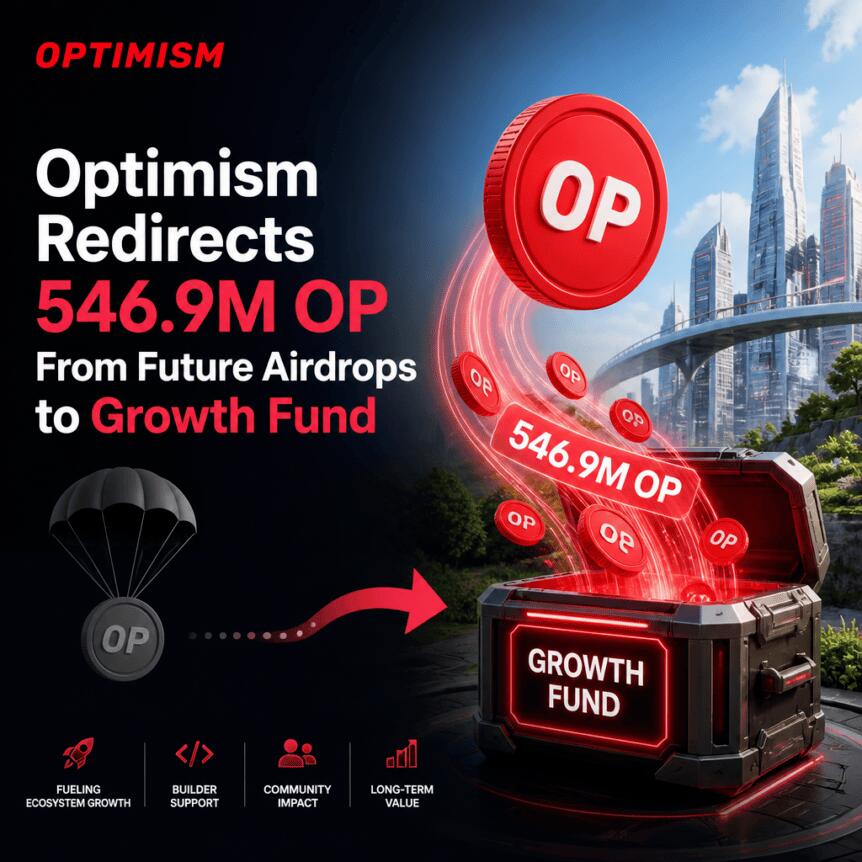
Optimism governance has approved a proposal to redirect 546.9 million OP tokens—previously set aside for user airdrops—into a new initiative aimed at accelerating ecosystem development and institutional engagement.
On-chain approval also follows Optimism’s statement that it does not plan additional airdrops after distributing 269.1 million OP across five rounds. The decision is now a central point of debate among delegates over whether the foundation is moving from broad user acquisition to enterprise-focused growth early enough—and how success will be measured.
Key takeaways
- 546.9 million OP tokens earmarked for future airdrops will be repurposed to fund Optimism’s new Strategic Ecosystem Fund.
- Optimism says it has already completed its airdrop program, distributing 269.1 million OP in five rounds, and views airdrops as more suited to an earlier growth phase.
- The fund is designed to support partnerships and incentives intended to grow activity and liquidity on OP Mainnet and OP Enterprise.
- Some delegates raised concerns about broken promises to users and questioned how returns on the fund will be evaluated.
- At current levels, the repurposed allocation is roughly $50 million, depending on OP’s market price, according to CoinGecko.
Airdrop funds redirected into a strategic ecosystem budget
The governance vote approved the transfer of 546.9 million OP tokens into what Optimism describes as a new Strategic Ecosystem Fund. The intent is to shift resources toward ecosystem growth efforts that—according to the project—are better aligned with its current priorities around institutional adoption.
The proposal also signals a change in how Optimism is trying to compete. Rather than focusing on distributing tokens broadly to users, supporters argued the allocation could be used to strengthen relationships with chains, protocols, and institutions, and to offer incentives aimed at increasing on-chain activity and market depth.
However, the decision was not universally welcomed. Some delegates pushed back, arguing the tokens had been promised to users and raising questions about accountability. In particular, they wanted clarity on how the foundation would measure whether the fund delivers measurable outcomes rather than simply reallocating value.
The vote is recorded on Optimism’s governance platform: Optimism proposal.
Optimism says additional airdrops aren’t planned
Optimism stated that it has no additional airdrops planned after completing token distribution of 269.1 million OP across five rounds. The project framed this as a lifecycle transition: airdrops, it argued, are most useful during an earlier phase built around wide user onboarding, while its current stage emphasizes institutional and enterprise readiness.
That framing matters because it underpins the justification for repurposing the remaining allocation. If the airdrop program is considered complete, governance can treat the unused reserve as discretionary—while critics view the same reserve as a commitment that should be fulfilled later rather than redirected to new objectives.
Where the OP Stack revenue comes in
Optimism operates as an Ethereum scaling effort, including OP Mainnet and the OP Stack, a framework used by multiple networks. The article’s data points also highlight that Optimism’s broader economic model is not purely dependent on token incentives: the project says more than 30 OP Stack chains contribute revenue to Optimism. This revenue-linked ecosystem context is relevant to the fund debate because it suggests the foundation is trying to balance token-driven growth with platform-level earnings from chains built on its stack.
Optimism references its OP Stack ecosystem here: OP Stack.
Still, delegates’ concerns about measurable outcomes remain important regardless of revenue streams. A strategic fund can strengthen partnerships, but it also creates an additional channel where governance stakeholders will want evidence of effectiveness.
Token impact and broader market signals
Following the vote, OP reportedly traded around $0.09 on Thursday, up roughly 11% over 24 hours amid a broader crypto market rally. Even with the rebound, OP remains far below its peak—more than 93% under its all-time high, based on market tracking data.
CoinGecko data also places OP’s market cap at roughly $214 million with a circulating supply of about 2.29 billion OP. The same dataset implies the governance allocation—546.9 million tokens—is worth in the neighborhood of $50 million at current prices, or close to a quarter of the token’s reported market capitalization.
CoinGecko: OP on CoinGecko.
This matters for investors because token allocation votes can affect expectations about how the ecosystem will be funded and how quickly it can convert into growth. While a funding shift does not guarantee price movement, it can influence sentiment around whether a network is focused on sustainable activity and institutional adoption—or whether it is sacrificing user-facing promises for faster enterprise positioning.
Enterprise narrative under development
Optimism’s decision lands alongside ongoing enterprise-leaning activity. Earlier coverage from Cointelegraph noted that Optimism signed a memorandum of understanding with Viva Republica, the operator of South Korea’s mobile money app Toss, to test a Korean won-based stablecoin infrastructure for institutional payments over a three-month proof-of-concept period.
This is the kind of partnership angle the governance supporters are effectively betting on with the Strategic Ecosystem Fund: using OP resources to accelerate collaborations that can translate into real-world payment rails and institutional workflows.
Earlier coverage: Cointelegraph report.
Still, the governance pushback underscores the tension investors and users should watch: the network is trying to move toward enterprise growth, but delegates also want assurance that token commitments to users and the promise of earlier allocations are handled transparently.
Going forward, market participants will likely track whether Optimism provides clear reporting on how the Strategic Ecosystem Fund is deployed and what measurable milestones it targets—especially given the vote’s stated goal of growing activity and liquidity on OP Mainnet and OP Enterprise.
https://www.cryptobreaking.com/optimism-redirects-546-9m-op/?utm_source=blogger%20&utm_medium=social_auto&utm_campaign=Optimism%20Redirects%20546.9M%20OP%20From%20Future%20Airdrops%20to%20Growth%20Fund%20
Comments
Post a Comment