
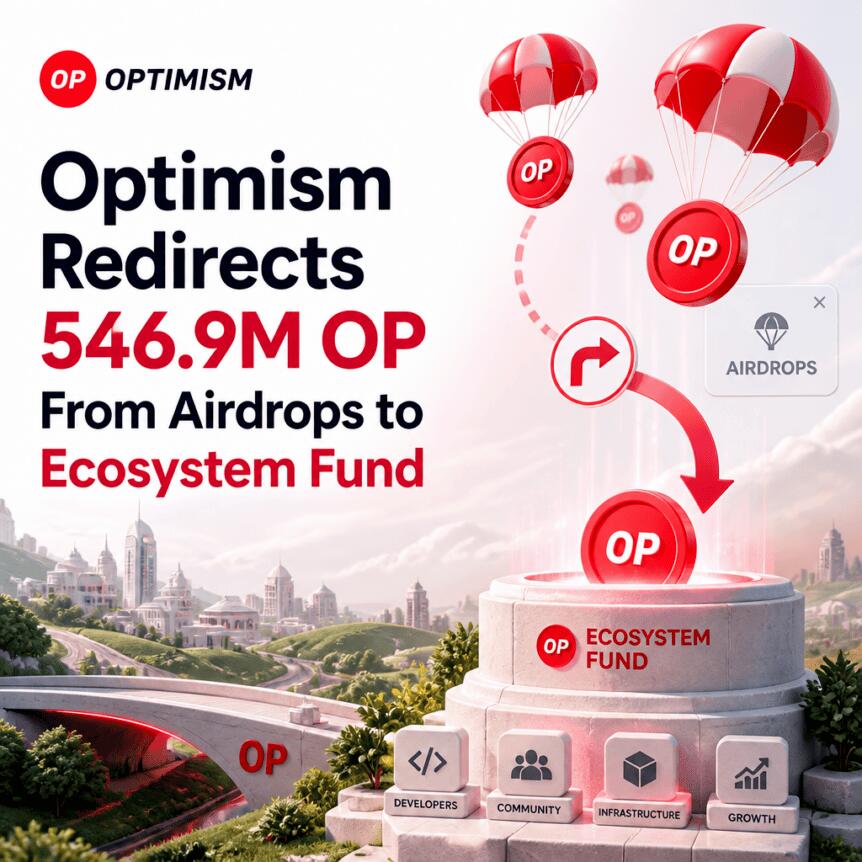
Optimism’s on-chain governance has approved a plan to redirect 546.9 million OP tokens, previously earmarked for user airdrops, into a new Strategic Ecosystem Fund designed to back ecosystem growth and institutional adoption.
According to CoinGecko data, OP is currently valued at roughly $214 million in market capitalization with a circulating supply of about 2.29 billion tokens (CoinGecko). At today’s price levels mentioned in the coverage, the repurposed allocation is roughly $50 million—about a quarter of the token’s market cap.
Key takeaways
- Optimism governance voted to move 546.9M OP from planned user airdrops into a new Strategic Ecosystem Fund.
- The fund is intended to support partnerships with chains, protocols, and institutions, alongside incentives to boost activity and liquidity on OP Mainnet.
- Some delegates pushed back, arguing the tokens were previously promised to users and questioning how returns would be measured.
- Optimism says it does not plan additional airdrops after distributing 269.1M OP across five rounds, framing this as a shift from user acquisition to institutional focus.
A shift from user distribution to ecosystem and enterprise growth
The approved proposal creates a fund meant to accelerate broader adoption rather than focusing on further token distribution. In the plan, the Strategic Ecosystem Fund will back initiatives including partnerships with other networks and protocols, as well as incentives aimed at increasing activity and liquidity on OP Mainnet.
It also explicitly points to growth for OP Enterprise, a component of Optimism’s wider push to serve institutional and enterprise users. Supporters of the change argued that the redeployment better positions Optimism to compete for enterprise-focused deals and drive measurable ecosystem expansion.
Governance debate highlights trust and accountability questions
Not all delegates were convinced. The proposal faced pushback from some participants who argued that the tokens were already committed to user airdrops. They also raised concerns about how Optimism would evaluate the fund’s outcomes, including what “success” would look like for the foundation and how investments would be assessed.
Optimism’s proponents, by contrast, framed the allocation as a pragmatic reallocation toward later-stage priorities. They argued that the ecosystem’s next growth phase requires resources targeted at institutional adoption and increased network utilization—goals they believe align more closely with a fund built for partnerships and liquidity incentives.
Optimism: airdrops are largely done, institutional push is next
Optimism stated that it has no additional airdrops planned following the distribution of 269.1 million OP across five rounds. The project’s rationale is that airdrops were most appropriate for an earlier phase focused on broad user acquisition, whereas Optimism says it has now moved toward a different growth strategy centered on institutional adoption.
The network emphasized that this change reflects an evolution in its priorities rather than a reversal. The governance decision, however, makes the measurement question central: if a fund is moved away from token distribution, stakeholders will likely want clearer metrics around ecosystem impact, partnership quality, and any resulting activity or revenue tied back to the spending.
OP price reacts as token remains far below its peak
While the governance vote addresses long-term allocation, OP’s market behavior shows how quickly investor attention can move to any major token-related decision. The coverage notes that OP traded around $0.09 on Thursday, up about 11% over the prior 24 hours amid a broader market rally. Even after the rebound, the token remains more than 93% below its all-time high.
At the referenced price, the repurposed 546.9M token allocation would be worth around $50 million, consistent with roughly one-quarter of OP’s market capitalization at the time mentioned. That comparison underscores why the vote is relevant to market participants: shifting a large token reserve allocation can influence expectations about future supply dynamics, ecosystem spending priorities, and how investors think about the project’s runway.
Where the OP Stack fits into the next growth phase
Optimism is the Ethereum scaling project behind OP Mainnet and the OP Stack, the modular blockchain framework that supports other networks. Among projects cited in the coverage are Base, Unichain, Kraken’s Ink, and Sony’s Soneium. Optimism also states that more than 30 OP Stack chains currently contribute revenue to Optimism.
This matters for the governance decision because the new fund is designed to complement an ecosystem model that depends on both network activity and partnerships. If OP Stack chains continue to expand, the foundation’s ability to attract additional enterprises and liquidity could become a more direct driver of usage across OP Mainnet and related tooling.
Investors and builders will likely watch for how Optimism operationalizes the Strategic Ecosystem Fund—particularly whether it publishes clear allocation criteria and measurable targets for partnerships, liquidity incentives, and OP Enterprise outcomes. The governance vote moves the budget needle now, but the next phase will depend on follow-through and transparency about results.
https://www.cryptobreaking.com/optimism-redirects-546-9m-op-2/?utm_source=blogger%20&utm_medium=social_auto&utm_campaign=Optimism%20Redirects%20546.9M%20OP%20From%20Airdrops%20to%20Ecosystem%20Fund%20
Comments
Post a Comment