
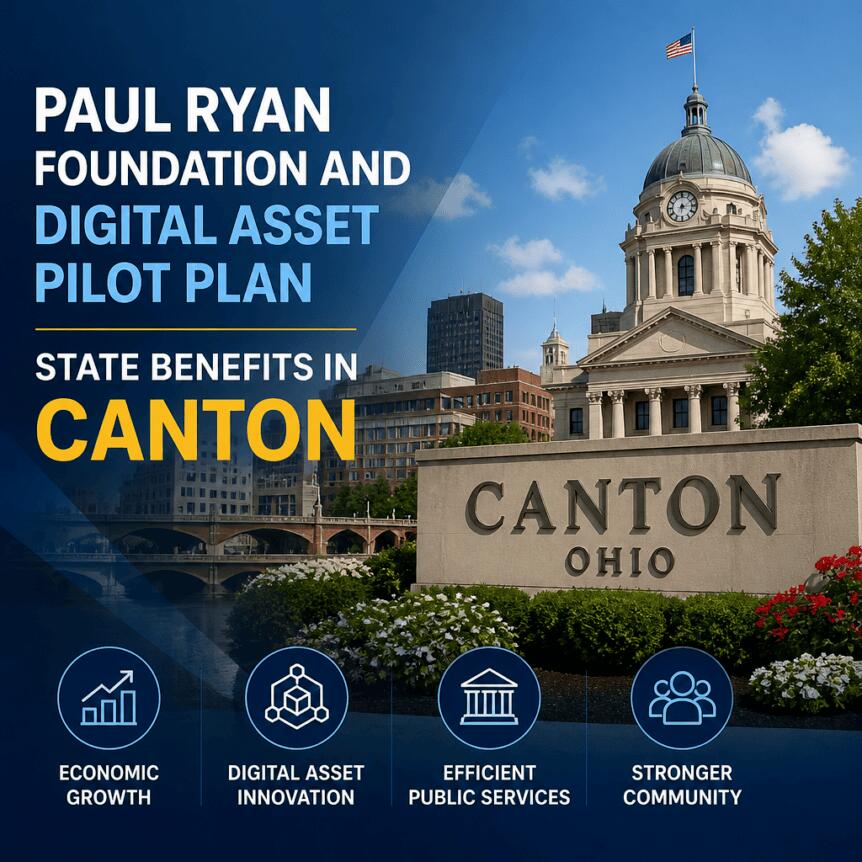
Digital Asset, the company behind the Canton Network, is partnering with the American Idea Foundation—co-founded by former US House Speaker Paul Ryan—to pilot a blockchain-based program for administering state benefits in the United States. The initiative, branded RISE, is designed to modernize how eligibility rules and payment logic are applied when household circumstances change.
According to the announcement, the pilot is planned to launch in the first quarter of 2027 and would bundle multiple benefits into monthly or twice-monthly payments. It would also incorporate spending rules for categories such as food, child care, and cash, while giving participating agencies visibility into payment status, balances, spending, and compliance information via Canton.
Key takeaways
- RISE aims to use Canton to automate benefit distribution while adjusting support as household income changes.
- The system would group multiple benefits into periodic payments and apply spending constraints across specific categories.
- Participating agencies could track payments, balances, spending, and compliance data through Canton, with access limited for sensitive information.
- The pilot is not yet finalized: Digital Asset and the American Idea Foundation said it remains subject to federal approval, and the states and benefit programs were not disclosed.
- Canton’s government-linked use cases are expanding beyond finance toward real-world public service delivery.
RISE: automating benefit logic on a blockchain network
The proposed RISE program centers on how benefit rules can be translated into automated systems that respond to real-time changes in a household’s finances. Digital Asset said Canton would coordinate the rules, permissions, and transactions needed to distribute benefits—while restricting access to sensitive data.
In practice, that means the program is intended to handle more than payment issuance. The plan calls for automatic adjustment of benefit levels as household income changes, potentially reducing overpayments or underpayments that can trigger penalties for recipients when circumstances improve.
Ryan said the pilot’s purpose is to help demonstrate what a “modern safety net” could look like by addressing fragmentation across benefits and by measuring results more rigorously.
By combining fragmented benefits, reducing penalties as families earn more, and rigorously measuring results, these pilots can help show what a modern safety net should look like.
What isn’t decided yet: states, programs, and federal sign-off
While the announcement outlines how RISE would work at a systems level, it did not name which US states would participate. It also did not specify which benefit programs would be included or how the category-based spending rules would map to existing administration processes.
Both Digital Asset and the American Idea Foundation emphasized that the pilot remains subject to federal approval. That qualifier matters because public benefits programs in the US are governed by layered federal and state requirements, and any attempt to shift how benefits are calculated, disbursed, or constrained typically depends on regulatory clearance.
For stakeholders watching the project, the key question will be what approvals ultimately permit—particularly around data access controls, auditing requirements, and how “compliance data” would be generated and shared among agencies.
Canton’s pivot toward public-sector and settlement use cases
RISE adds a new government-linked application layer to Canton’s broader track record. Recent Canton activity has been heavily associated with institutional finance, including projects involving government securities. Still, the network has been moving into other public-facing and regulated settings.
In April, Japan Securities Clearing Corporation (JSCC), Mizuho, Nomura, and Digital Asset launched a proof of concept using Canton to test Japanese government bonds as digital collateral. The project included support under Japan’s Financial Services Agency Payment Innovation Project and explored use cases such as real-time, cross-border transactions.
Later in July, Canton was used to settle a tokenized US Treasury trade involving Franklin Templeton and Virtu Financial. In that instance, Tradeweb handled execution and price discovery, with the Treasury changing hands against USDCx in real time—an approach Tradeweb described as an industry first. The details reinforce that Canton’s architecture has been aimed at structured settlement workflows, not just token transfers.
RISE would extend those capabilities into daily life for beneficiaries by turning policy and compliance logic into operational rules executed through the network—an application that, if implemented, could test whether the same settlement-grade determinism can be applied to welfare administration at scale.
The network’s ecosystem: Canton Coin and institutional traction
Canton Coin (CC), the network’s native asset used to pay fees for transactions through Canton’s Global Synchronizer, is currently positioned as a market-visible indicator of activity within the ecosystem. CoinGecko data cited in the announcement places CC’s market capitalization at about $4.1 billion, ranking it 23rd among cryptocurrencies. The same data indicated CC is up around 10% over the past week.
Beyond price, the more consequential element for investors is how Canton continues to convert partnerships into production-grade workflows. The RISE proposal is still early—states and programs have not been selected and federal approval is required—but it signals an intent to broaden Canton’s role from financial infrastructure toward regulated public administration.
Readers should watch next for two things: which states and benefit programs (if any) are selected for RISE, and what conditions federal regulators impose before the pilot can proceed. Even if the timeline targets early 2027, the approvals—and the data governance model around compliance and sensitive information—will likely determine whether the project can move from concept to a deployable system.
https://www.cryptobreaking.com/paul-ryan-foundation-and-digital/?utm_source=blogger%20&utm_medium=social_auto&utm_campaign=Paul%20Ryan%20Foundation%20and%20Digital%20Asset%20Pilot%20Plan%20State%20Benefits%20in%20Canton%20
Comments
Post a Comment