
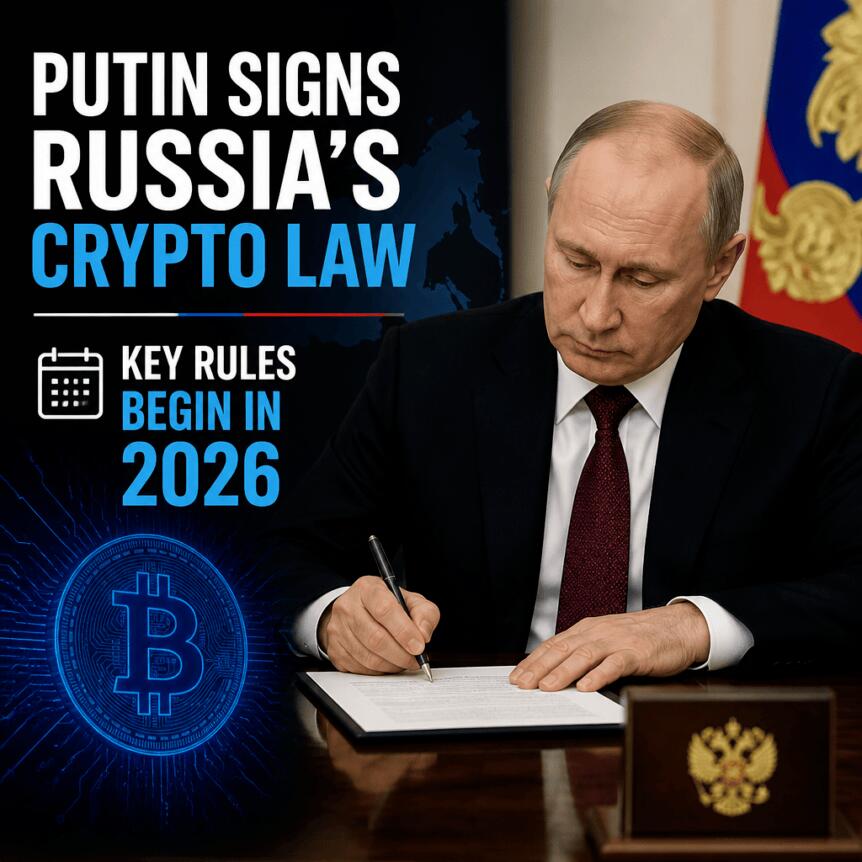
Russian President Vladimir Putin has signed legislation that lays out a regulated framework for cryptocurrency markets in Russia, marking a significant shift from the country’s largely restrictive posture toward a formal rules-based approach for licensed crypto activity.
The law, identified as bill No. 1194918-8 and titled “On Digital Currencies and Digital Rights,” was signed on Tuesday, according to official records from the State Duma, Russia’s lower house of parliament. It sets out requirements for major categories of crypto market participants, including exchanges, brokers, custodians, and other service providers.
Key takeaways
- Russia has moved toward a regulated crypto market through bill No. 1194918-8 (“On Digital Currencies and Digital Rights”).
- Crypto exchanges must meet regulatory conditions and join a financial market self-regulatory organization.
- Retail investors will be limited to purchasing only approved digital assets via intermediaries, with a 300,000 ruble annual cap per intermediary.
- Qualified investors are expected to face fewer restrictions and be able to buy any cryptocurrency.
- The law keeps Russia’s ban on using crypto assets to pay for goods and services domestically.
What the law changes for Russian crypto activity
At the center of the new bill is a licensing and oversight model intended to bring Russia’s crypto market into a clearer regulatory structure. The legislation defines rules for key participants across the crypto ecosystem, including trading venues (exchanges) and intermediary services such as brokerage and custody.
Under the framework, operators of crypto exchanges are required to comply with regulatory requirements and become members of a financial market self-regulatory organization. That combination suggests that, beyond direct supervision, exchanges will likely be subject to additional industry-level governance through the self-regulatory body.
Limits for retail investors, flexibility for qualified investors
A major practical feature of the law is how it differentiates between types of market participants. The bill limits retail investors’ access to cryptocurrencies by requiring intermediaries to sell only approved crypto assets and by imposing a quantitative ceiling on purchasing activity.
Specifically, the law sets an annual cap of 300,000 rubles (about $3,700) per intermediary for retail investors. Qualified investors, by contrast, will be allowed to purchase any cryptocurrency without the same restrictions.
For everyday users and smaller investors, the implication is straightforward: access to the broader crypto market could become more fragmented and filtered through intermediaries—while larger or more formally designated investors may be able to maintain wider exposure.
Regulatory oversight and the approval process
According to the law as reported through official parliamentary records, the Bank of Russia will be responsible for overseeing the regulated crypto market. That includes issuing related regulatory rules and determining which crypto assets licensed intermediaries can offer to investors.
In late July, the State Duma approved the legislation after final readings, an earlier step referenced in separate coverage at Cointelegraph. With the signing now completed, implementation becomes the next critical phase—particularly because different parts of the law take effect at different times.
When rules take effect—and what stays prohibited
Timing matters for investors, exchanges, and service providers because regulatory obligations rarely arrive all at once. The core provisions of the law take effect on Sept. 1, 2026. Some elements—including rules covering non-resident digital depositories—are scheduled to begin on July 1, 2027.
The law also preserves an existing prohibition on using crypto assets to pay for goods and services within Russia. That means the new regulatory structure is aimed at governance of crypto market participants and investor access, rather than enabling everyday crypto spending domestically.
Why this framework could reshape Russia’s crypto market
This legislation matters beyond legal formality because it defines who can participate, what assets can be offered through licensed channels, and how investors access those markets. By placing responsibility on the Bank of Russia to issue rules and approve which assets intermediaries may provide, the law effectively creates a gatekeeping mechanism—one that could influence liquidity, available trading pairs, and the list of cryptocurrencies that reach retail customers.
The retail investment cap per intermediary may also affect product design for brokers and custodians, since their compliance exposure would be linked to both approved asset lists and distribution limits. Meanwhile, the distinction between retail and qualified investors suggests that market access will not be uniform: segments of the investor base could experience different levels of flexibility and risk exposure depending on their classification.
As the implementation dates draw closer, market participants will likely focus on how the Bank of Russia translates the law into operational guidance—especially around licensing conditions, asset approval procedures, and the treatment of non-resident digital depositories.
Investors and builders should watch closely for the Bank of Russia’s rulemaking and for how “approved” crypto assets are selected, since those decisions will determine what retail users can realistically access before the Sept. 1, 2026 start date.
https://www.cryptobreaking.com/putin-signs-russias-crypto-law/?utm_source=blogger%20&utm_medium=social_auto&utm_campaign=Putin%20Signs%20Russia’s%20Crypto%20Law;%20Key%20Rules%20Begin%20in%202026%20
Comments
Post a Comment