
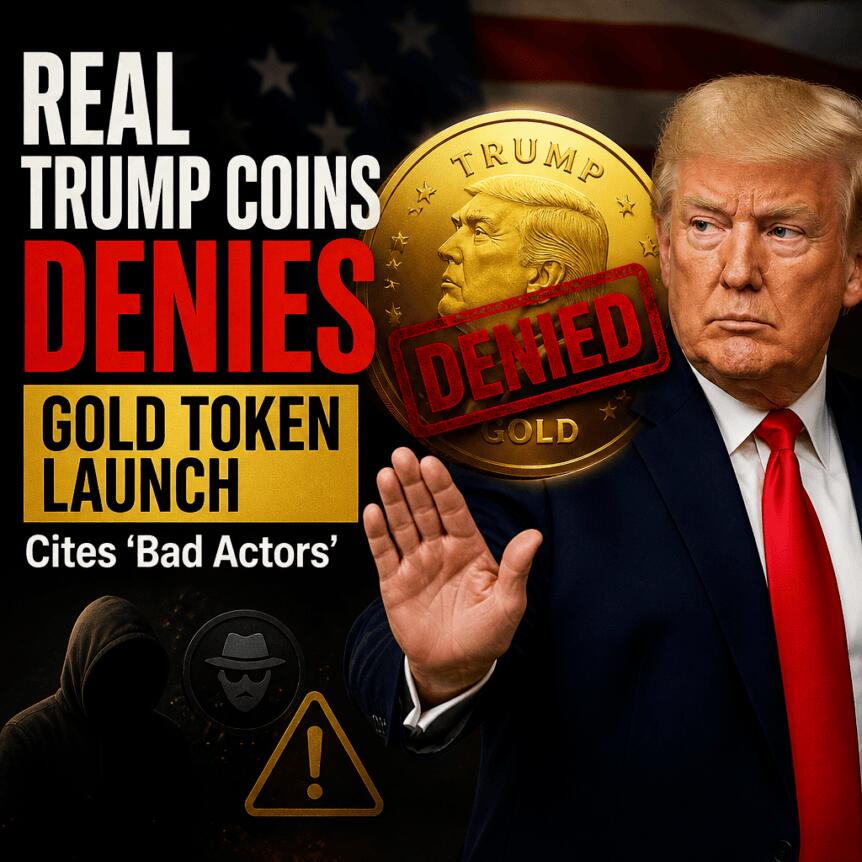
Real Trump Coins has denied any involvement in the brief launch and promotion of a Solana-based token called “Trump Digital GOLD,” which appeared across its online channels before disappearing. The company said the activity was driven by “third-party bad actors,” adding that it is working with authorities to investigate.
The denial followed a short-lived marketing push from the Real Trump Coins X account on Saturday. That account promoted the token and directed users to RealTrumpCoins.com, where GOLD was also advertised. The posts were later deleted, and the X account now points to a different domain, TrumpCoins.com.
Key takeaways
- Real Trump Coins says it never authorized the “Trump Digital GOLD” token and is investigating the incident with authorities.
- Blockchain analytics highlighted a highly concentrated token allocation, with team-linked wallets reportedly controlling the majority of supply.
- Both the X account activity and the RealTrumpCoins.com promotion created confusion about whether any platform compromise occurred.
- The token’s rapid disappearance after promotion underscores how quickly scam tokens can be distributed and then pulled.
Denial and escalation to authorities
In an X post on Saturday, Real Trump Coins stated: “Trump Coins has not authorized and will not launch, promote, or authorize any digital token.” The statement also said the team is working with authorities to investigate what happened.
The company’s message came after the Real Trump Coins X account promoted GOLD and users were routed to RealTrumpCoins.com. Observers noted that the X posts were subsequently removed and that the account’s linked domain changed, suggesting either a rapid corrective action—or that attackers may have shifted infrastructure to reduce traceability.
Real Trump Coins also clarified through its denial that it will not stand behind any token promotion that appears under its brand. For investors and token buyers, that distinction matters because brand-adjacent campaigns are often used to build short-term credibility for new tokens.
What Lookonchain’s wallet analysis suggests
Separate from the brand dispute, blockchain analytics reported unusually tight control over the token’s initial distribution. According to Lookonchain, the developer and newly created wallets controlled 82.45% of GOLD’s supply.
Lookonchain further reported that 15 wallets associated with the team sold their holdings for about $330,000, estimating profits around $312,000. Such concentration is a common red flag in token launches that operate more like coordinated distribution events than community-driven projects, particularly when promotions are short-lived.
This kind of structure typically enables insiders to move supply quickly—especially when liquidity is limited—while public buyers may only have brief windows to react to the promotion. Even if the brand claims innocence, the on-chain pattern described by Lookonchain indicates that GOLD’s rollout behaved like a pre-planned distribution rather than a distributed issuance.
Why the X account and domain mismatch raised questions
Crypto observers were unsettled by how closely the token promotion appeared to track Real Trump Coins’ online identity. One point of confusion was the apparent linkage between the X account and the brand’s web presence.
At the time the incident was being discussed, the Real Trump Coins X profile bio had been updated to link to TrumpCoins.com, while at least one earlier post still directed customers to RealTrumpCoins.com as recently as Aug. 25. That earlier post remained online at the time of publication.
In addition, some observers noted that Real Trump Coins was still following the Real Trump Coins X account—one of several accounts (53) it reportedly followed. That detail matters because it can imply either long-standing relationships between accounts or overlapping community management, raising further questions about whether the promotional activity could have been compromised or hijacked.
RuneCrypto_, an X user, publicly questioned how both the account and the domain could have been affected, pointing to the inconsistency between the X bio link and the continued RealTrumpCoins.com promotion.
As of the time of reporting, RealTrumpCoins.com still displayed the GOLD promotion, while the X account had shifted its linked destination to TrumpCoins.com. That sequence suggests the web and social layers were not aligned at the same time—either due to attacker behavior, partial cleanup by the legitimate operator, or asynchronous removal after deletion of the token posts.
How quickly these campaigns move—and what to watch next
The Real Trump Coins denial and the subsequent deletion of posts illustrate a pattern seen in many token scams: promotional content spreads quickly, routes users to a branded website to increase trust, and then is removed once attention rises or funds begin moving.
The on-chain reporting from Lookonchain adds another layer for observers: even if a brand operator did not authorize the token, insider-style wallet concentration and rapid selling can make such events damaging to retail participants. Buyers may be exposed before they fully understand what is legitimate and what is unauthorized.
Moving forward, investors and community members should watch for several practical signals: whether Real Trump Coins publicly provides follow-up findings from its investigation, whether the token contract receives any official takedown or blacklisting responses, and how the involved wallets behave after the initial promotion window.
https://www.cryptobreaking.com/real-trump-coins-denies-gold/?utm_source=blogger%20&utm_medium=social_auto&utm_campaign=Real%20Trump%20Coins%20Denies%20GOLD%20Token%20Launch,%20Cites%20‘Bad%20Actors’%20
Comments
Post a Comment