
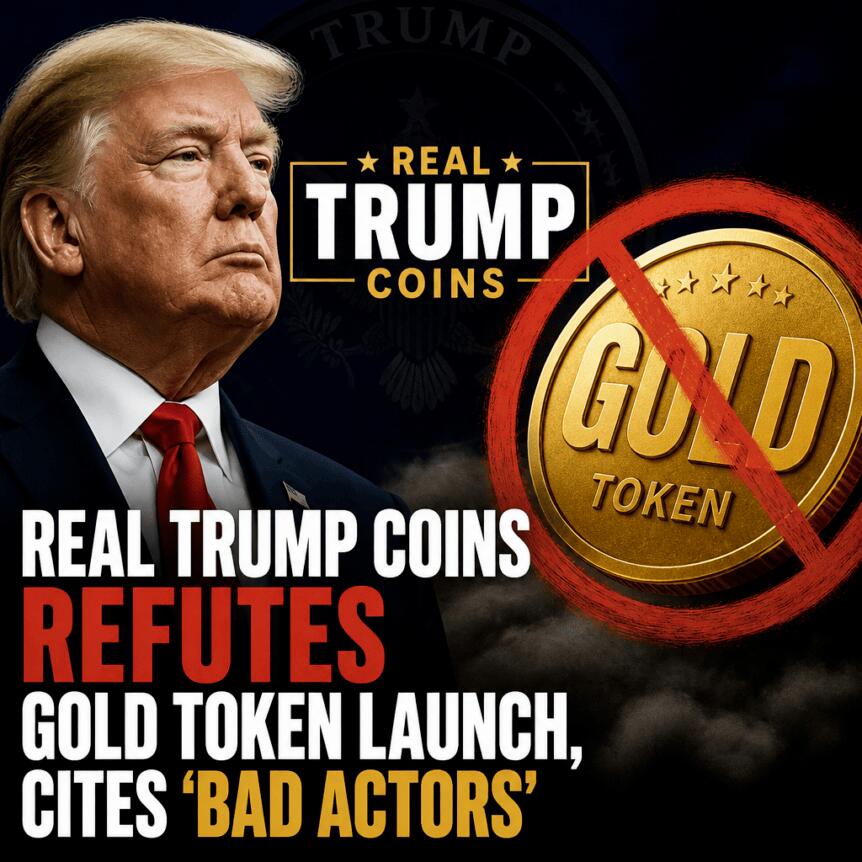
Real Trump Coins has denied involvement in the launch of a token called “Trump Digital GOLD,” after the project briefly promoted the Solana-based asset across its online channels before the promotion disappeared.
The company said the activity was carried out by “third-party bad actors” and stated it is working with authorities to investigate. The episode comes amid scrutiny of how crypto promotions can move fast—and sometimes leave little trace—before platforms delete posts.
Key takeaways
- Real Trump Coins says it did not authorize or promote any digital token, following short-lived advertising for “Trump Digital GOLD.”
- Promotion originated from the Real Trump Coins X account and RealTrumpCoins.com, though the posts were deleted after going live.
- Blockchain data cited by Lookonchain indicates extreme concentration of supply among a small number of newly created wallets.
- Real Trump Coins’ denial has prompted confusion among observers about how both the account and its website appeared to be advertising the token.
Token promotion appears, then vanishes
According to Cointelegraph, the Real Trump Coins X account promoted “Trump Digital GOLD” on Saturday and directed users to RealTrumpCoins.com, where the token was also advertised. The promotional posts were subsequently deleted.
As the incident unfolded, the X account began linking to a different domain, TrumpCoins.com, while RealTrumpCoins.com had still displayed the GOLD promotion for at least a period afterward. Cointelegraph also reported that at the time of publication, RealTrumpCoins.com continued to show the token advertisement.
In the meantime, Real Trump Coins’ X account bio had been updated to point to TrumpCoins.com, even as some audience members saw earlier posts—including at least one referenced by the reporting—that still pushed users toward RealTrumpCoins.com as late as Aug. 25.
Project denies authorization and cites “bad actors”
In an X post on Saturday, Real Trump Coins said it had not authorized any token launch or promotion, adding that it would not do so. The project’s statement also said it is working with authorities to investigate the matter.
That denial raises the central question for observers: whether the token promotion was the result of compromise on the project’s side, or whether there was another mechanism used to make the promotion appear affiliated with Real Trump Coins.
Concentration concerns highlighted by Lookonchain
Separate reporting and on-chain analysis framed the token as potentially suspicious based on distribution and sell activity. Lookonchain reported that the developer and newly created wallets controlled 82.45% of the token supply.
Lookonchain also said that 15 wallets tied to the team sold holdings worth about $330,000, resulting in an estimated $312,000 profit. Such concentration—paired with rapid selling by wallets linked to the launch—can be a red flag for traders because it often suggests the possibility of coordinated exits rather than broad, organic distribution.
While tokenomics alone do not prove wrongdoing, the combination of tight control by a small set of wallets and swift monetization typically heightens investor risk, especially when promotions appear to be connected to recognizable brand accounts.
Why the account-and-domain confusion matters
The incident has drawn attention not just for the token itself, but for how branding and audience access were leveraged. Cointelegraph noted that observers were confused by the relationship between the X account and the two different domains—RealTrumpCoins.com and TrumpCoins.com—particularly after posts were deleted.
Crypto users questioned how both the social account and the website appeared to be participating in the promotion, especially given that the X account reportedly linked to TrumpCoins.com while, in later checks, RealTrumpCoins.com still displayed the GOLD advertising.
This kind of mismatch can be a warning sign for anyone dealing with brand-adjacent token launches. If a reputable or officially connected account appears compromised—or if a token promotion is run through lookalike infrastructure—the practical effect is similar: consumers may assume endorsement where none exists.
Real Trump Coins’ continued activity and following behavior also drew notice from observers in the Cointelegraph report, including that Trump followed the Real Trump Coins X account and that the account was among a set of accounts the person followed. The significance of that detail is limited to what it implies socially, but in incidents like this it can still affect how quickly users decide whether to trust promotional content.
What to watch next
For investors and builders, the key unanswered items are whether Real Trump Coins will provide additional technical details on how the promotion occurred and what changes it will make to prevent repeat misuse. Until then, the episode underscores how quickly a token can surface alongside brand signals—and how crucial it is to verify authenticity through more than just a token’s earliest promotional footprints.
https://www.cryptobreaking.com/real-trump-coins-refutes-gold/?utm_source=blogger%20&utm_medium=social_auto&utm_campaign=Real%20Trump%20Coins%20Refutes%20GOLD%20Token%20Launch,%20Cites%20‘Bad%20Actors’%20
Comments
Post a Comment