
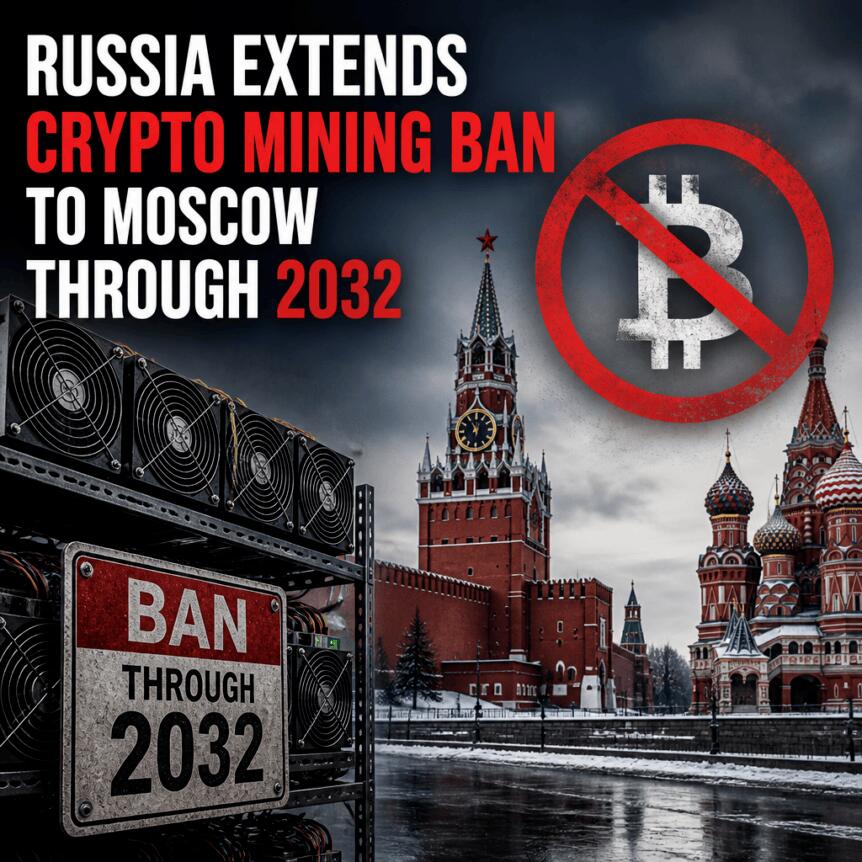
Russia is tightening its cryptocurrency mining rules by expanding a ban that will apply in Moscow and surrounding areas. The restriction takes effect on Aug. 15, 2026, and is scheduled to run through Dec. 31, 2032, according to a government resolution published on Pravo.ru.
The updated measure, signed July 25, 2026 by Prime Minister Mikhail Mishustin, amends earlier restrictions adopted in December 2024. It broadens the list of regions where mining is prohibited, citing electricity supply and demand pressures in power-constrained territories.
Key takeaways
- Russia’s Resolution No. 936 (signed July 25, 2026) extends crypto mining restrictions to Moscow and the Moscow Region.
- The Moscow-area ban starts Aug. 15, 2026 and runs through Dec. 31, 2032.
- Additional affected areas include several territories within Russia’s Kursk Region, plus eight municipal districts and the city of Lgov.
- The Kremlin-linked restrictions build on an earlier Dec. 2024 mining curbs order, and follow region-by-region bans introduced since early 2026.
Resolution expands mining ban into Moscow and nearby territories
Under the revised framework, mining restrictions now include Moscow, the Moscow Region, and multiple areas within Russia’s Kursk Region. The document also lists eight municipal districts and the city of Lgov as part of the restricted zone.
The changes are formalized in Resolution No. 936, referenced in records published on Pravo.ru. The resolution amends an earlier order issued in December 2024, which had already established limitations on cryptocurrency mining in specific parts of Russia.
Electricity demand remains the policy rationale
Russian officials have previously connected mining restrictions to grid strain and rising electricity demand. According to reporting by TASS, the Moscow Region’s energy authorities said a ban was needed as consumption increased.
TASS also cited power infrastructure figures, stating that Moscow and the Moscow Region have 65 data centers linked to the grid with a combined capacity of 734 megawatts (MW). Within that total, 19 data centers are located in the Moscow Region, totaling 233 MW of capacity.
While the new resolution expands the restricted geography, the underlying logic mirrors earlier steps: authorities are attempting to limit additional load from mining activities in areas where power supply and demand are already under pressure.
Earlier regional restrictions set the stage for a broader move
This Moscow-focused expansion follows a broader pattern of state action against crypto mining in selected regions. The updated rules amend the December 2024 restriction order, which had already begun shaping where mining could operate.
Earlier restrictions were also introduced in parts of Russia, including areas in Buryatia and Zabaykalsky Krai. As described in the Pravo.ru records, those bans were set to run from April 1, 2026 through March 15, 2031.
In other words, Russia is not simply imposing a new nationwide approach; it is layering restrictions by region—first in selected territories and now into major urban and power-dependent areas like Moscow and its surrounding region.
What to watch next for miners and operators
For mining companies and energy-intensive operators, the key practical implication is that compliance will depend heavily on location rather than a single countrywide rule. With the start date set for Aug. 15, 2026 and a long time horizon through 2032, operators in or near the newly restricted areas will need to plan for regulatory compliance well ahead of implementation.
Investors, traders, and builders should watch whether authorities continue expanding the banned geography beyond Moscow and Kursk, and whether grid-capacity reporting becomes more central to future policy decisions. Additional region-specific amendments would further reinforce Russia’s approach of using electricity supply constraints as the deciding factor for mining permissions.
https://www.cryptobreaking.com/russia-extends-crypto-mining-ban-2/?utm_source=blogger%20&utm_medium=social_auto&utm_campaign=Russia%20Extends%20Crypto%20Mining%20Ban%20to%20Moscow%20Through%202032%20
Comments
Post a Comment