
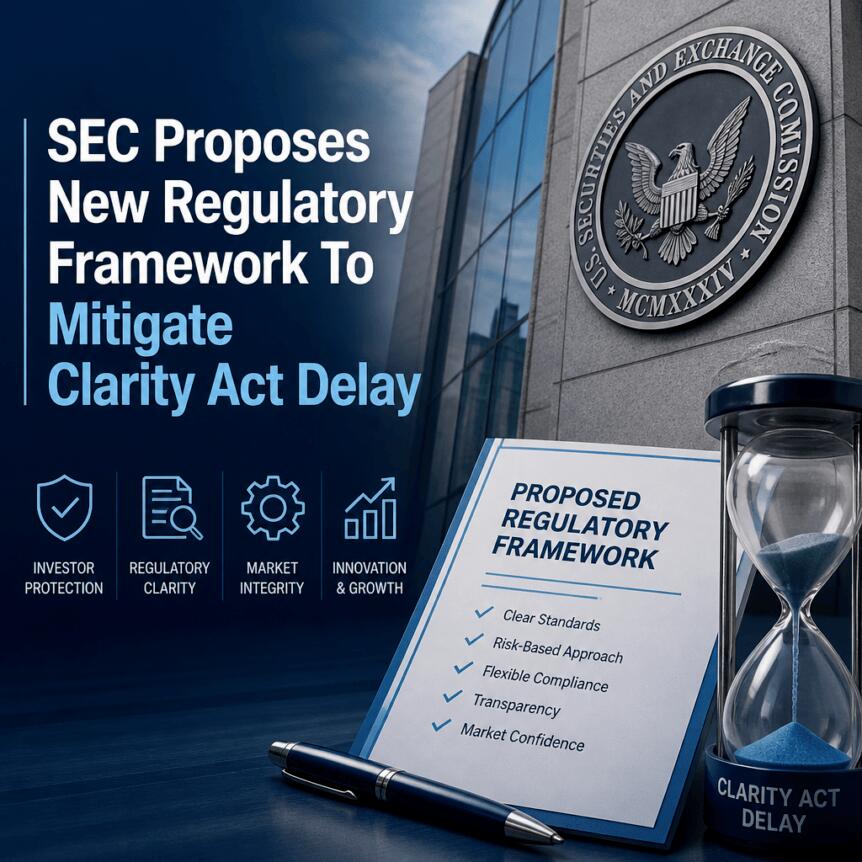
The United States Securities and Exchange Commission (SEC) has proposed new rules for specific crypto asset investment contracts after Congress failed to advance the CLARITY Act before the August recess.
The framework clarifies when crypto assets and transactions fall under the ambit of federal securities laws. The public has 60 days to provide feedback on the proposal after it is published in the Federal Register.
SEC Proposes New Cryptocurrency Rules
The United States Securities and Exchange Commission (SEC) has proposed a new regulatory framework for crypto asset investment contracts. The proposal outlines exemptions for specific issuers to raise capital without registering their products under the Securities Act. The framework builds on the SEC’s interpretation of how federal securities laws apply to crypto and crypto transactions. The proposal is part of the SEC’s efforts to establish a clear framework for crypto-related offerings and maintain disclosure and investor protection requirements. SEC Chair Paul Atkins stated,
“As we continue the Commission’s efforts to provide clarity for crypto markets, and as Congress works to establish a lasting regulatory framework, Regulation Crypto Assets seeks to provide crypto asset entrepreneurs and market participants with clear pathways to raise capital under the federal securities laws.”
Crypto Fundraising Exemptions
The proposal also distinguishes two exemptions from the Securities Act of 1933. The first offers companies a one-time exemption for offerings of up to $5 million over four years, while the second allows issuers to conduct offerings of up to $75 million during 12 months. Any issuer using the exemptions must provide principle-based narrative disclosures to investors. Issuers using the $75 million exemption will be subject to additional requirements, including ongoing reporting and detailed financial statements.
The SEC’s proposal also establishes a conditional “safe harbor” from the term “investment contract” under the Securities Act and the Securities Exchange Act of 1934. The “safe harbor” exempts crypto assets from being treated as subject to an investment contract if specific conditions are satisfied. Additionally, the SEC has proposed pre-empting state securities laws registration and qualification requirements for offerings under the new exemptions and specific secondary market transactions.
The new regulatory framework is expected to provide clarity around when crypto and crypto-related transactions fall under the ambit of federal securities laws. According to the SEC, the proposal will incentivize issuers to operate in the US and give investors access to crypto offerings under a consistent regulatory framework. The agency will accept public comments on the exemptions for 60 days after they are published in the Federal Register.
No Innovation Exemption
However, the rules do not include the expected “innovation exemption” for crypto-based stocks. The proposed rules come after the Senate failed to advance the CLARITY Act ahead of its August recess. SEC Chair Atkins stated,
“egislation remains indispensable to enacting ‘future-proofed’ rules of the road that are durable enough to protect the work we are undertaking today from being unwound by a future rogue regulator. The SEC has and will continue to support Congress in delivering the CLARITY Act to President Trump’s desk.”
US Agencies Continue Crypto Regulatory Efforts
The proposal is part of continued efforts by the SEC and the Commodity Futures Trading Commission (CFTC) to develop clear rules and establish a regulatory framework for the industry. According to CFTC Chairman Mike Selig, the agency will create regulations to foster innovation in technologies, including blockchain, AI, and prediction markets. Selig stated in a post on X,
“POTUS put together a dream team with one goal in mind: shepherd America towards the new frontier of finance.”
Disclaimer: This article is provided for informational purposes only. It is not offered or intended to be used as legal, tax, investment, financial, or other advice.
https://www.cryptobreaking.com/sec-proposes-new-regulatory-framework/?utm_source=blogger%20&utm_medium=social_auto&utm_campaign=SEC%20Proposes%20New%20Regulatory%20Framework%20To%20Mitigate%20Clarity%20Act%20Delay%20
Comments
Post a Comment