
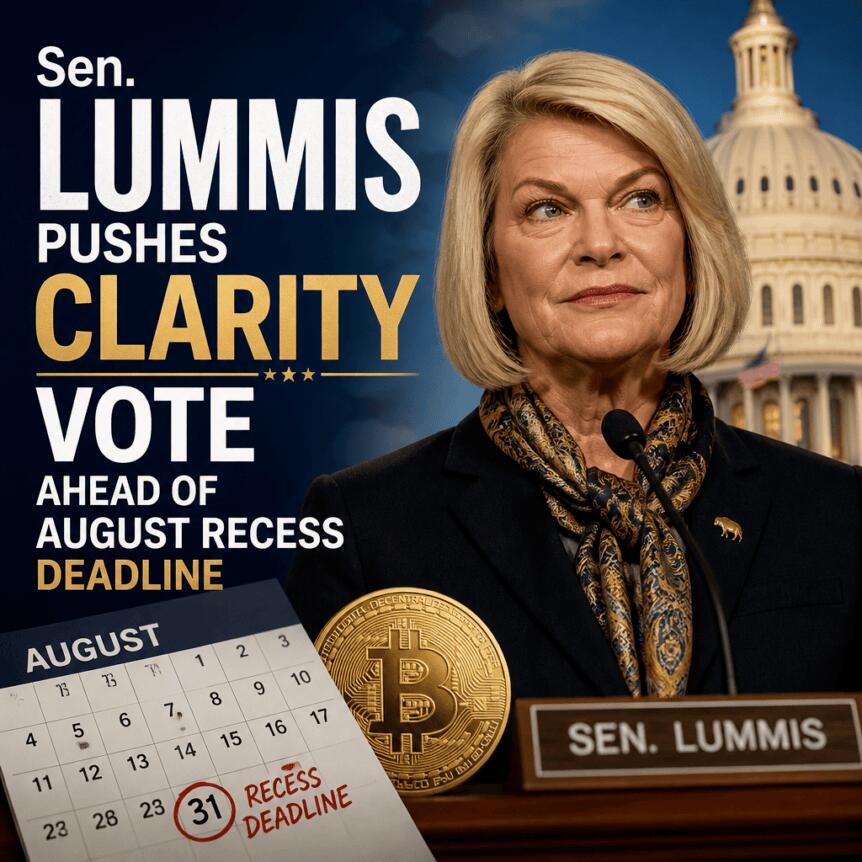
With the Senate poised to go on recess in days, momentum for the US crypto market structure bill—known as the Digital Asset Market Clarity (CLARITY) Act—is starting to look increasingly constrained. Senator Cynthia Lummis, one of the bill’s most visible champions, said she expects lawmakers to place the measure on the calendar before the chamber breaks for its month-long August recess.
The timing matters because the window for a comprehensive vote appears to be narrowing. According to Democrats’ posted Senate schedule for Wednesday, there was no CLARITY vote listed at the time of the announcement—leaving only a small number of business days to resolve key procedural hurdles and political disputes.
Key takeaways
- Senator Cynthia Lummis says she expects a Senate vote on the CLARITY Act before the chamber’s month-long August recess.
- Democrats’ Senate schedule posted for Wednesday showed no CLARITY vote, heightening uncertainty over whether leadership will call one soon.
- The bill needs 60 votes in the Senate to overcome a filibuster via cloture—an additional threshold beyond simple majority support.
- Opposition persists, including among some Democrats seeking stronger ethics rules tied to US President Donald Trump’s digital-asset-related disclosures.
- At least one Republican lawmaker, Josh Hawley, has reportedly signaled he would not support the bill without further changes related to bank concerns.
Why the August recess deadline is becoming decisive
In an X post on Wednesday, Lummis indicated she anticipated the Senate would vote on the CLARITY Act before it leaves Washington for the month-long August recess. The bill has been a focal point of division across Congress and the broader crypto industry, largely due to disagreements over ethics provisions, stablecoin rules, and how tokenized securities should be treated under US law.
Those divisions are not new. The CLARITY Act moved through the House in July 2025, passing 294–134, but it has faced heightened scrutiny in the Senate. Now, procedural time is tightening: after Friday, the Senate is set to be out until mid-September, which effectively pushes final consideration of the measure into the lead-up to the 2026 midterm elections.
Procedural math: the 60-vote cloture hurdle
Even if leadership schedules a vote, passage would still require Senate Democrats and Republicans to clear the chamber’s filibuster rules. As described in the reporting cited here, the CLARITY Act would need 60 votes to invoke cloture and allow the bill to advance—meaning it cannot rely solely on party-line support.
As of Wednesday, a calendar posted by Senate Democrats reportedly showed no CLARITY vote scheduled. That detail is significant because the Senate majority leader—John Thune—would generally be the lawmaker with the authority to determine whether and when to schedule such a vote. Reports indicate Thune was still planning to bring it up before Saturday, but the lack of an immediately visible slot adds uncertainty for lawmakers and market participants watching the bill’s trajectory.
Ethics and disclosure concerns remain a major sticking point
Opposition to the CLARITY Act in the Senate has centered on ethics provisions and how they would apply to the president’s financial interests. Earlier reporting noted that some Democrats want stronger ethics language before supporting the bill.
That position is tied to additional scrutiny of President Donald Trump following disclosures that he earned more than $1.4 billion from investments linked to digital assets in 2025. While the Senate debate is ultimately about statutory language, the underlying political dynamic is straightforward: lawmakers who want firmer guardrails around conflicts of interest appear unwilling to move forward without changes they believe meaningfully strengthen ethics protections.
In other words, the bill’s fate is not just about technical regulatory design. It’s also about whether enough senators conclude that the legislation’s safeguards—and their enforceability—are robust enough for the political moment.
Stablecoin compromises, bank concerns, and possible Republican holdouts
Supporters point to progress already made. According to earlier coverage cited in the source material, lawmakers reached a compromise with banking groups on an issue involving stablecoin yield. However, the same reporting suggests the compromise has not ended the fight—some industry leaders and legislators have continued pushing for provisions requiring crypto companies to be subject to licensing and restrictions comparable to those applied to banks.
Separately, Politico reported that Senator Josh Hawley would withhold support unless the bill addresses concerns from banks. If a senator like Hawley follows through on that approach, it could reduce the bill’s already narrow path to cloture—especially given the 60-vote requirement.
The tension here is between two competing visions of how much regulatory alignment crypto should have with existing financial infrastructure. The stablecoin yield compromise indicates that negotiation has been possible, but the persistence of bank-related licensing and restriction questions suggests that core disagreements still remain.
What happens if the bill slips past recess
If CLARITY does not get scheduled and voted on before the Senate breaks, consideration likely shifts into a more politically charged period. After the recess, lawmakers return in mid-September, and attention will inevitably start to intensify as the 2026 midterms approach. That does not guarantee the bill dies, but it changes the incentives: leadership and members may be less willing to spend scarce floor time on a measure that still lacks the vote count to clear cloture comfortably.
Readers should also watch whether Thune publicly commits to a scheduling plan and whether additional amendments—particularly around ethics provisions and bank-related concerns—move the bill closer to a coalition with at least 60 votes in the Senate.
For now, the key variable is simple: whether leadership can secure enough votes fast enough to overcome the cloture threshold before recess removes the Senate’s near-term momentum. Even small changes in support could matter, but the clock is already tightening around the prospects for a final push.
https://www.cryptobreaking.com/sen-lummis-pushes-clarity-vote/?utm_source=blogger%20&utm_medium=social_auto&utm_campaign=Sen.%20Lummis%20Pushes%20CLARITY%20Vote%20Ahead%20of%20August%20Recess%20Deadline%20
Comments
Post a Comment