
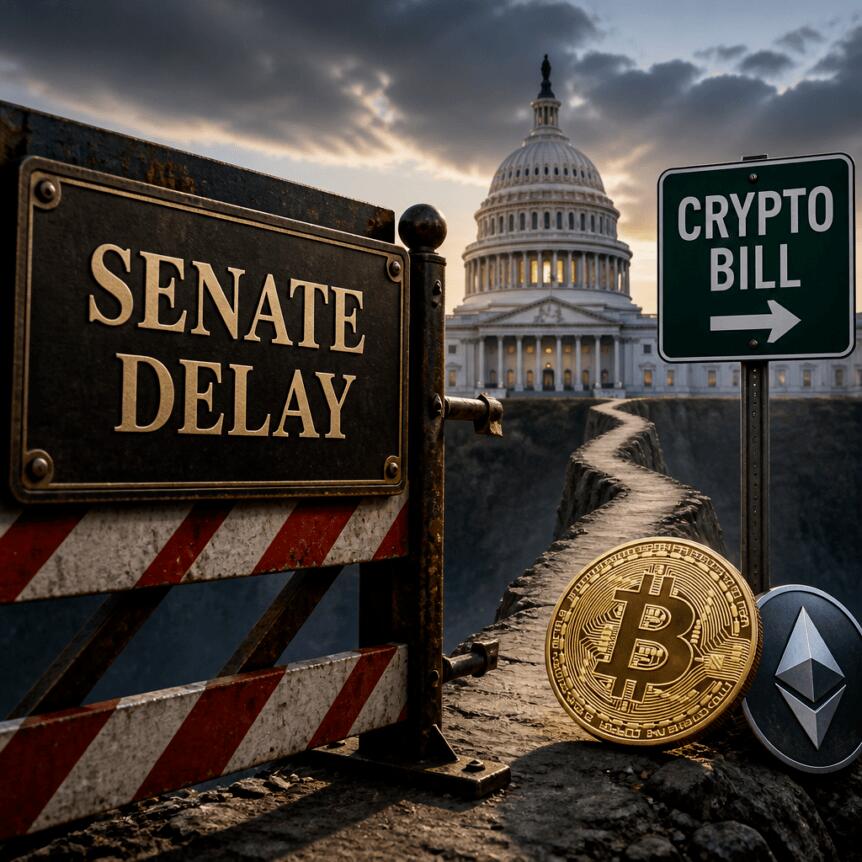
Majority Leader John Thune has moved the US Senate toward a potential September vote on the Digital Asset Market Clarity (CLARITY) Act, using a cloture filing that would allow the sweeping crypto market-structure bill to be considered on the Senate floor. The measure is now set to face a tight procedural and legislative timeline once lawmakers return from a month-long recess.
However, the path to final passage remains uncertain. Senate Democrats and industry stakeholders have flagged key sticking points—including proposed ethics-related language tied to President Donald Trump’s digital-asset connections and additional limits on how crypto firms may offer stablecoin rewards. Even if cloture happens in September, the Senate could still have only limited time to resolve outstanding disputes before the chamber breaks again ahead of the November election.
Key takeaways
- Thune filed for cloture on the CLARITY Act shortly before the Senate’s August recess, setting up a possible September floor push.
- After lawmakers return on Sept. 14, they would have 14 scheduled session days before another recess tied to the November election calendar.
- Major unresolved issues include ethics provisions involving President Trump’s digital-asset ties and restrictions on stablecoin-reward offerings.
- If the Senate misses its window, election-year dynamics could further complicate negotiations during the next Congress.
A narrow procedural window after the September return
The Senate is expected to return from recess on Sept. 14, with only 14 days scheduled to be in session before the chamber breaks again ahead of the November election. After that pre-election recess, lawmakers would face another gap—followed by additional time before the end of the year—meaning the practical window for resolving disputes over the CLARITY Act could be measured in weeks rather than months.
Thune’s cloture filing is a procedural step that can bring a bill closer to floor consideration, but it does not settle the substantive questions that have delayed action. According to reporting referenced by Cointelegraph, lawmakers had not publicly announced deals on several provisions that remain contentious.
The stakes for market participants are straightforward: CLARITY is intended to create clearer market-structure rules for digital assets by setting out how responsibilities should be allocated across regulators. Without the bill’s passage, companies and exchanges are left navigating a patchwork of existing regulatory approaches and enforcement-driven expectations.
Why the Senate’s unresolved provisions matter
At the center of the political friction are provisions that would shape the compliance landscape and business models for parts of the crypto industry.
Cointelegraph’s coverage notes that the Senate version of the CLARITY Act has drawn attention to ethics language linked to President Trump’s digital-asset ties. Opponents have previously described the measure as enabling “crypto corruption,” a critique that contributed to scrutiny of earlier versions and broader resistance from many Democrats during the bill’s protracted journey.
Another major point of contention involves additional restrictions for crypto companies offering stablecoin rewards. Stablecoin incentives have become a common customer-acquisition and retention tool in parts of decentralized and centralized finance, and limits in this area could affect how issuers and platforms structure programs, marketing, and risk disclosures.
Even if cloture is secured in September, lawmakers would still need time to address these unresolved elements before a potential floor vote—and the calendar may not provide enough runway to find compromises acceptable to both chambers.
How election-year uncertainty could reshape negotiations
The CLARITY Act has already taken more than a year to travel through Congress after the House passed it last year. During that period, the Senate faced multiple disruptions, including more than one government shutdown, along with sustained pushback from within the political system and from industry leaders. Opposition has also been fueled by concerns about conflicts of interest and the ethics framework attached to the legislation, as described in earlier coverage referenced by Cointelegraph.
Looking ahead, a procedural setback in September could carry consequences beyond simple delay. After November, 33 Senate seats and all 435 House seats would be up for election. Election outcomes can significantly affect committee priorities, legislative bandwidth, and which members remain in office—potentially slowing or resetting negotiations into the next Congress.
For investors and operators, election-year uncertainty can be more than a political inconvenience. Regulatory clarity delays often translate into longer periods of compliance experimentation, more reliance on legal interpretations and agency guidance, and greater sensitivity to enforcement risk—even when market activity continues.
Regulators may fill the gap if Congress stalls
With the legislation back in limbo, some market participants are turning their attention to federal agencies—particularly the Commodity Futures Trading Commission (CFTC) and the Securities and Exchange Commission (SEC)—for regulatory signals and rulemaking momentum.
Cointelegraph’s cited reporting indicates that the legislation would be expected to give the CFTC more authority to oversee and enforce rules affecting digital assets. Still, the broader point for the crypto sector is practical: if lawmakers do not finalize CLARITY, agencies have indicated they can move forward through their own rulemaking or enforcement frameworks.
In a July interview highlighted by Cointelegraph, SEC Chair Paul Atkins said the agency was “ready, willing, and able to come out with rules” to address crypto if Congress failed to pass CLARITY. Separately, Cointelegraph cited statements from CFTC Chair Michael Selig in April indicating that the commission was “ready to take responsibility” for oversight—referring to the expectation of legislative passage that would clarify roles.
Both agencies have also reportedly taken steps to coordinate oversight of financial markets, according to Cointelegraph’s reference to a memo describing efforts to align regulatory approaches. That coordination matters because market structure rules can otherwise become fragmented—leading to inconsistent treatment depending on which regulator asserts primary jurisdiction.
In other words, even without CLARITY, market participants may not be waiting in a vacuum. The question is whether agencies’ actions will provide the kind of stability that a comprehensive market-structure law is designed to deliver.
For now, the most important thing to watch is whether the Senate can convert Thune’s cloture filing into actual floor movement during the post–Sept. 14 schedule—while negotiations continue over ethics and stablecoin-reward provisions; if that narrow window closes, both the political calendar and regulator-driven rulemaking could become the main determinants of how quickly compliance expectations evolve.
https://www.cryptobreaking.com/senate-delay-leaves-crypto-bill/?utm_source=blogger%20&utm_medium=social_auto&utm_campaign=Senate%20Delay%20Leaves%20Crypto%20Bill%20With%20a%20Tight%20Path%20to%20Passage%20
Comments
Post a Comment