
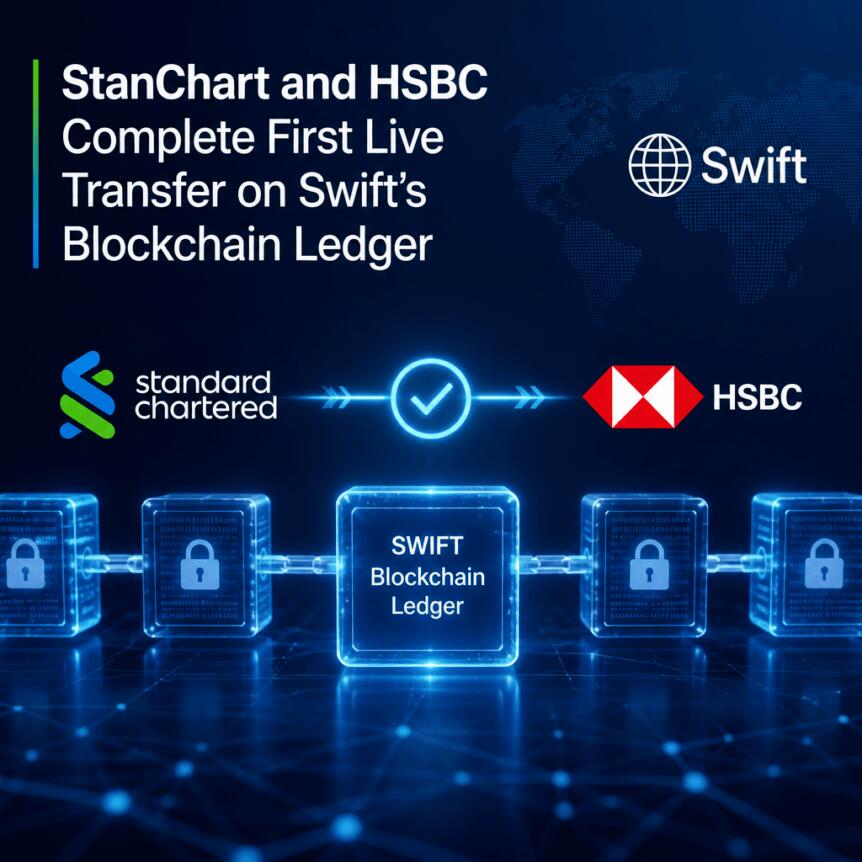
Standard Chartered and HSBC have completed what they describe as the first live cross-border transaction using Swift’s blockchain-based ledger, marking an early interoperability milestone for banks experimenting with tokenized deposits. The test took place about a month after Swift said the ledger was ready for initial use.
According to the details of the transaction, payment messages were exchanged between the two banks via Swift’s ledger, while the resulting obligations were recorded on HSBC’s Tokenised Deposit Service and StanChart’s tokenized deposit infrastructure. Swift’s ledger then acted as an orchestration layer—matching and netting obligations between the banks before final settlement through existing payment systems.
Key takeaways
- HSBC and Standard Chartered report the first live cross-border trade on Swift’s blockchain-based ledger.
- Swift’s ledger is positioned as an orchestration and netting layer, with settlement still tied to existing payment infrastructure.
- The test builds on Swift’s July announcement that 17 banks would pilot live transactions using tokenized deposits.
- The approach targets 24/7 cross-border settlement while keeping established compliance, risk, and settlement controls in place.
- Interoperable tokenized deposits are increasingly being tested across jurisdictions, with broader industry trials also underway.
What happened in the first live transaction
Swift’s blockchain-based ledger is designed to connect tokenized deposits issued on separate bank infrastructure. In the live transaction between HSBC and Standard Chartered, the mechanics were centered on messaging, obligation recording, and settlement orchestration rather than a full replacement of the banks’ existing settlement rails.
Rather than moving funds end-to-end solely on-chain, the transaction used Swift’s ledger to handle the exchange of payment messages between the banks. The obligations that resulted from those messages were captured within each bank’s own tokenized deposit setup—HSBC’s Tokenised Deposit Service for HSBC and Standard Chartered’s tokenized deposit infrastructure for StanChart.
Swift’s ledger then netted and matched the obligations between the two counterparties, after which settlement proceeded through existing payment systems. That structure is significant for banks that want faster and more continuous execution without abandoning the operational, legal, and risk frameworks already embedded in traditional payment workflows.
How Swift’s ledger fits into the broader tokenized-deposit push
The live report follows Swift’s July announcement that its blockchain-based ledger was ready for initial use. Swift said it would support a pilot involving 17 banks spanning six continents, preparing to conduct live transactions using tokenized deposits.
The banks named as part of that pilot include Citi, BNP Paribas, BNY, Wells Fargo, UBS, MUFG, DBS, and ANZ, alongside HSBC and Standard Chartered. Swift has framed the ledger as a way to enable interoperability between tokenized deposits across different institutions, while still respecting the settlement, compliance, and risk controls that financial institutions require.
For investors and market participants watching the “tokenization” trend, the key signal is not only that banks are testing digital assets, but that they’re working toward connectivity between separate tokenized systems. Interoperability is often the hardest problem: tokenized value can exist inside a silo, but cross-border payment usefulness rises substantially when institutions can transact across siloed infrastructures.
Why orchestration and netting matter for adoption
Swift describes its ledger as an orchestration layer that matches and nets obligations before final settlement. That design choice can reduce the operational complexity of cross-border payments between different tokenized deposit environments—each bank can maintain its own infrastructure while relying on Swift’s ledger to coordinate the interaction.
The emphasis on netting also reflects a practical reality: cross-border payment systems must handle large numbers of transactions without turning every transfer into a fully independent settlement event. By pairing messaging with netting, banks can potentially reduce friction and execution overhead—while still settling obligations via established payment rails.
Swift’s positioning is also relevant to a wider debate in crypto-adjacent payments about how far blockchain should be used in the payment stack. This pilot suggests a hybrid direction: blockchain-based infrastructure for coordination and continuity, alongside conventional settlement processes where required.
Industry momentum beyond Swift’s pilot
The Swift-anchored cross-border transaction is occurring as other major institutions pursue tokenized deposit and “real-value” settlement trials.
HSBC previously indicated plans to expand its Tokenised Deposit Service to corporate clients in the US and UAE in the first half of 2026, building on deployments in Hong Kong, Singapore, the UK, and Luxembourg. The service was also launched in the US in April, with coverage for eligible corporate and institutional clients seeking 24/7 domestic and cross-border transfers using tokenized deposits.
Standard Chartered has participated in broader efforts to test tokenized bank money across institutions. In July, it was among 28 financial institutions and central banks involved in the Bank for International Settlements’ Project Agorá, which conducted real-value settlement trials using tokenized commercial bank deposits and central bank reserves across six currencies.
Meanwhile, the US payments landscape is also moving toward connectivity between legacy systems and tokenized rails. The Clearing House has reportedly discussed plans to launch a tokenized deposit network in the first half of 2027, connecting traditional payment networks with digital asset infrastructure for around-the-clock settlement.
Taken together, these efforts point to a broader pattern: rather than treating tokenized deposits as isolated experiments, major players are working toward networks and coordination layers that can make tokenized money function across boundaries—geographic, institutional, and regulatory.
Next, market participants will want to track how quickly the Swift ledger pilot expands beyond initial counterparties, and whether additional banks can complete similar end-to-end workflows with the same level of operational readiness—particularly around reliability, compliance processes, and how netting and orchestration behave as transaction volumes increase.
https://www.cryptobreaking.com/stanchart-and-hsbc-complete-first/?utm_source=blogger%20&utm_medium=social_auto&utm_campaign=StanChart%20and%20HSBC%20Complete%20First%20Live%20Transfer%20on%20Swift’s%20Blockchain%20Ledger%20
Comments
Post a Comment