
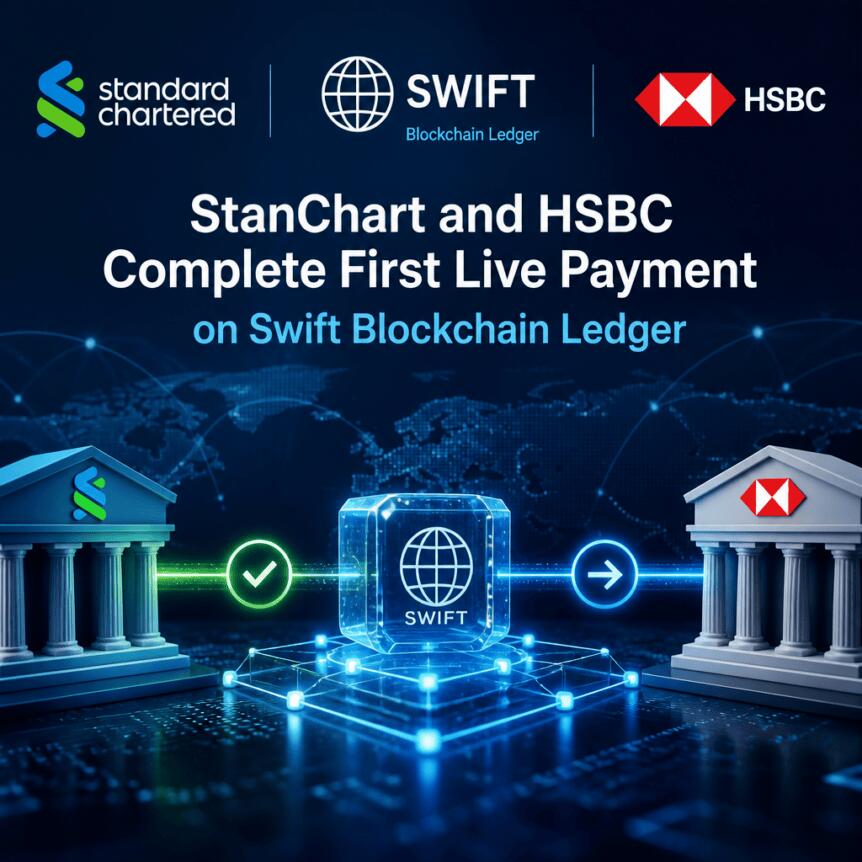
Standard Chartered and HSBC have completed the first live cross-border transaction using Swift’s blockchain-based ledger, marking an early proof that tokenized deposit systems from different banks can interoperate in real time. The demonstration comes roughly a month after Swift said its ledger was ready for initial use.
According to Swift’s description of the approach, the test relied on payment messages exchanged between the two banks through the ledger. The resulting obligations were recorded on HSBC’s Tokenised Deposit Service and StanChart’s tokenized deposit infrastructure, while Swift’s ledger served as an orchestration layer—matching and netting the obligations before settlement was completed through existing payment channels.
Key takeaways
- HSBC and Standard Chartered have executed the first live cross-border transaction on Swift’s blockchain-based ledger.
- Swift’s ledger was used to orchestrate, match, and net obligations between different banks’ tokenized deposit systems before final settlement.
- The workflow is designed to preserve banks’ existing settlement, compliance, and risk controls rather than replace them.
- The move follows Swift’s July announcement that a pilot with 17 banks across six continents was preparing to run live transactions using tokenized deposits.
How the ledger-based payment run worked
The core idea behind Swift’s blockchain-based ledger is interoperability: connecting tokenized deposits issued on separate bank infrastructure so that cross-border payments can operate more continuously. In this live transaction, payment messages were exchanged between HSBC and Standard Chartered via the ledger, and the banks’ respective tokenized systems captured the obligations created by that messaging.
Swift characterized the ledger as an orchestration layer rather than a replacement for settlement rails. In the described process, the ledger helps match and net what each party owes to the other. Settlement then proceeds through existing payment systems, reflecting a hybrid design aimed at reducing operational friction while keeping established governance and controls intact.
Why this matters for tokenized deposits
Banks have been testing tokenized bank deposits for a range of use cases, but interoperability remains the major hurdle. Tokenized deposits can improve settlement speed and enable more flexible payment flows, yet meaningful progress depends on whether institutions can connect their systems across jurisdictions and counterparty networks.
Swift’s ledger approach targets that gap by acting as a shared orchestration mechanism. The result, if the pilot continues to demonstrate reliability at scale, is a pathway toward 24/7 cross-border payment capability without forcing each bank to abandon its existing settlement processes, compliance frameworks, or risk management procedures.
That “connect without replacing everything” philosophy is a key distinction from proposals that attempt to rebuild the full payment stack end-to-end. It also helps explain why interoperability-focused pilots have gained momentum alongside stablecoins and other digital settlement narratives: regulators and risk teams may be more comfortable with incremental changes that preserve familiar guardrails.
The timeline: from Swift’s pilot plans to a first live run
The transaction follows Swift’s July announcement that its blockchain-based ledger was ready for initial use and that 17 banks across six continents were preparing to pilot live transfers. The pilot group included Citi, BNP Paribas, BNY, Wells Fargo, UBS, MUFG, DBS, and ANZ, alongside the institutions involved in this first live cross-border transaction.
Swift also described the ledger as designed to support 24/7 cross-border payments while maintaining existing settlement, compliance, and risk controls. By reporting a first live cross-border transaction only weeks after the ledger’s readiness announcement, Swift and participating banks are effectively moving from planning to operational validation—an important step for any distributed ledger initiative aimed at financial messaging.
Earlier reporting highlighted that the ledger approach would enable banks to connect tokenized deposits issued on separate infrastructures. This first execution between HSBC and Standard Chartered provides a tangible example of how that “connection” can work in practice: obligations are recorded on the banks’ tokenized services, while Swift’s ledger handles the orchestration needed for interoperability.
Broader industry push toward interoperable digital settlement
The Swift-led progress sits within a wider push by financial institutions toward tokenized bank money and networked settlement. In November 2025, HSBC said it planned to expand its Tokenised Deposit Service to corporate clients in the US and UAE in the first half of 2026. The bank also previously launched the service in the US, offering eligible corporate and institutional clients 24/7 domestic and cross-border transfers using tokenized deposits (HSBC’s expansion plan is described in its coverage at Cointelegraph and the related press release is hosted on HSBC’s site).
Standard Chartered has also participated in real-value settlement efforts. In July, it was included among institutions and central banks involved in Bank for International Settlements’ Project Agorá trials, which reportedly settled about $1 million across six currencies using tokenized commercial bank deposits and central bank reserves (as covered by Cointelegraph).
Meanwhile, other industry players are building parallel network concepts. The Clearing House—owned by some large US banks—has been reported to plan a tokenized deposit network in the first half of 2027 intended to connect traditional payment rails with digital asset infrastructure for round-the-clock settlement (details appear in Cointelegraph).
Taken together, these efforts point to a sector trying to standardize interoperability through multiple routes: shared orchestration layers like Swift’s ledger, institution-specific tokenized deposit platforms such as HSBC’s service, and broader network initiatives like those discussed by payments operators. The question for the market is whether these paths converge into interoperable standards—or remain fragmented across separate ecosystems.
For investors, traders, and builders, the next watch is performance and scale: whether further live transactions on Swift’s ledger expand beyond a limited bilateral test, and how quickly participating banks can expand tokenized deposit interoperability across routes while keeping settlement and risk controls aligned with established regulatory expectations.
https://www.cryptobreaking.com/stanchart-and-hsbc-complete-first-2/?utm_source=blogger%20&utm_medium=social_auto&utm_campaign=StanChart%20and%20HSBC%20Complete%20First%20Live%20Payment%20on%20Swift%20Blockchain%20Ledger%20
Comments
Post a Comment