
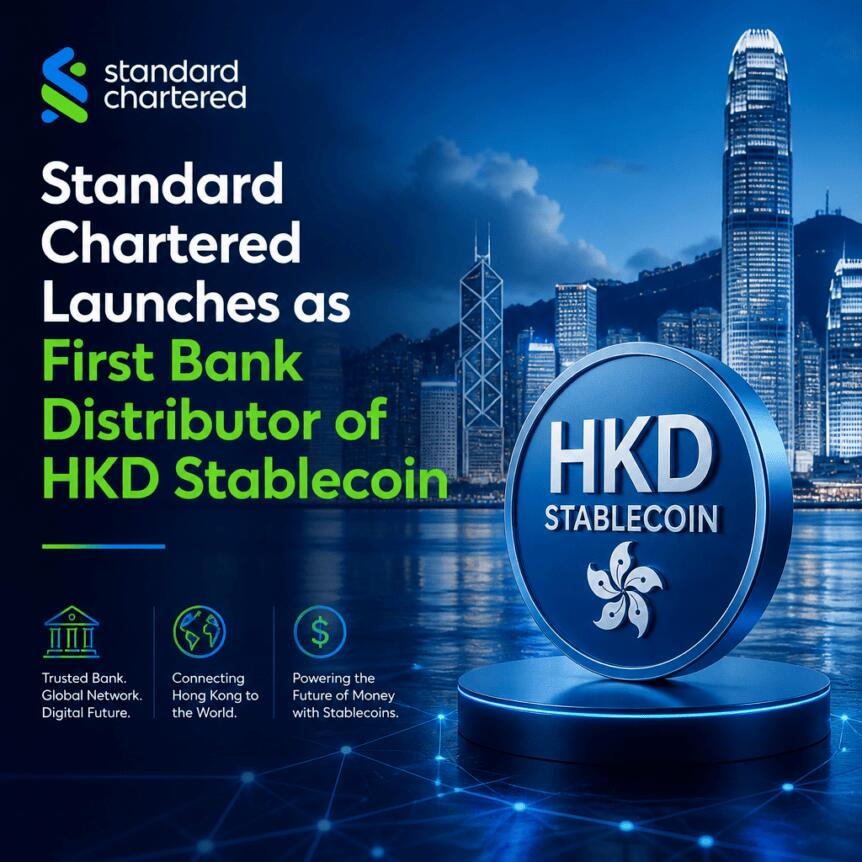
Standard Chartered Bank (Hong Kong) has become the first authorized bank to distribute HKDAP, a regulated Hong Kong dollar-backed stablecoin issued by Anchorpoint Financial. The bank said it is now working with eligible institutional clients and partners as part of a phased rollout, with early use cases focused on tokenized fund settlements, treasury operations and cross-border payments.
Standard Chartered’s announcement comes less than a couple of weeks after Anchorpoint began offering beta access to HKDAP via HashKey Group and OSL. The expansion into a traditional banking distribution channel marks a notable step for firms looking to use stablecoins within regulated financial workflows rather than solely through crypto-native venues.
Key takeaways
- Standard Chartered Bank (Hong Kong) is the first authorized distributor of HKDAP, extending the stablecoin’s reach into conventional banking distribution.
- HKDAP distribution is rolling out in phases, starting with institutional clients and partner-led pilots tied to settlement, treasury, and payments.
- The bank plans HKDAP-linked subscriptions and settlements for tokenized money market funds in the fourth quarter.
- Anchorpoint’s broader licensing and oversight framework is tied to Hong Kong’s Stablecoins Ordinance, including reserve backing, redemption, governance, and AML requirements.
Bank distribution moves from sandbox to mainstream channels
In its announcement, Standard Chartered Bank (Hong Kong) said it is engaging eligible institutional clients and partners on practical applications for HKDAP. According to the bank, the initial focus areas include tokenized fund settlements, treasury operations, and cross-border payments, which generally require reliability, clear operating procedures, and strong compliance controls.
The move also expands HKDAP’s distribution footprint beyond the beta access routes already provided through HashKey Group and OSL. Standard Chartered characterized the rollout as phased, and it added that it expects to introduce new commercial applications over the coming months.
For market participants, the key shift is where stablecoin access is landing. While stablecoins often circulate via exchanges, OTC desks, and other crypto infrastructure, a bank-authorized distribution channel can simplify onboarding for institutions that prefer established compliance and settlement pathways.
Planned use cases: tokenized money markets and internal settlement
Standard Chartered outlined several specific near- and mid-term applications for HKDAP. The bank said it intends to offer HKDAP-based subscriptions and settlements for tokenized money market funds with both international and local asset managers in the fourth quarter. In addition, it plans to use the stablecoin for intragroup settlements across its banking network in the near term.
The bank’s near-term intragroup settlement plan matters because it targets a high-frequency, process-driven environment where operational efficiency and reconciliation are central. Stablecoins, when paired with regulated licensing and redemption mechanisms, can reduce friction in value transfer and settlement timing—at least in theory and in early pilots—though outcomes will depend on how counterparties and internal systems integrate.
Standard Chartered also positioned the distribution as a way for eligible clients to access HKDAP through a regulated banking channel, tying stablecoin usage to payments, settlement and treasury management activities.
Anchorpoint’s licensing trajectory under Hong Kong’s stablecoin framework
HKDAP is issued by Anchorpoint Financial, an entity created as a joint venture involving Standard Chartered’s Hong Kong arm, telecommunications company HKT, and Web3 investment company Animoca Brands. Standard Chartered is the largest shareholder, and Anchorpoint operates as a subsidiary of the bank.
Earlier in the process, the partners announced plans for an HKD-backed stablecoin in February 2025, after participating in the Hong Kong Monetary Authority’s (HKMA) stablecoin issuer sandbox that began in July 2024. By August 2025, they formally established Anchorpoint Financial and moved toward obtaining an issuer license.
Hong Kong’s regulatory groundwork is anchored in the Stablecoins Ordinance, which took effect on Aug. 1, 2025. Before that date, the HKMA issued supervisory guidelines and published a public register of licensed issuers—elements designed to create transparency around who can legally operate within the framework.
On April 10, the HKMA granted what were described as the first stablecoin issuer licenses, including to Anchorpoint and HSBC’s Hong Kong banking arm. The licensing process is governed by requirements aimed at reserve backing, redemption, governance, and Anti-Money Laundering (AML) controls.
Against this backdrop, Standard Chartered’s role now shifts from participation in a licensing regime to actively distributing a regulated stablecoin. In other words, the story is no longer only about whether issuers can meet regulatory standards—it’s also about whether established financial institutions can deploy stablecoin rails for real financial products.
Regulated stablecoins vs. the risk of impersonation
Hong Kong’s push for regulated stablecoins has also been accompanied by public warnings about counterfeit or unauthorized assets. Earlier coverage from Cointelegraph noted that Hong Kong warned of fake stablecoins impersonating HSBC and Anchorpoint. That serves as a reminder that even as regulation improves legitimacy, end-users and institutions still need clear verification steps when evaluating stablecoin products and counterparties.
With Standard Chartered now distributing HKDAP through a conventional banking channel, the primary value for institutional users may be reduced uncertainty around compliance status and operational legitimacy—assuming integration and custody arrangements remain tightly aligned with the licensed framework.
Investors and market participants will likely watch how quickly HKDAP moves from institutional pilots into broader tokenized fund workflows, and whether the planned Q4 subscriptions and settlements for tokenized money market funds come to fruition as described. The next signal to monitor is the pace and scope of additional “commercial applications” Standard Chartered expects to introduce, since that will indicate how much regulatory-ready demand exists beyond initial settlement and treasury use cases.
https://www.cryptobreaking.com/standard-chartered-launches-as-first/?utm_source=blogger%20&utm_medium=social_auto&utm_campaign=Standard%20Chartered%20Launches%20as%20First%20Bank%20Distributor%20of%20HKD%20Stablecoin%20
Comments
Post a Comment