
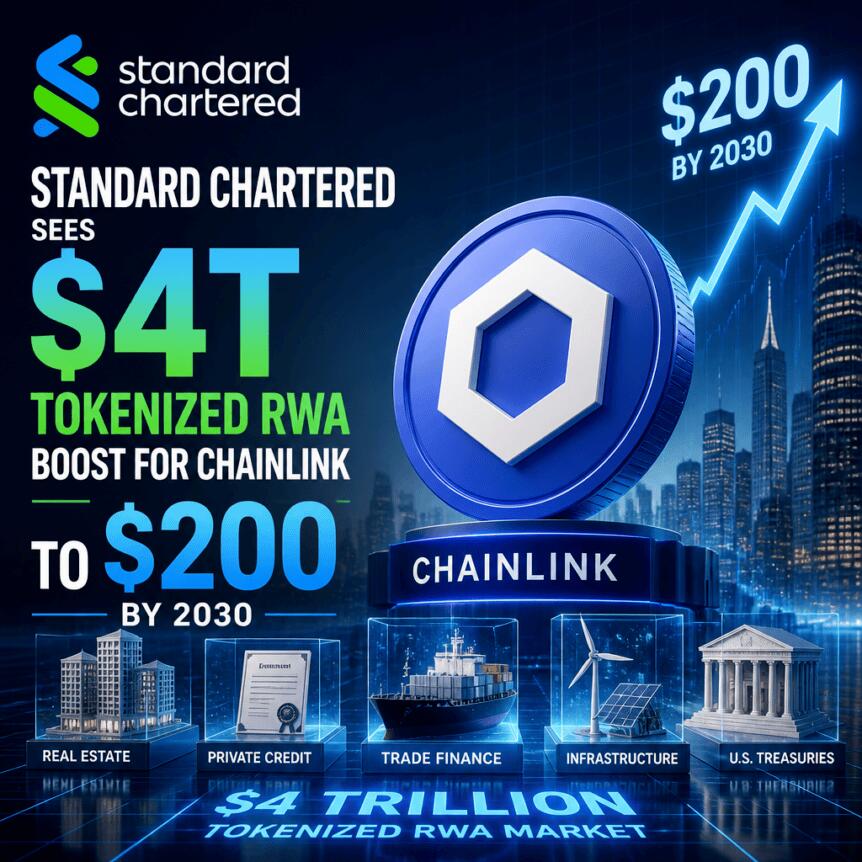
Standard Chartered’s Geoff Kendrick has laid out a bullish long-term case for Chainlink (LINK), tying potential LINK growth to the expanding tokenization of real-world assets (RWAs) and the infrastructure needed to make those assets work reliably on-chain.
In a report shared with Cointelegraph, Kendrick forecast that tokenized RWAs could reach $4 trillion by the end of 2028—creating a larger market for secure, verifiable external data. He argues this could translate into a major increase in Chainlink’s fee generation and ultimately push LINK to as high as $200 by the end of 2030, up from roughly $8 at the time of the report.
Key takeaways
- Standard Chartered expects tokenized RWAs to grow to $4 trillion by the end of 2028, expanding demand for secure on-chain data services.
- Kendrick links that demand to increased fee generation for Chainlink and a potential LINK price target of $200 by 2030.
- The forecast also projects tokenized and crypto-native decentralized finance (DeFi) assets rising to $2.7 trillion by 2030.
- Risks to the forecast include slower-than-expected institutional tokenization, competitive pressure from other oracle providers, and possible technical setbacks.
Why tokenized RWAs could boost oracle demand
Kendrick’s central point is that tokenized assets require more than just on-chain execution—they need trusted external information to be brought securely to blockchains. He said the growth of tokenized RWAs would increase the need for external data delivered “securely onchain,” which could support higher fee generation for Chainlink.
The report frames Chainlink as a key infrastructure layer for that process. By Kendrick’s account, tokenized ecosystems will need dependable data feeds, interoperability across networks, privacy-preserving compliance, and integration with established financial systems—requirements that he argues only Chainlink is currently positioned to provide.
From DeFi growth to a larger “data plumbing” market
The bullish thesis extends beyond RWAs. Standard Chartered also forecast a 37-fold increase in tokenized and crypto-native assets deployed in DeFi, projecting such assets could reach $2.7 trillion by the end of 2030.
That matters because DeFi participation often depends on continuous access to verified information—whether for pricing, settlement conditions, risk parameters, compliance-related checks, or cross-chain interoperability. Kendrick suggested these use cases will require trusted data delivery, privacy-preserving compliance, and system-to-system integration, creating broader demand for oracle services across multiple DeFi and tokenization workflows.
Signals from the market: tokenized RWA volumes are rising
The report arrives as on-chain tokenized-asset activity continues to expand. Cointelegraph noted that tokenized RWA trading on decentralized exchanges reached a new all-time high of $141 billion in July, according to CryptoRank data cited in the article. The same dataset indicated this represented a 19.5% month-over-month increase, with public equities identified as a major driver.
While a single month of DEX trading volume doesn’t automatically translate into future oracle revenue, it does reinforce the direction of travel: more tokenized assets are being traded onchain, and that usually implies a larger ecosystem of issuers, exchanges, custody and compliance providers, and the middleware needed to keep systems synchronized and verifiable.
Chainlink’s position—and the caveats
In the same coverage, Chainlink was described as the leading decentralized oracle provider for cross-chain communication, with $34.4 billion in total value secured, while Chronicle was cited as second with $7.36 billion. Those figures were attributed to DefiLlama’s oracle data.
At the same time, Standard Chartered’s Kendrick stressed that the LINK price path to his $200 target is not guaranteed. In the report, potential risks include slower-than-expected institutional tokenization efforts, competition from specialist oracle providers, and potential technical setbacks that could affect performance or adoption.
For investors and builders, the practical takeaway is that the thesis depends on execution on multiple fronts: tokenization must scale, institutional participants must move beyond pilots, and the required data and compliance tooling must work smoothly at real-world volume. If any of those steps stall, the timeline—and the magnitude—of the projected LINK upside could be pressured.
Readers should watch next how tokenized asset issuance and DEX/DeFi deployment evolve through the remainder of the decade, and whether oracle competitors gain traction. The most important variable will likely be whether tokenization growth keeps translating into sustained, verifiable on-chain data demands—the same mechanism Standard Chartered’s forecast is built on.
https://www.cryptobreaking.com/standard-chartered-sees-4t-tokenized/?utm_source=blogger%20&utm_medium=social_auto&utm_campaign=Standard%20Chartered%20Sees%20$4T%20Tokenized%20RWA%20Boost%20for%20Chainlink%20to%20$200%20by%202030%20
Comments
Post a Comment