
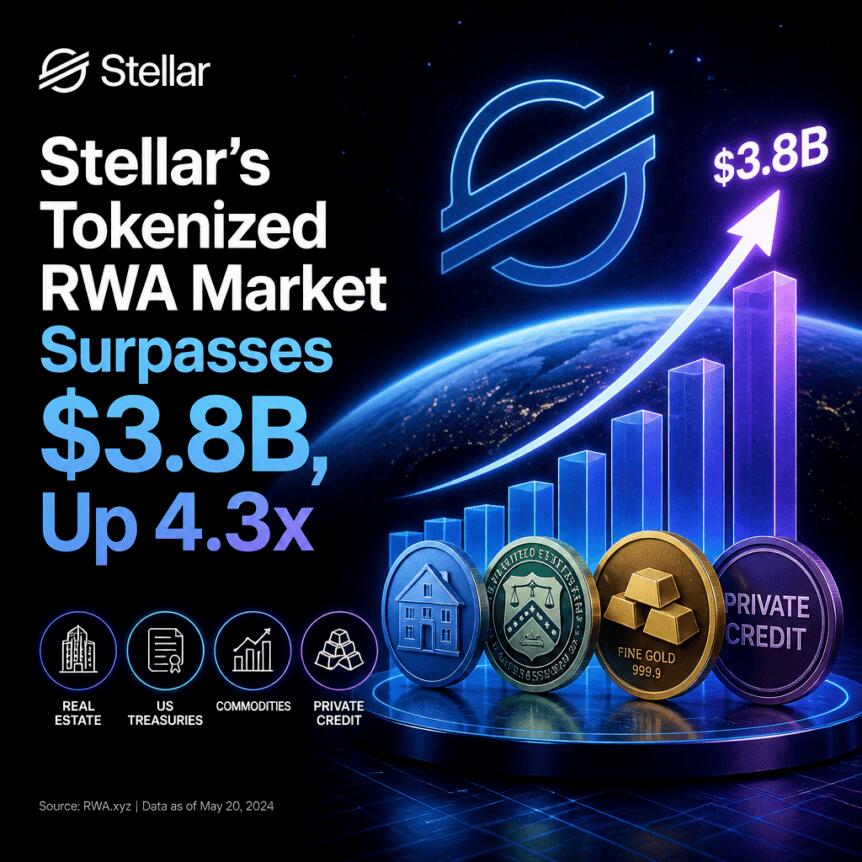
Tokenized real-world assets (RWAs) on the Stellar blockchain have surged to nearly $4 billion in 2026, according to a Dune Analytics dashboard maintained by Stellar. The jump—about 360% over the year—marks a significant acceleration in how major issuers are positioning tokenized debt and government-linked instruments on public chains.
As of Aug. 29, Stellar’s RWA market cap stood at $3.996 billion, spanning US Treasurys, private and public credit, non-US government debt, and other tokenized asset classes. However, the ecosystem’s growth has not been mirrored by Stellar’s native token: XLM is down roughly 11% year to date, trading near $0.18, according to CoinGecko data.
Key takeaways
- Stellar’s tokenized RWA market cap reached $3.996 billion as of Aug. 29, nearly $4 billion after a ~360% rise in 2026, per a Dune Analytics dashboard.
- RWA liquidity and exposure on Stellar remain concentrated: Spiko led with about $1.55 billion, followed by Realiz, Tradable, Franklin Templeton, and Ondo.
- Non-US government debt is gaining traction, with Stellar holding roughly $490 million as of Aug. 20, including tokenized Mexican CETES and Brazilian bonds issued via Etherfuse.
- Institutional integrations are a major driver, including planned DTCC connectivity that could bring tokenized assets to Stellar in the first half of 2027.
- Stellar’s RWA and payment-related expansion is progressing even as XLM underperforms on the year, suggesting broader tokenization momentum isn’t automatically translating into token price strength.
RWA market cap surges toward $4B on Stellar
The Dune Analytics dashboard indicates Stellar’s RWA value grew from $868.8 million at the end of the prior year to nearly $4 billion by late August 2026. The composition reflects the typical early pattern for RWA growth on public networks: a mix of government-linked instruments, credit products, and a smaller set of highly visible issuers.
The market remains skewed toward a handful of participants. As of Aug. 27, Spiko accounted for $1.55 billion of the total RWA value on Stellar, with Realiz at $559 million, Tradable at $548 million, Franklin Templeton at $546 million, and Ondo at $535 million. For investors and developers, the concentration matters: it can accelerate liquidity and credibility when adoption expands, but it also means momentum may be sensitive to changes at a small number of institutions.
Stellar’s overall RWA positioning also ties into broader debt tokenization themes, where on-chain issuance can streamline settlement, distribution, and compliance controls—especially when established financial players already have distribution and custody relationships.
Non-US government debt becomes a noticeable share
While tokenized Treasurys often attract the most attention, Stellar’s data highlights momentum in non-US government instruments. The Stellar Development Foundation pointed to RWA.xyz data, saying Stellar held about $490 million in non-US government debt as of Aug. 20.
That figure includes tokenized Mexican CETES and Brazilian government bonds issued via Etherfuse. The shift is important because it expands the range of sovereign-linked assets accessible on-chain and can broaden demand beyond US-centric portfolios. It also indicates that tokenization pipelines on Stellar are extending into markets where local instruments are packaged for global access.
For participants tracking adoption, the key question is whether these categories keep growing at a similar pace—and whether additional sovereign and quasi-sovereign issuances follow the same onboarding patterns.
Institutional integrations and payments push the pipeline
The RWA expansion aligns with a series of institutional moves aimed at bringing regulated tokenized products onto Stellar infrastructure. One notable thread is DTCC’s plan to connect its tokenization service to Stellar. In May, DTCC announced plans to make tokenized assets available on Stellar in the first half of 2027, with DTC-tokenized assets expected to follow that timeline. Earlier reporting associated the potential expansion with tokenized US Treasurys and broader exposure such as major index ETFs and Russell 1000-related assets.
Another step toward scaling credit offerings came in July. Tokenization platform Tradable said it plans to bring up to $1 billion in private credit assets to Stellar. The integration is designed to support compliance, investor onboarding, and asset lifecycle management, building on Tradable’s already-tokenized private credit of $1.7 billion across nearly 30 positions. That matters because credit products often require more operational work than simpler treasury-style instruments; faster lifecycle handling can reduce friction for issuers and improve the consistency of the user experience.
Stellar’s growth story also extends beyond tokenized securities into regulated dollar remittance and payment rails. In June, MoneyGram launched MGUSD, its dollar stablecoin, on Stellar. The launch allows users to hold dollar-denominated balances and move funds through MoneyGram’s global payments network, adding an everyday utility layer alongside RWA issuance.
MGUSD joins roughly $438 million in reserve-verified stablecoins already issued on Stellar, according to the same Dune dashboard. Taken together, RWA issuance and stablecoin payment capacity can reinforce each other: stablecoin balances can help with settlement and liquidity, while on-chain RWAs can create additional demand for compliant dollar exposure.
Growth in RWAs doesn’t automatically lift XLM
Despite Stellar’s rapid expansion in tokenized assets, the network’s native token has struggled to keep pace. CoinGecko data shows XLM down about 11% year to date, trading near $0.18. This divergence is a reminder that blockchain ecosystem metrics and token performance do not always move together in the short term.
Several dynamics can explain the gap: token price depends on broader market conditions, risk appetite, liquidity, and speculative flows, while RWA growth is often driven by institutional issuance schedules and product onboarding timelines. In other words, increased RWA capitalization is not necessarily the same as increased immediate demand for XLM.
What to watch next is whether upcoming institutional integrations—particularly DTCC’s planned connectivity—lead to faster onboarding of high-profile tokenized products, and whether stablecoin and payment usage continues to expand in parallel with the RWA balance sheet growth.
For readers tracking Stellar, the near-term indicators to monitor are category-level growth within the RWA dashboard (especially non-US government debt), the rollout pace for major institutional integrations expected in 2027, and whether tokenization-driven activity translates into deeper on-chain demand across liquidity and payment flows.
https://www.cryptobreaking.com/stellars-tokenized-rwa-market-surpasses/?utm_source=blogger%20&utm_medium=social_auto&utm_campaign=Stellar’s%20Tokenized%20RWA%20Market%20Surpasses%20$3.8B,%20Up%204.3x%20
Comments
Post a Comment