
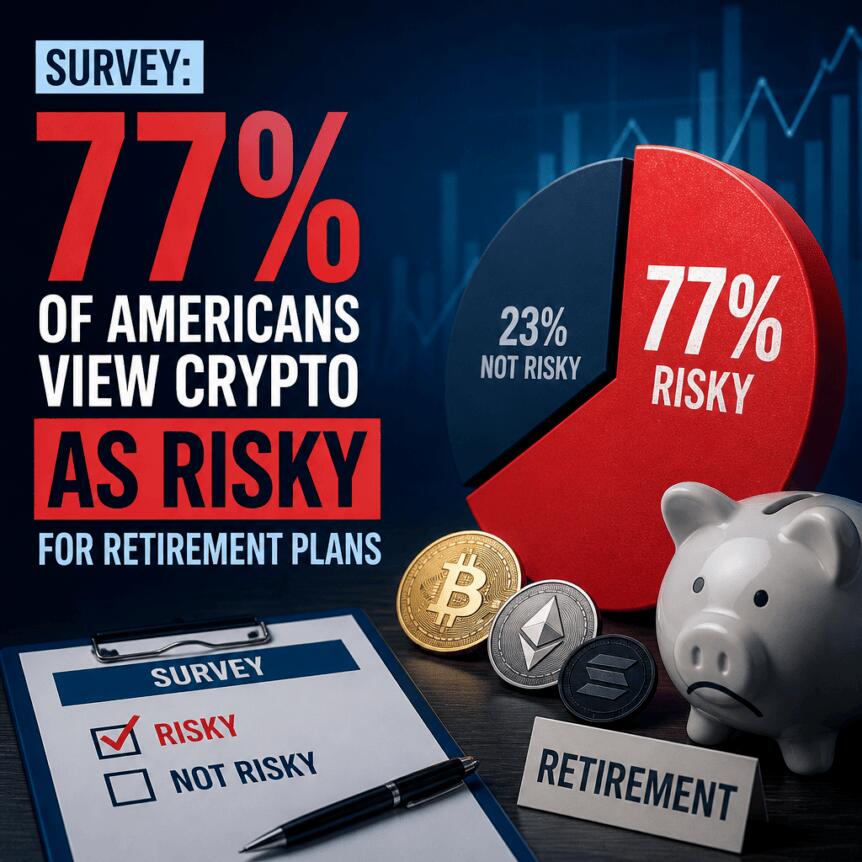
Americans remain highly skeptical about putting cryptocurrency into workplace retirement plans, according to a new survey by the National Institute on Retirement Security (NIRS). The findings arrive as federal regulators and the Trump administration move in the opposite direction—seeking to broaden what employers may offer inside 401(k) and other defined-contribution accounts.
In the NIRS survey, 77% of respondents said crypto in workplace retirement plans is risky, including 46% who called it “very risky.” At the same time, 53% opposed employers offering crypto as an investment option. The results also point to wider anxieties about retirement readiness: 80% said the US faces a retirement crisis (up from 67% in 2020), and 61% expressed concern about achieving financial security in retirement.
Key takeaways
- 77% of Americans view crypto in workplace retirement plans as risky, with 46% calling it very risky.
- 53% oppose employers including crypto in retirement-plan investment menus.
- Retirement insecurity is rising: 80% report seeing a retirement crisis, up from 67% in 2020.
- Policy direction is shifting toward alternatives in 401(k)s, including assets exposed to digital assets.
- Regulatory changes are still contested, with lawmakers warning about volatility and safeguards.
What the NIRS survey suggests about investor psychology
The NIRS report captures a public mood that is not simply about crypto—it is tied to fear about retirement outcomes more broadly. While the survey found substantial resistance to crypto as a retirement holding, it also shows that many respondents believe the underlying system is failing them. According to the report, 61% of respondents are worried they won’t achieve financial security in retirement, and 80% say the US faces a retirement crisis.
Affordability pressures appear to compound that anxiety. The survey found that 68% say it is becoming harder to prepare for retirement, while 77% reported that debt prevents them from saving enough. In that context, skepticism toward crypto may reflect not only risk concerns specific to digital assets, but also a lack of confidence that retirement accounts can reliably deliver stability—especially for people already constrained by debt and household budgets.
The survey was conducted by Greenwald Research between Oct. 24 and Nov. 14, 2025, and included 1,203 Americans aged 25 and older. NIRS states the results were weighted by age, gender and income.
For readers tracking retirement-plan policy, the most important takeaway is the mismatch between public sentiment and the direction of travel in Washington: Americans perceive crypto as an outsized risk inside retirement structures, even as regulators explore mechanisms meant to make alternative assets easier to include.
US regulators step back from “extreme care” language
The broader policy shift began with a change in how regulators frame fiduciary duty for retirement-plan decisions. In May 2025, the US Department of Labor rescinded guidance that had advised 401(k) fiduciaries to exercise “extreme care” when considering cryptocurrency investments. The department replaced that with a more neutral stance, one that neither endorses nor discourages adding crypto to retirement plan investment menus.
The legal and compliance implications of that earlier “extreme care” posture mattered because it could have increased hesitation among plan sponsors and fiduciaries. By moving away from that emphasis, the DOL reduced one potential barrier to offering crypto or crypto-linked products—while keeping fiduciary obligations and plan-level considerations in focus.
The DOL’s subsequent actions continued that shift. In August 2025, the department rescinded 2021 guidance that had discouraged 401(k) fiduciaries from considering alternative assets. It said investment decisions should instead be handled using a neutral, principles-based approach.
Then, in March 2026, the Labor Department proposed rules on how 401(k) fiduciaries could include alternative assets in investment lineups. The proposal included safe harbors intended to reduce litigation risk, while also requiring consideration of factors such as fees, liquidity, valuation and performance. These are precisely the categories lawmakers and critics tend to focus on when arguing that retirement savers may not be adequately protected against under-disclosed risk.
Readers should note that “neutral” fiduciary language does not eliminate responsibility; it changes how regulators expect decisions to be evaluated. Still, the policy tone shift is significant for employers and recordkeepers that must balance compliance risk with the desire to expand plan menus.
Executive order expands access to alternative assets
While the DOL’s guidance changes helped set the stage, the policy momentum accelerated with an executive order signed by President Donald Trump on Aug. 7, 2025. The order was aimed at expanding access to alternative assets in defined-contribution retirement plans, including investment vehicles that hold digital assets. It directed the Labor Department and the US Securities and Exchange Commission to consider regulatory changes that could facilitate that access.
The political thrust of the order is straightforward: rather than limiting retirement-plan exposure to traditional asset classes, policymakers are pushing toward broader menu construction. For investors, this matters because employers control the first gate—what options exist inside a retirement plan often determines what savers can actually allocate to.
At the same time, the order and the later proposed DOL framework land in a social environment where most respondents are already wary of crypto’s fit in retirement accounts. That tension between expanded access and perceived risk is likely to shape how quickly proposals become real-world options, as well as what additional safeguards may be demanded by lawmakers and advocacy groups.
The Labor Department’s March 2026 rules proposal is now at the center of that debate, offering safe harbors for fiduciaries while imposing conditions meant to ensure alternatives are evaluated in structured ways.
Political pushback signals ongoing regulatory uncertainty
The proposed rules have drawn pushback. In June 2026, Sens. Bernie Sanders and Elizabeth Warren and Rep. Bobby Scott urged the Labor Department to withdraw the proposal. Their objection, as described in related coverage, centered on concerns about crypto’s volatility and what they characterized as insufficient investor safeguards.
This is where the mismatch between public sentiment and policymaking could become most consequential. If lawmakers conclude that safe harbors and evaluation requirements do not adequately address real risks to retirement savers, the rules could face delays, revisions, or additional constraints—especially for crypto-exposed products.
In practical terms, plan sponsors may treat the regulatory landscape as unsettled until the final rules clarify what constitutes compliance. Even when the DOL articulates principles-based fiduciary evaluation, the prospect of political scrutiny can influence corporate behavior—particularly where retirement-plan decisions are tied to potential enforcement or litigation risk.
According to the survey results, many Americans already expect retirement crypto to behave like a high-volatility outlier. If policymakers respond by tightening or narrowing eligibility for crypto-related investments, the final shape of retirement-plan access may end up less expansive than proponents originally aimed for.
Going forward, the key things to watch are how the Labor Department’s alternative-asset proposal evolves through the rulemaking process and whether lawmakers insist on additional limits or disclosure requirements specific to crypto-linked products. Until the regulatory framework is finalized, the gap between public skepticism and policy ambition is likely to remain a central feature of the retirement crypto debate.
https://www.cryptobreaking.com/survey-77-of-americans-view/?utm_source=blogger%20&utm_medium=social_auto&utm_campaign=Survey:%2077%%20of%20Americans%20view%20crypto%20as%20risky%20for%20retirement%20plans%20
Comments
Post a Comment