
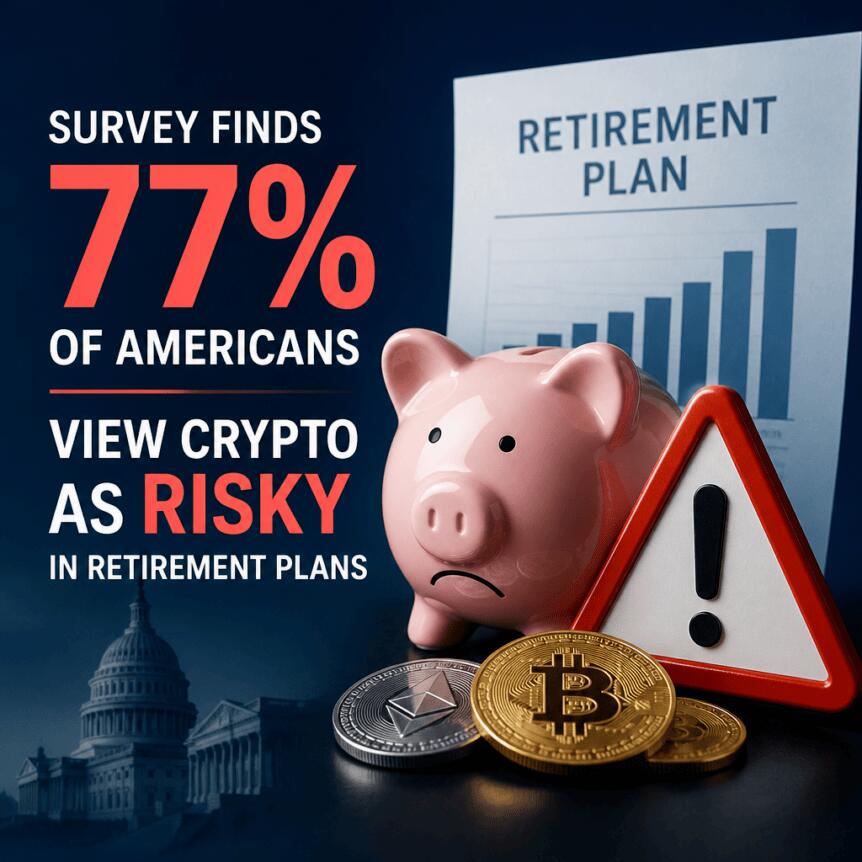
A new survey from the National Institute on Retirement Security (NIRS) finds that most Americans remain wary of including cryptocurrency in workplace retirement plans. The research comes as U.S. policymakers work to broaden the range of alternative assets available in 401(k) and other defined-contribution plans—potentially placing crypto more directly in retirement-savings conversations.
According to the NIRS survey, 77% of Americans view cryptocurrency included in workplace retirement plans as risky, with 46% describing it as “very risky.” In parallel, 53% oppose employers offering crypto as an investment option.
Key takeaways
- 77% of respondents say crypto exposure in workplace retirement plans is risky, including 46% who call it very risky.
- 53% oppose employers adding crypto to retirement plan investment lineups.
- Concerns about retirement security are rising: 80% say the U.S. faces a retirement crisis, up from 67% in 2020.
- Debt and affordability pressures persist: 77% say debt blocks them from saving adequately.
- Regulatory direction is shifting: multiple federal actions have moved away from prior “extreme care” language and toward a framework that may facilitate alternative-asset inclusion.
Survey signals distrust even as retirement pressures mount
The NIRS report ties its crypto findings to broader anxieties about retirement outcomes. 80% of survey respondents said the U.S. faces a retirement crisis—an increase from 67% in 2020—while 61% said they are concerned about achieving financial security in retirement.
Affordability challenges also appear central to the survey’s picture. The research reports that 68% say it is becoming harder to prepare for retirement, and 77% say debt prevents them from saving enough. In that context, investor protection and risk tolerance are likely to remain key fault lines for any plan sponsors considering crypto-like exposures.
The survey was conducted by Greenwald Research between Oct. 24 and Nov. 14, 2025, surveying 1,203 Americans aged 25 and older. Results were weighted by age, gender, and income.
From “extreme care” to neutrality: a policy pivot
While public opinion in the NIRS survey skews negative toward crypto in employer retirement plans, regulatory posture has been moving in the other direction. The NIRS report points to changes under the Trump administration and federal regulators aimed at expanding access to alternative assets in defined-contribution plans.
One turning point came when the U.S. Department of Labor rescinded guidance from May 2025 that had urged 401(k) plan fiduciaries to exercise “extreme care” when considering cryptocurrency investments. In its place, the Department of Labor returned to a neutral approach that neither endorses nor discourages crypto as an investment option.
The policy shift accelerated further after Aug. 7, 2025, when President Donald Trump signed an executive order intended to “democratize access to alternative assets for 401(k) investors.” The order calls for expanding access to alternative assets in defined-contribution retirement plans, including those carried by investment vehicles that hold digital assets, while directing the Labor Department and the U.S. Securities and Exchange Commission to consider regulatory changes.
Labor Department guidance continues to broaden the door
Following the executive order, the Department of Labor also rescinded earlier language. A few days later, it rescinded a 2021 guidance document that had discouraged 401(k) fiduciaries from considering alternative assets, saying investment decisions should instead be assessed through a neutral, principles-based framework.
More recently, the Department of Labor has moved from rescinding older guidance toward outlining how fiduciaries could evaluate alternative assets within plan lineups. In March 2026, it proposed rules describing how 401(k) fiduciaries could include alternative assets—again, with the stated goal of providing structures that reduce litigation risk. The proposal would require fiduciaries to consider factors such as fees, liquidity, valuation, and performance.
Still, the debate is far from settled. The NIRS report notes pushback from lawmakers, including Sens. Bernie Sanders and Elizabeth Warren and Rep. Bobby Scott, who urged the Department of Labor in June to withdraw the proposal. Their objections, as described in earlier coverage from Cointelegraph, cite crypto’s volatility and argue that safeguards for investors are insufficient.
Why the divide matters for retirement investors
The NIRS survey and the ongoing regulatory shift point to a significant mismatch between how Americans perceive crypto risk and how the regulatory framework may evolve around retirement-plan menus.
For plan sponsors and fiduciaries, this gap is likely to shape how proposals land with employers, participants, and policymakers. Even if rules become clearer about what diligence should look like, the core question for retirement consumers is whether crypto exposures align with retirement risk tolerance—especially when the same survey shows many Americans are already struggling with affordability and debt constraints.
For participants, the next phase to watch is whether proposed Labor Department rules finalize in a way that meaningfully changes what employers can offer, and how regulators address the specific concerns raised by lawmakers—particularly around volatility, liquidity, and valuation transparency.
As NIRS data underscores, public skepticism is high; the coming regulatory decisions and any resulting plan changes will therefore be tested not only by legal standards, but by whether they can earn participant trust in the context of retirement security.
https://www.cryptobreaking.com/survey-finds-77-of-americans/?utm_source=blogger%20&utm_medium=social_auto&utm_campaign=Survey%20Finds%2077%%20of%20Americans%20View%20Crypto%20as%20Risky%20in%20Retirement%20Plans%20
Comments
Post a Comment