
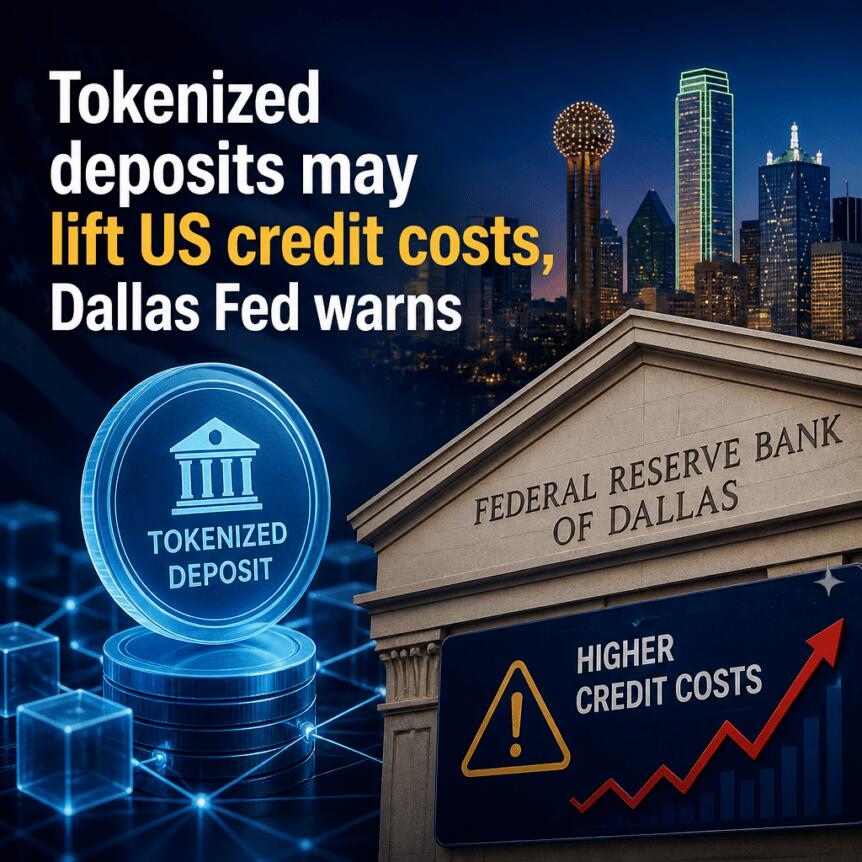
Tokenized bank deposits—made possible by instant settlement and automated transfers—could destabilize bank funding and eventually raise borrowing costs for US households and businesses, according to an analysis by economists at the Federal Reserve Bank of Dallas.
In a report by Rosie Levy and Srini Ramaswamy, the authors argue that technologies enabling deposits to move more quickly between banks would make funding portfolios more sensitive to interest-rate changes. They frame their work as scenario-based modeling rather than a forecast of immediate outcomes, but the conclusions add a new risk lens as the banking sector accelerates shared infrastructure for tokenized settlement.
Key takeaways
- The Dallas Fed economists warn that instant settlement could let depositors chase higher yields faster, increasing deposit “rate sensitivity.”
- In their scenarios, a 10% increase in deposit sensitivity to interest rates could reduce banks’ capacity to hold long-term loans and assets by about $700 billion in 10-year equivalents.
- A separate scenario—deposits staying at banks for 10% less time—could lower that capacity by about $580 billion (also in 10-year equivalents).
- The analysis emphasizes that the figures are not direct, dollar-for-dollar reductions in lending, but reflect changes in banks’ balance-sheet room over time.
- Banks are already building networks intended to move tokenized deposits around the clock while keeping funds within regulated banking channels.
Why tokenized deposits may change bank funding dynamics
Levy and Ramaswamy’s central point is that deposit behavior could shift if tokenized deposits make it easier—potentially near-instantly—for customers to move their money between institutions. They note that programmable “deposit tokens” and automation tools, including agentic artificial intelligence, could reduce the friction typically associated with switching banks.
That, in turn, could affect the stability of deposit funding—a key input for how banks manage long-term lending. Traditional banking relies on the assumption that many depositors do not change banks immediately when yields move. If tokenized settlement shortens the window in which deposits remain with a particular bank, banks may face funding profiles that respond more rapidly to interest-rate changes.
What the Dallas Fed model suggests—interest-rate sensitivity and liquidity trade-offs
To illustrate potential impacts, the economists quantify two hypothetical scenarios. First, they estimate the effect if deposits become 10% more sensitive to interest rates. In their modeling, that increased sensitivity could reduce banks’ capacity to hold long-term loans and other assets by roughly $700 billion, expressed in 10-year equivalents.
Second, they model a situation where deposits remain at banks for 10% less time. Under that scenario, the reduction in banks’ capacity to hold long-term assets is estimated at about $580 billion in 10-year equivalents.
Levy and Ramaswamy stress that these are scenarios designed to capture balance-sheet sensitivity; they do not claim a direct dollar-for-dollar drop in lending. Still, their work connects funding volatility to potential credit tightening pressures: if banks cannot rely on stable deposits, they may need to adjust asset and funding structures to manage risk.
How banks could respond: more liquidity, more wholesale funding
Rather than predicting an inability to lend, the report outlines likely adjustments banks might make when facing more volatile deposits. The authors suggest banks could increase holdings of highly liquid assets—such as reserves and US Treasurys—to ensure they can meet withdrawal or transfer demands.
They also point to the possibility of relying more heavily on term debt to sustain lending portfolios. However, the report indicates that funding loans through wholesale debt could increase credit costs for consumers and businesses, which is where the consumer impact implied by “higher credit costs” enters the analysis.
In other words, even if tokenized deposits do not immediately shrink lending totals, they may alter the cost and structure of funding in ways that propagate to borrowers over time.
Infrastructure is already moving: networks for tokenized deposits and real-world linking
The analysis lands as the banking industry builds mechanisms intended to support tokenized deposits and automated settlement. On Tuesday, 39 US state banking associations formed the BankChain Alliance to develop a nationwide network for tokenized deposits, stablecoins, and automated settlement. Separately, The Clearing House is developing another network backed by major banks including JPMorgan Chase, Bank of America, Citi, BNY, and Wells Fargo.
Beyond broad network planning, banks have also started connecting systems across institutions. On Aug. 20, Standard Chartered and HSBC reported completing a live cross-border transaction using Swift’s blockchain ledger, which linked their respective tokenized-deposit systems and recorded obligations prior to settlement through existing payment infrastructure.
This matters for the Dallas Fed’s thesis because the practical goal of these networks is to enable rapid, potentially continuous movement of deposits within the regulated banking perimeter. The more that implementation reduces settlement delays and operational friction, the more relevant the scenario of increased deposit mobility becomes.
Lessons from instant payments—comparisons and limits
To ground the discussion, Levy and Ramaswamy look to instant-payment systems as a partial analogy. They cite Brazil’s Pix, while noting that it is not identical to tokenized deposits. The report references a 2025 study from Brazil’s central bank that found heavier Pix usage was associated with banks holding more liquid assets and reducing credit intermediation.
That comparison doesn’t prove tokenized deposits will replicate Pix’s effects. But it supports the broader mechanism the Dallas Fed economists emphasize: when money moves faster and more easily, banks may rebalance toward liquidity and away from activities that require stable funding, at least relative to the counterfactual.
What to watch next
As tokenized-deposit networks advance from pilots to wider rollouts, the key unknown is how quickly depositors actually alter behavior when transfers become easier and settlement is effectively “always on.” Investors, borrowers, and regulators should watch whether banks respond primarily by shifting to more liquid asset buffers or by leaning more on term funding—both of which could influence credit conditions and the broader cost of capital.
https://www.cryptobreaking.com/tokenized-deposits-may-lift-us/?utm_source=blogger%20&utm_medium=social_auto&utm_campaign=Tokenized%20deposits%20may%20lift%20US%20credit%20costs,%20Dallas%20Fed%20warns%20
Comments
Post a Comment