
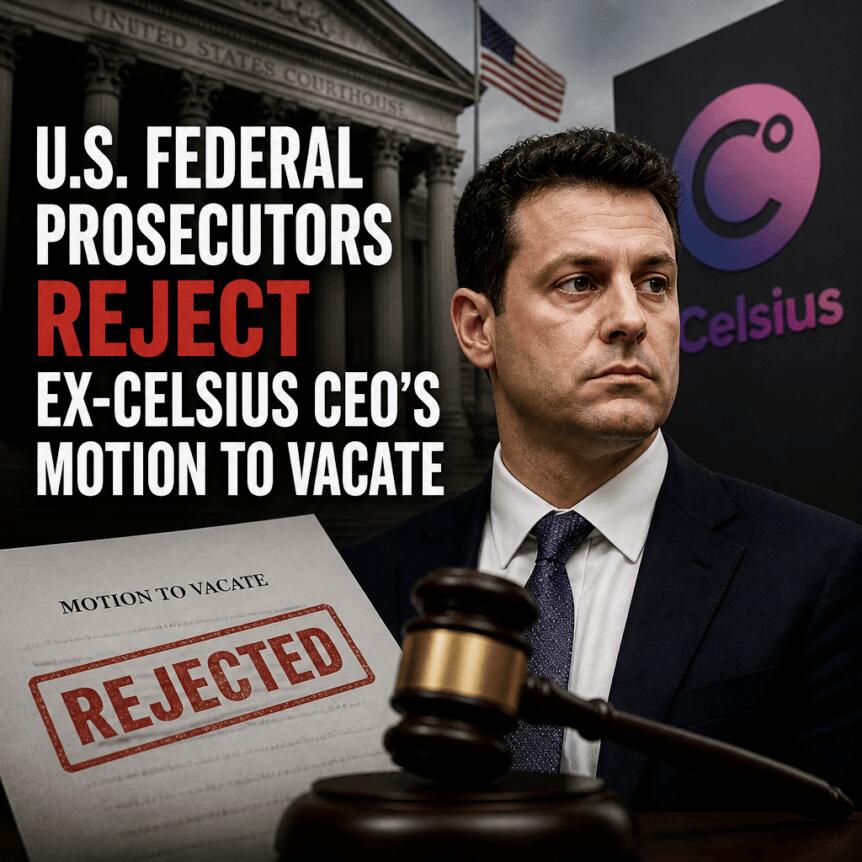
Prosecutors in the Southern District of New York (SDNY) are urging a federal judge to reject Alex Mashinsky’s bid to overturn his 12-year prison sentence tied to Celsius’s collapse. In a Friday filing, SDNY attorneys James McDonald and Allison Nichols argued that Mashinsky’s petition lacks legal substance and should be denied without additional proceedings.
The dispute centers on a motion Mashinsky filed after telling the court in May that he would proceed pro se—representing himself. His petition to vacate the conviction and sentence includes claims that point to matters involving cryptocurrency exchange FTX and his former colleague, Celsius chief revenue officer Roni Cohen-Pavon.
Key takeaways
- SDNY prosecutors asked the court to deny Mashinsky’s motion to vacate, calling multiple arguments “without merit.”
- The government criticized the petition for relying on allegations that were not supported by a sworn declaration.
- Prosecutors disputed claims that Mashinsky received ineffective assistance of counsel.
- Mashinsky is serving a May 2025 sentence of 144 months after pleading guilty to commodities and securities fraud.
- Cohen-Pavon, who prosecutors described as providing “substantial assistance,” was sentenced to time served in May.
Prosecutors reject claims in Mashinsky’s petition
In their filing, prosecutors said Mashinsky failed to meet the threshold for relief. They argued that his motion is essentially a reprise of issues raised during sentencing, rather than a valid basis to undo the conviction or the punishment.
Prosecutors also pushed back on Mashinsky’s complaints about the performance of his legal team. While the filing indicates Mashinsky stops short of asserting factual innocence, it characterizes his approach as shifting blame to counsel for not pursuing certain arguments.
“Mashinsky has not even submitted a sworn declaration in support of these baseless allegations, and his petition should be denied without a hearing or further fact-finding,” prosecutors wrote, adding that the court should not revisit settled points based on unsworn claims.
What the court filing says about evidence and procedure
Mashinsky’s motion was filed after he announced he would take over his own representation. The government’s response suggests the petition’s evidentiary posture is a key weakness: prosecutors singled out the absence of a sworn declaration supporting the allegations.
That procedural detail matters because motions to vacate typically require more than generalized accusations; courts generally look for specific, substantiated grounds for relief. In the government’s view, Mashinsky’s filing did not meet that standard.
As of Tuesday, the judge overseeing the case had not issued a response to the government’s submission.
Background: Celsius collapse, guilty pleas, and sentencing
Mashinsky was sentenced in May 2025 to 144 months in prison after pleading guilty to commodities fraud and securities fraud connected to “manipulative and deceptive devices” at Celsius. The guilty plea followed a broader legal crackdown on Celsius after the platform filed for bankruptcy in 2022 amid a wider market downturn that began with the collapse of Terraform Labs.
Roni Cohen-Pavon—Celsius’s chief revenue officer—was also indicted in 2023 alongside Mashinsky and later pleaded guilty. According to prosecutors, Cohen-Pavon provided “substantial assistance” to the government’s case. In May, she was sentenced to time served.
At sentencing, Mashinsky was ordered to pay $48 million in forfeiture. He also agreed to pay $10 million as part of a separate settlement with the US Federal Trade Commission, alongside arrangements described as including a $47 billion judgment that was suspended.
Earlier coverage also noted related enforcement actions against Celsius leadership, including a separate FTC matter involving Celsius co-founders Leon Goldstein and another defendant, referenced in connection with the broader Celsius fallout.
Regulators still pursuing parallel cases
While the criminal case reached sentencing for Mashinsky and Cohen-Pavon, regulators continued to work through other legal tracks tied to Celsius leadership.
In June, the US Commodity Futures Trading Commission (CFTC) announced that Mashinsky was permanently banned from trading in markets under the CFTC’s authority. That action was described as among the last major resolutions tied to Mashinsky and Celsius following the 2022 collapse.
At the same time, a civil action by the US Securities and Exchange Commission (SEC) involving a co-founder was reported as ongoing even after the criminal case moved forward and the court issued judgment against the platform. As of July 30, the SEC said its attorneys and Mashinsky were “engaged in settlement discussions.” The SEC requested 60 days to file a status report, effectively pushing the next checkpoint toward the end of September.
For investors and market participants, these parallel processes underline a recurring reality in crypto enforcement: criminal cases can conclude on a timetable that differs from regulatory litigation. Even when one front reaches a sentencing milestone, other matters—whether commodities, securities, or consumer-protection—can continue to shape compliance expectations and potential liability.
Readers should watch whether the SDNY judge grants or denies Mashinsky’s request to vacate, and whether the court allows any additional fact-finding or hearings. At the same time, settlement dynamics in the SEC civil matter—and any further regulatory steps following the CFTC’s permanent trading ban—remain key to understanding what outcomes could still materially affect Celsius-related defendants and those watching closely for precedent in crypto enforcement.
https://www.cryptobreaking.com/u-s-federal-prosecutors-reject/?utm_source=blogger%20&utm_medium=social_auto&utm_campaign=U.S.%20Federal%20Prosecutors%20Reject%20Ex-Celsius%20CEO’s%20Motion%20to%20Vacate%20
Comments
Post a Comment