
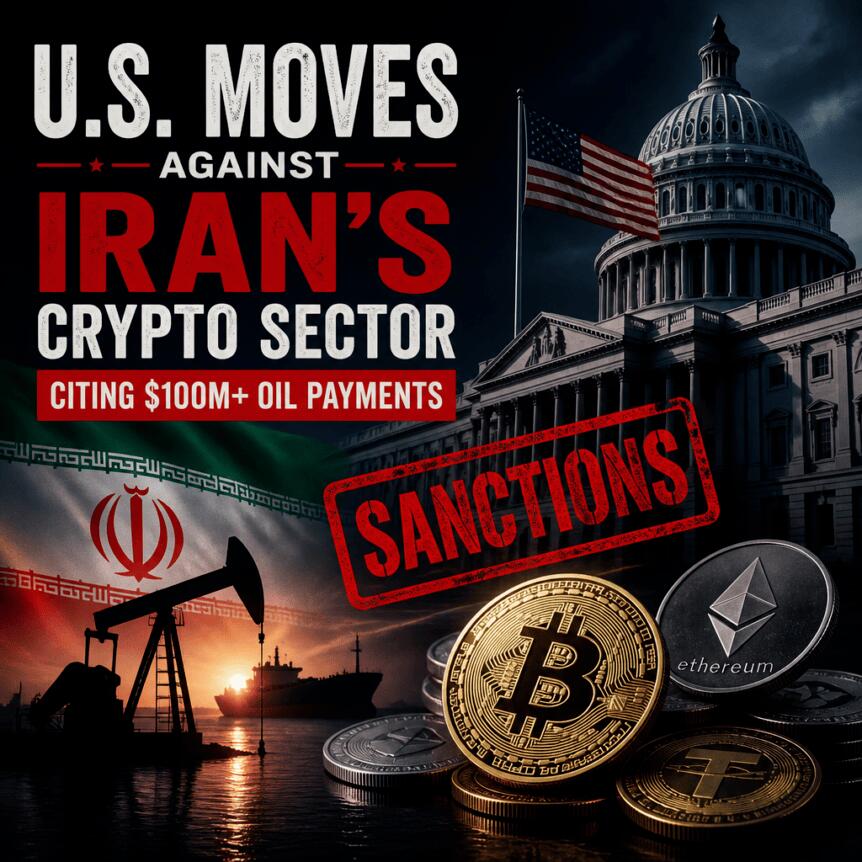
The U.S. Treasury has broadened its Iran sanctions to explicitly target the country’s digital asset sector, citing alleged use of crypto payments to support Iranian oil sales. The move, implemented through new determinations by the Office of Foreign Assets Control (OFAC), expands the government’s ability to sanction not only crypto companies directly tied to Iran, but also foreign actors that participate in or provide services to that ecosystem.
In a press release issued Monday, the Treasury said OFAC designated additional sectors tied to Iran, including digital assets along with technology, gold, aviation, and shipping. It also sanctioned nearly 60 entities, individuals, and vessels connected to areas such as nuclear, missile, cyber, and oil networks.
Key takeaways
- The new OFAC “digital assets” sector determination gives the U.S. a wider legal pathway to sanction foreign companies and individuals supporting Iran’s crypto activity.
- The Treasury’s core allegation links crypto payments—reported at “more than $100 million”—to transactions used to facilitate Iranian oil sales.
- Unlike earlier actions focused on named exchanges and wallets, the sector-based approach can extend pressure to a broader set of intermediaries.
- Designated parties face blocked U.S.-linked property, and foreign institutions that handle significant transactions for them may face restrictions on access to U.S. accounts.
A sector-wide determination, not just targeted exchanges
The digital asset determination is designed to sanction foreign individuals and companies that operate in Iran’s digital asset sector or provide services that support it. According to the Treasury, Iran has increasingly treated cryptocurrency as a “tool of choice for sanctions evasion,” including in transactions tied to the Islamic Revolutionary Guard Corps (IRGC) and government insiders.
The Treasury said the practical effect of the sector designation is to “significantly expand” OFAC’s ability to apply sanctions to a wider range of participants. That matters for compliance, because it shifts enforcement from narrow platform-specific takedowns toward a broader framework where involvement in the covered sector can trigger consequences.
More than $100 million alleged in crypto-linked oil payments
The Treasury’s action also includes named designations. It alleged that a UAE-based Ukrainian broker, Ivan Obukhov, processed over $100 million in cryptocurrency payments since 2023 to facilitate oil sales on behalf of the IRGC’s Quds Force. OFAC sanctioned Obukhov and his UAE-based company, Foscom FZE.
For market participants, the significance is the evidentiary narrative the Treasury is using: crypto is presented not only as a payment rail for ordinary commerce, but as part of an interlinked sanctions-evasion structure connected to Iran’s oil trade. That framing tends to influence how financial institutions and regulated service providers assess risk around counterparties, especially when routing or brokerage services are involved.
The Treasury further indicated that OFAC’s determinations are tied to Executive Order 13902, which provides the legal basis for sanctions against persons operating in the covered sectors. The accompanying OFAC determination states that any person determined to operate in Iran’s digital asset sector will be subject to sanctions under that order.
How this expands prior U.S. Iran crypto enforcement
This sector-wide move follows a sequence of earlier U.S. actions targeting specific Iran-related crypto businesses and wallets. In January, OFAC sanctioned UK-registered Zedcex and Zedxion, which the Treasury described as its first Iran-related designations of digital asset exchanges—an early signal that U.S. enforcement was extending into exchange infrastructure tied to Iran.
Then, on June 3, the Treasury sanctioned four Iranian crypto exchanges, including Nobitex, Iran’s largest platform. That decision came days after Treasury Secretary Scott Bessent said the U.S. had seized nearly $1 billion in cryptocurrency from Iranian exchanges and wallets, according to earlier reporting covered by Cointelegraph: US has seized nearly $1 billion in Iranian crypto, Treasury secretary says.
More recently, OFAC sanctioned Shelbit and Aban Tether on Aug. 7, alleging the companies facilitated a combined $5 million in digital assets connected to Iran. Those earlier cases helped establish a pattern: the Treasury was willing to use sanctions to target specific exchanges and intermediaries tied to Iran.
However, the new determination changes the scope. As the Treasury put it, this action is intended to provide a basis for sanctions based on participation in Iran’s wider digital asset sector. Instead of focusing only on named venues, the U.S. can now sanction foreign actors that operate in or provide services supporting the covered sectors.
What designated parties and banks should expect
The Treasury’s press release outlines the likely consequences for parties caught by the sanctions. It said that designated parties’ U.S.-linked property must be blocked. In addition, foreign banks that facilitate significant transactions for designated parties could face restrictions on access to U.S. accounts.
That banking component is particularly relevant given the operational reality of digital asset markets, where fiat on-ramps, custody, and settlement often require interaction with traditional finance. Even if a sanctions target does not directly hold assets in the U.S., the threat of compliance action can affect counterparties’ willingness to provide services, process transactions, or maintain relationships linked to the sanctioned network.
For those operating in global crypto infrastructure, the regulatory message is clear: sector-based sanctions increase the compliance burden by widening the set of entities that may qualify as “supporting” or “operating in” the covered digital asset space. As a result, diligence around brokers, intermediaries, and service providers—especially those with potential links to sanctioned jurisdictions—may become more stringent.
U.S. authorities have repeatedly emphasized that sanctions evasion has become more sophisticated and often uses crypto pathways to move value around restrictions. With the Treasury now explicitly covering the digital asset sector, the next question for the market is how quickly enforcement spreads beyond named individuals and companies into broader groups of intermediaries—such as payment processors, brokers, and other service providers operating near the edge of Iran-linked activity.
https://www.cryptobreaking.com/u-s-moves-against-irans/?utm_source=blogger%20&utm_medium=social_auto&utm_campaign=U.S.%20Moves%20Against%20Iran’s%20Crypto%20Sector,%20Citing%20$100M+%20Oil%20Payments%20
Comments
Post a Comment