
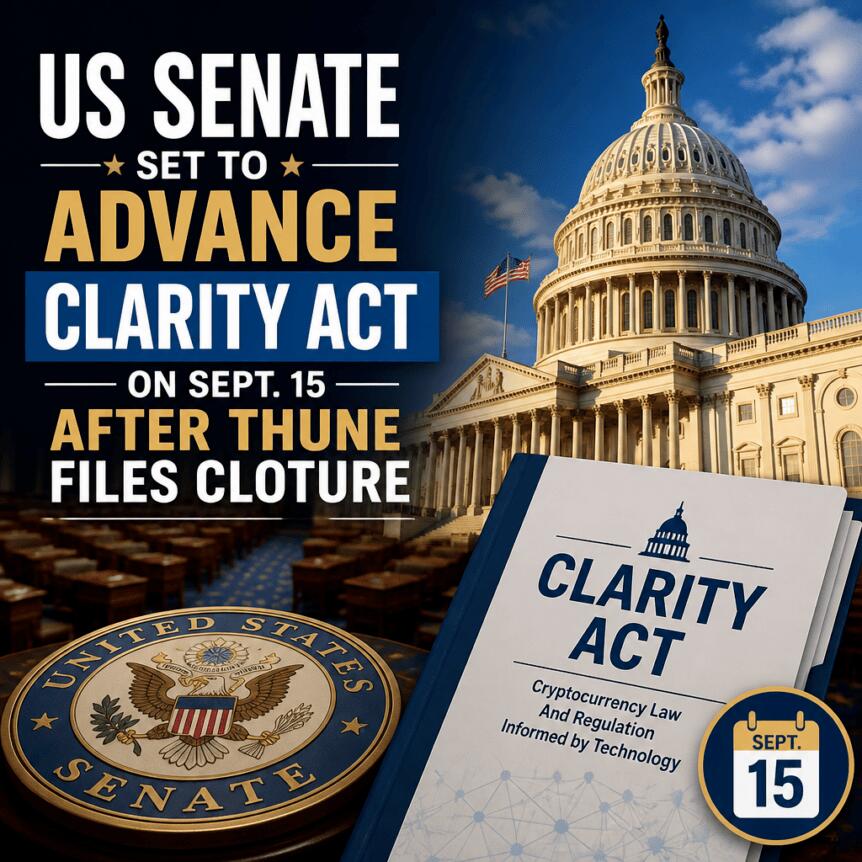
U.S. Senate Majority Leader John Thune has filed cloture on a motion to bring the Digital Asset Market Clarity Act—known as the CLARITY Act—to the Senate floor, setting up a pivotal procedural vote tied to the next legislative window. The move comes as lawmakers prepare to return to Washington after the August recess, with the Senate expected to reconvene on Sept. 15.
Under Senate rules, invoking cloture requires a 60-vote threshold, meaning Republicans will need support from Democrats to clear the procedural hurdle. The filing does not automatically translate into final passage; instead, it is designed to advance the bill for consideration and potentially a later vote on the legislation itself.
Key takeaways
- John Thune filed cloture to take up the CLARITY Act, a procedural step requiring 60 votes.
- The Senate is expected to reconvene on Sept. 15, with the vote anticipated shortly after.
- Cloture clears a path for consideration but does not guarantee the bill will ultimately pass.
- Negotiations have stalled over disagreements, including ethics provisions and how stablecoin-related rewards should be regulated.
- Lawmakers are reportedly working on a bipartisan ethics addendum to address concerns tied to the president’s crypto-related financial interests.
Procedural push puts the CLARITY Act back on the calendar
According to the U.S. Senate Daily Press, the Majority Leader’s office confirmed that Thune filed cloture on the motion to bring the CLARITY Act to the Senate floor for consideration. The Senate Daily Press is tied to the daily publication of official Senate floor scheduling and related procedural matters, making it a direct channel for confirming when actions like cloture are submitted.
Cloture matters because it addresses debate length and related parliamentary tactics. With 60 votes required to invoke cloture, the bill’s fate in the chamber hinges on whether enough senators across party lines agree the legislation should move forward for lawmakers to debate and vote on substance.
Thune’s filing effectively repositions the CLARITY Act for action after negotiations failed to produce a deal before the August recess. Lawmakers now have additional time leading up to the September session—when procedural momentum can become substantive momentum, if the outstanding policy issues can be resolved.
Why the bill is politically and structurally significant
The CLARITY Act is widely described as a landmark effort to create a more uniform federal framework for how digital assets are categorized and overseen. The bill’s core aim is to establish a federal market structure for digital assets and clarify how regulators should apply existing securities and commodities laws.
In particular, the legislation is positioned to delineate when particular crypto assets fall under the jurisdiction of the Securities and Exchange Commission versus the Commodity Futures Trading Commission. That clarity is a major concern for market participants because regulatory ambiguity can complicate product development, market access, and compliance strategies.
While the procedural step now puts the bill back into focus, the filing also underscores that the legislative path is still conditional. Even if senators clear cloture, the CLARITY Act could still face further obstacles in a later floor vote depending on whether negotiators can bridge remaining disagreements.
The sticking points: ethics rules and stablecoin-related provisions
The road to a compromise has been complicated by disputes over multiple elements, including ethics provisions and rules governing stablecoin rewards. The ethics question has been particularly difficult, according to reporting referenced in the original coverage: lawmakers have been unable to settle on proposed restrictions that would limit government officials—and their families—from issuing or profiting from digital assets while in office.
These provisions are more than technical language. Ethics rules can become a defining political battleground because they shape how lawmakers manage perceived conflicts of interest, especially in a sector where public officials may hold or interact with crypto investments.
Beyond ethics, stablecoin rewards have also reportedly been a source of friction. While the specific policy details are not laid out in the available text, the inclusion of stablecoin-related reward rules indicates that negotiators have to align on how certain yield or incentivization mechanics should be treated under U.S. oversight.
Until those issues are resolved, the CLARITY Act’s movement in the Senate may be best understood as a procedural advance—an effort to keep negotiations alive rather than a guarantee that consensus is close.
Reported attempt to break the ethics impasse
To address the ethics impasse, lawmakers have reportedly been working on a bipartisan addendum. Earlier coverage from Cointelegraph referenced a proposal aimed at addressing Democratic concerns about President Donald Trump’s crypto-related financial interests, with Bloomberg reporting that the approach would require the president to divest from certain crypto-related businesses.
The rationale for such an addendum is straightforward: rather than relying solely on broad restrictions on officials and their families, negotiators may seek a targeted solution tied to the president’s holdings. The shift matters because it could alter the negotiation dynamics between parties—potentially allowing the ethics language to become more politically acceptable while still addressing conflict-of-interest concerns.
However, the existence of a proposed ethics framework does not itself confirm that the final language will be agreed upon or adopted. The next procedural vote will signal whether enough senators believe the bill is worth taking up despite remaining uncertainties, and it may also pressure negotiators to finalize language quickly enough to avoid further delays.
What to watch after Sept. 15
With the Senate expected to reconvene on Sept. 15 and the cloture vote anticipated soon after, the immediate question is whether Democrats will provide the additional votes needed to reach the 60 threshold. If they do, lawmakers can proceed to debate substance—but readers should still watch for how ethics and stablecoin-reward provisions evolve, since those items have been central to the breakdown in earlier negotiations.
https://www.cryptobreaking.com/us-senate-set-to-advance-2/?utm_source=blogger%20&utm_medium=social_auto&utm_campaign=US%20Senate%20Set%20to%20Advance%20CLARITY%20Act%20on%20Sept.%2015%20After%20Thune%20Files%20Cloture%20
Comments
Post a Comment