
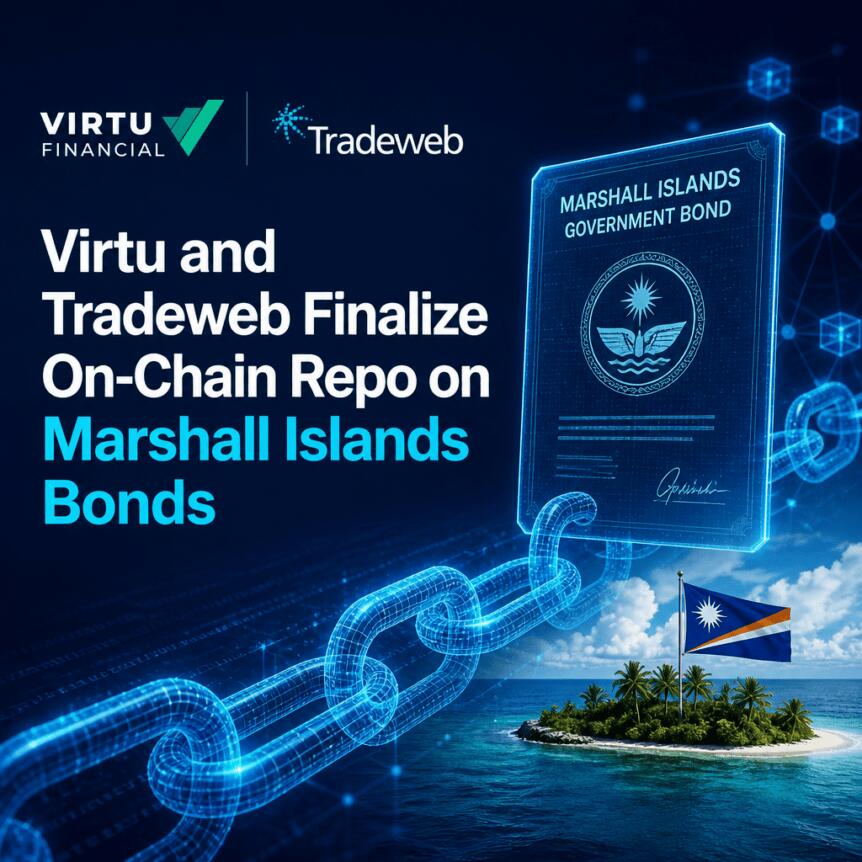
Virtu Financial, M1X Global and Tradeweb have completed an onchain repo transaction that used a tokenized sovereign digital bond as collateral and settled the full repurchase cycle on the Canton Network. According to the parties involved, the transaction was executed between regulated counterparties and finished end-to-end in under 10 minutes.
The collateral in the deal was USDM1, a US dollar-denominated sovereign bond issued onchain by the Republic of the Marshall Islands. The bond is designed to pay a coupon while also functioning as collateral, and it is backed 1:1 by short-term US Treasurys. Its structure is governed under New York law and is described as a fully collateralized sovereign obligation.
Key takeaways
- Three institutions—Virtu Financial, M1X Global and Tradeweb—completed a repo using tokenized sovereign collateral with settlement on Canton.
- USDM1 collateral is structured as a coupon-paying, fully collateralized sovereign bond backed 1:1 by short-term US Treasurys.
- Atomic settlement claim: the parties say it was the first repo combining natively issued sovereign collateral with fully onchain atomic settlement.
- Under 10 minutes was cited for the full repo and repurchase cycle from execution to completion.
- Adoption remains uncertain: the transaction is framed as an early example, with no clear indication yet of broad scaling in institutional repo markets.
USDM1 becomes collateral in a full onchain repo
While tokenized bonds have often been positioned as tradable assets or issuance rails, this transaction focuses on their role inside institutional financing. The deal demonstrates how tokenized sovereign debt can be used not just for ownership and trading, but also as functional collateral through the repo lifecycle.
In the reported structure, USDM1 was used as the collateral layer within a repurchase agreement process, with the full transaction settling on Canton. The parties emphasize that the workflow targeted the repo and repurchase cycle as a complete “atomic” onchain settlement process, rather than splitting settlement across different systems or steps.
Tradeweb acted as the platform for execution between regulated counterparties. For custody, the release names Anchorage Digital, BitGo and tZERO as institutional custody providers supporting access to USDM1 through the electronic trading venue.
Why Canton’s permissioned design matters for institutional finance
Canton Network is built for institutional financial use cases, with features aimed at regulated trading and tokenized asset workflows, including permissioning and privacy controls. The repo example comes after multiple other Canton-linked developments that show how the network is being used to move tokenized instruments and settle transactions.
In an earlier July transaction, Tradeweb facilitated a real-time transfer of a tokenized US Treasury from Franklin Templeton to Virtu Financial on Canton, with settlement executed against USDCx. That prior example centered on token transfer and settlement mechanics; the latest repo follows by applying Canton’s approach to a financing structure that depends heavily on collateral management.
For market participants, this distinction is important: repo is operationally and legally complex, and it typically involves tightly coordinated settlement steps. If tokenized sovereign collateral can be integrated into that process with rapid onchain settlement, it may reduce operational friction and shorten the time between execution and completion—at least within the confines of controlled test or pilot environments.
Momentum builds: cross-chain swaps and native stablecoins on Canton
The new repo arrives as activity on Canton increased during August, according to earlier reporting and announcements referenced in the source. FalconX and Interstice launched a cross-chain swap engine linking Canton with Ethereum, Solana and Robinhood Chain, expanding how assets can be routed across ecosystems while using Canton as the institutional settlement environment.
At the same time, World Liberty Financial launched a native USD1 stablecoin on Canton. In addition to payment and settlement utility, native stablecoin deployment can also influence how institutions model liquidity and collateral flows within tokenized workflows.
Broader plans were also mentioned involving Digital Asset and the American Idea Foundation, founded by former US House Speaker Paul Ryan. The parties announced plans this month for a 2027 pilot that would use Canton to distribute state-administered benefits across three US states.
Taken together, these items suggest Canton is being used as more than a single-application testnet. Instead, the ecosystem is gradually incorporating exchange-like capabilities, stablecoin issuance, and settlement for institutional workflows—components that are often prerequisites for scaling to wider capital markets use.
What this means for institutional repo markets—today and next
The latest repo is positioned as an early-stage milestone: the parties involved are effectively using tokenized sovereign debt as collateral inside a real repo process, and then completing the cycle onchain. The speed reported—under 10 minutes for the full repo and repurchase cycle—signals that operational complexity is being addressed in practice, at least in this instance.
However, the release also leaves open the central question facing the market: whether this model will translate into broader adoption across institutional repo markets. Repo is a core part of the fixed-income funding ecosystem, and widespread deployment typically depends on standardization across counterparties, legal frameworks, operational integration with existing back-office systems, and consistent liquidity for collateral tokens.
One clear development to watch is whether additional repo participants adopt natively issued sovereign token collateral in similar atomic settlement workflows, and whether the approach expands beyond controlled counterparties and specific venue support. Investors and builders should also look for incremental improvements in how collateral, stablecoin settlement assets, and cross-chain liquidity integrate under Canton’s permissioned architecture.
For now, the key takeaway is that tokenized sovereign bonds are moving from “asset onchain” to “collateral in institutional finance,” and Canton’s growing set of settlement and integration features will likely determine how quickly similar strategies can move from demonstrations to repeatable market infrastructure.
https://www.cryptobreaking.com/virtu-and-tradeweb-finalize-on/?utm_source=blogger%20&utm_medium=social_auto&utm_campaign=Virtu%20and%20Tradeweb%20Finalize%20On-Chain%20Repo%20on%20Marshall%20Islands%20Bonds%20
Comments
Post a Comment