
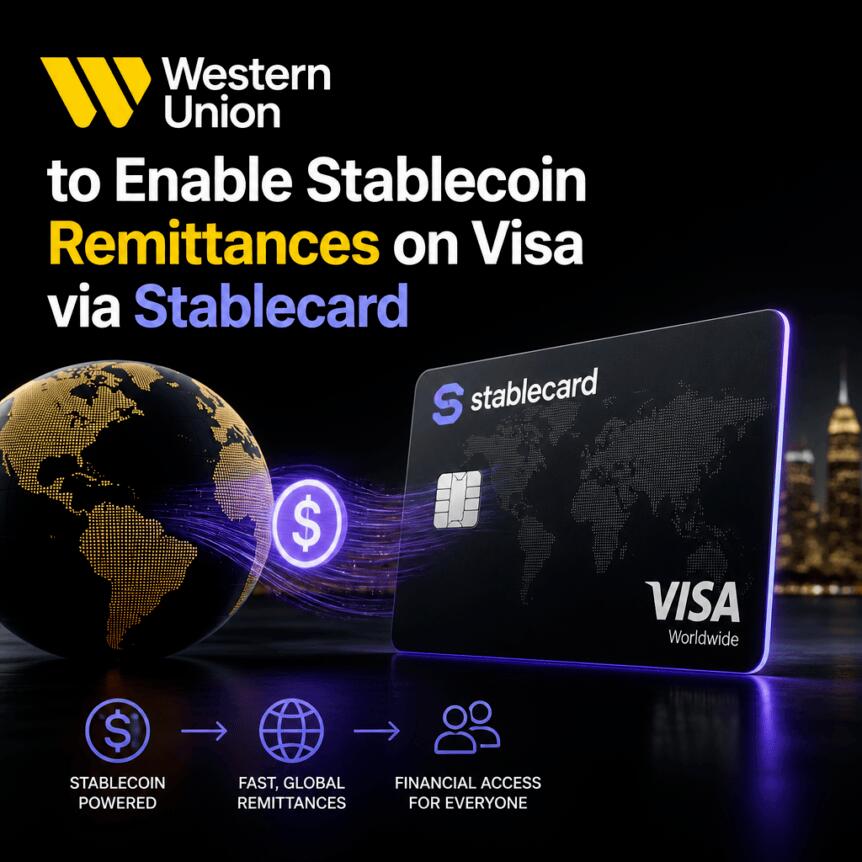
Western Union is making a significant push into blockchain-enabled payments with the launch of Stablecard, a Visa-branded wallet that lets customers hold, receive, transfer, and spend a US dollar-backed stablecoin. The company says the product is designed to bring dollar-denominated balances into everyday spending for people using remittance flows.
In an announcement on Wednesday, Western Union said Stablecard will support USDPT—an American dollar-pegged stablecoin issued by Anchorage Digital Bank on the Solana blockchain. The wallet-based system is positioned for remittance recipients and consumers in markets where local currency volatility makes it harder to confidently hold savings.
Key takeaways
- Stablecard brings USDPT stablecoin support into a Visa-branded spending flow for users in the 37 markets where it launched.
- Western Union is using stablecoin rails to support on-ramps from remittances, wallet transfers, and payment spending where Visa is accepted.
- USDPT is issued by Anchorage Digital Bank and runs on Solana, tying the wallet to existing cryptocurrency infrastructure.
- Western Union plans to expand Stablecard availability to more than 60 markets by the end of the year.
- The rollout aligns with Western Union’s broader digital asset strategy and its earlier decision to introduce USDPT.
Stablecard: turning USDPT into spendable value
Stablecard is presented as both a digital wallet and a payment method. According to Western Union, users can receive funds directly into a USDPT wallet—built around the stablecoin—then transfer those balances to compatible crypto wallets and exchanges. From there, the same USDPT balance can be spent anywhere Visa is accepted.
Western Union also highlighted that spending can occur through existing digital payment channels connected to Visa, including Apple Pay and Google Pay. For investors and users watching stablecoin adoption beyond trading, this is one of the clearer examples of stablecoins being integrated into a mainstream payments brand rather than remaining confined to crypto-native apps.
The product is intended to address a common challenge in cross-border payments: recipients often receive funds in local currencies that may be volatile, while traditional remittance providers typically deliver payments that are quickly spent or converted. By letting users hold a US dollar-backed asset and use it through familiar payment networks, Stablecard aims to give users more flexibility in how they manage funds.
Market rollout and what it signals for remittance competition
Western Union stated that Stablecard launched in 37 markets, with plans to expand to more than 60 markets by the end of the year. That expansion goal matters because it suggests the company views the product as more than a pilot—aiming to scale stablecoin-backed payments in meaningful geographies.
The move also reflects intensifying competition in money transfers. Stablecoins have increasingly been explored as rails for cross-border transfers, with the industry betting that dollar-pegged tokens can improve speed and reduce certain costs compared with older systems. For established remittance companies, stablecoin integration becomes a strategic attempt to modernize their infrastructure while keeping customer-facing touchpoints familiar.
Western Union’s rival MoneyGram has made a similar bet. Earlier coverage from Cointelegraph noted that MoneyGram launched MGUSD, a US dollar-pegged stablecoin on the Stellar network. In that setup, users can use a self-custodial wallet to hold dollar-denominated balances, send funds globally, and convert to local currencies when needed. Stablecard’s Visa-centered design is different in execution, but it points to the same competitive direction: remittance providers increasingly want stablecoins to help move value, not just settle transactions.
USDPT, Solana, and the regulatory framing
Stablecard’s stablecoin is USDPT, issued by Anchorage Digital Bank on the Solana blockchain. Western Union previously unveiled USDPT in May as part of a broader digital asset strategy, describing it as aligned with the framework established under the GENIUS Act—a recently enacted US law that sets federal rules for the issuance and oversight of payment stablecoins. That regulatory framing is important for long-term adoption, because it signals an effort to fit stablecoin issuance and distribution into clearer compliance expectations.
Western Union has also described ecosystem expansion around USDPT through exchange integrations. Cointelegraph reported earlier that Bybit added support for USDPT trading and transfers in June. These types of partnerships can be particularly relevant to usability: stablecoin wallets and payment systems become more valuable when users can also move balances between consumer apps, self-custody tools, and exchanges.
Why stablecoins still face friction in practice
Despite the momentum, stablecoin remittances are not automatically cheaper or faster in all cases. A recent Bank of Italy study, covered by Cointelegraph, found that stablecoin-based remittances did not consistently outperform traditional payment channels in cost or speed. Researchers pointed to a key bottleneck: friction often remains in fiat on- and off-ramps—converting between bank deposits, cash, and digital assets—where a large portion of settlement delays and transaction costs can still occur.
That observation matters for how to interpret Stablecard’s launch. A wallet that enables receiving and spending can reduce certain steps for users who can transact within the same payment ecosystem, but it doesn’t eliminate conversion challenges across borders. What will likely determine whether stablecoin remittances scale smoothly is how effectively providers integrate stablecoin rails with fiat access points, including local compliance, bank transfers, and cash-out routes.
In that context, Stablecard’s decision to connect stablecoin balances to Visa acceptance could be a practical lever. Rather than requiring a near-immediate conversion to local currency before spending, the product offers a way to use dollar-pegged value directly through established payment acceptance—potentially reducing the number of conversions some users need to make.
As stablecoins continue to expand their role in global payments, the next question for users and market participants is not only how many markets launch, but how well the on-ramps and off-ramps work in practice—especially under real-world load, local banking constraints, and changing compliance requirements.
https://www.cryptobreaking.com/western-union-to-enable-stablecoin/?utm_source=blogger%20&utm_medium=social_auto&utm_campaign=Western%20Union%20to%20Enable%20Stablecoin%20Remittances%20on%20Visa%20via%20Stablecard%20
Comments
Post a Comment