
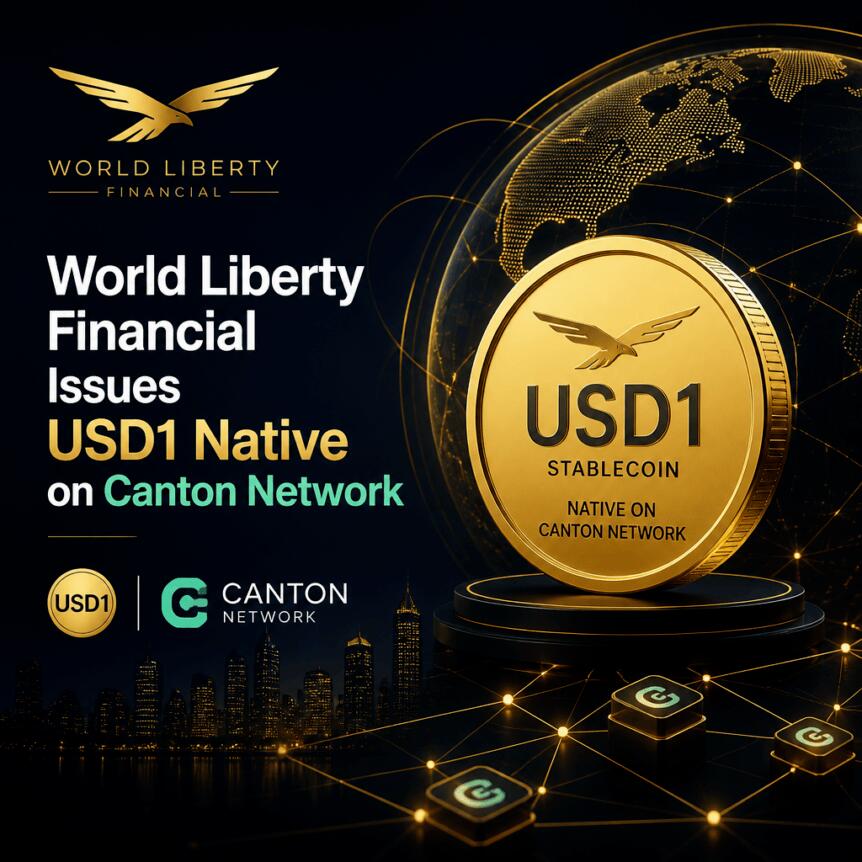
World Liberty Financial has rolled out its USD1 stablecoin in native form on the Canton Network, positioning the token to act as the “cash leg” inside transactions that also involve tokenized real-world assets (RWAs). The move targets institutional workflows where settlement often needs to occur alongside issuance, redemption, and collateralization rather than through separate payment rails.
In a Tuesday announcement, the project said institutions can use USD1 on Canton for settlement across activities such as derivatives collateral, institutional lending, and asset issuance and redemptions. The company emphasized that native issuance is designed to let USD1 clear alongside tokenized assets within the same transaction while leveraging Canton’s privacy and permissioning controls.
Key takeaways
- USD1 is now available natively on the Canton Network, aiming to streamline settlement for tokenized real-world assets.
- The stablecoin is positioned for institutional use cases including derivatives collateral, lending, and asset issuance/redemptions.
- World Liberty says native issuance enables USD1 to settle in the same transaction as tokenized assets while using Canton’s privacy/permissioning features.
- USD1’s circulating market capitalization is about $4.05 billion, making it the sixth-largest stablecoin per DeFiLlama.
- USD1 is managed by BitGo Bank & Trust for reserve oversight and for minting/redemption processing.
Why native settlement matters for tokenized RWAs
The practical value of launching a stablecoin “natively” on a blockchain geared toward institutional finance is that it reduces the friction between tokenized assets and payment settlement. Rather than treating cash settlement as an off-chain or external step, native issuance supports the idea that stablecoin flows can occur in parallel with asset transfers, issuance events, or contract-based collateral movements.
World Liberty’s framing is that USD1 can be used for settlement where tokenized RWAs are involved—specifically as a cash leg in transactions spanning derivatives collateral and institutional lending. That matters because many tokenization efforts hinge not only on representing assets on-chain, but also on how reliably and efficiently the corresponding payment leg can be executed under the constraints institutions require.
The company also pointed to Canton’s privacy and permissioning controls. For investors and institutions evaluating tokenized asset infrastructure, these features are often central: they can determine what data is visible, who can interact with what components, and how compliance-oriented workflows are structured within blockchain systems.
USD1’s current scale and who operates it
USD1 has a market capitalization of about $4.05 billion, according to DeFiLlama stablecoin data, where the token is described as the sixth-largest stablecoin by market cap. In terms of issuer and operations, World Liberty said USD1 is issued by BitGo Bank & Trust, which manages reserves and handles the minting and redemption process.
That operational separation—stablecoin reserve management and issuance processing handled by a named bank entity, while on-chain usage is enabled through a network integration—underscores how the stablecoin business model often blends traditional treasury controls with blockchain distribution. For participants on Canton, this structure can affect assumptions around redemption processes and reserve oversight, especially when stablecoin settlement is intended for regulated or institutional settings.
Canton’s institutional focus and the network’s tokenized-asset activity
Canton positions itself as a public, permissionless blockchain designed for institutional finance, and the company says it handles large volumes of tokenized asset movement. In the update accompanying the USD1 integration, Canton claimed it processes and issues more than $9 trillion in tokenized assets each month. It also cited more than $350 billion in onchain US Treasurys moving across the network daily.
Those figures are not direct guarantees about future USD1 usage on Canton, but they do help contextualize why a stablecoin integration is strategically meaningful. If tokenized securities and RWA instruments are already being transferred with significant frequency, the settlement layer becomes a key bottleneck—or a competitive advantage—depending on how efficiently it can match payment timing and compliance requirements.
By placing USD1 into that environment, World Liberty appears to be aiming for deeper integration with institutional token flows rather than limiting USD1 to a standalone stablecoin role within broader DeFi markets.
Integration timing: part of a wider push on Canton
The USD1 launch follows another expansion announcement for Canton reported last week. According to the earlier coverage, Digital Asset and former US House Speaker Paul Ryan’s American Idea Foundation unveiled plans to pilot a Canton-based system for distributing state-administered benefits across three US states, with an anticipated start in 2027.
While the USD1 initiative and the benefits distribution pilot are clearly different in purpose, they both point to Canton’s broader ambition: attracting enterprise-grade use cases and institutional participants. For observers, the sequence is important because it suggests the network is actively positioning its rails for multiple categories of on-chain activity—ranging from financial settlements involving tokenized assets to non-traditional public distribution workflows.
What to watch next for USD1 on Canton
With USD1 now live natively on Canton, the key question for market participants is how quickly institutions move from testing to sustained on-chain settlement for tokenized asset transactions. Watch for evidence of USD1 being used in the specific workflows World Liberty highlighted—especially collateral and issuance/redemption flows—as that will indicate whether native settlement delivers measurable operational advantages in real transactions.
https://www.cryptobreaking.com/world-liberty-financial-issues-usd1/?utm_source=blogger%20&utm_medium=social_auto&utm_campaign=World%20Liberty%20Financial%20Issues%20USD1%20Native%20on%20Canton%20Network%20
Comments
Post a Comment