
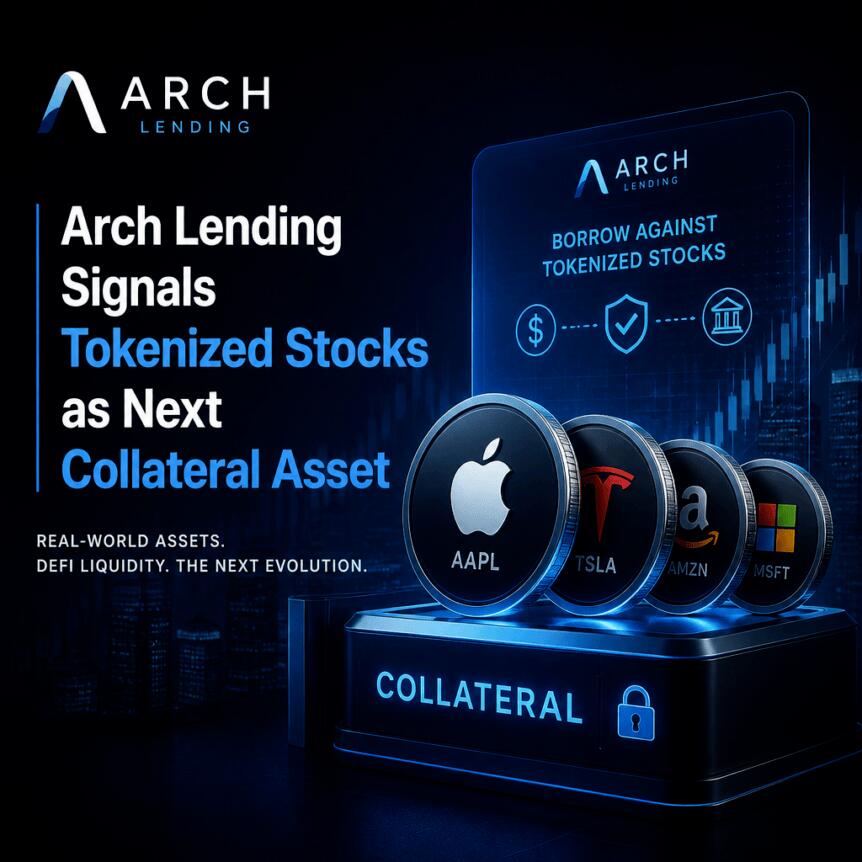
Arch Lending is preparing to expand its credit offerings to include loans backed by tokenized equities, as lenders increasingly look for new collateral categories to support onchain borrowing. Co-founder and chief revenue officer Himanshu Sahay said the firm expects to move “pretty soon,” arguing that demand for credit against tokenized stocks is growing as the asset class scales.
Speaking on Cointelegraph’s Chain Reaction podcast, Sahay pointed to rapid growth in tokenized equities over the past year, while noting that lending capacity against those assets still appears limited. He expects more lenders to follow as tokenized stock products mature and become easier to use in collateral frameworks.
Key takeaways
- Arch Lending plans to add loans backed by tokenized equities, expanding beyond crypto-only collateral.
- Sahay links the push to growing tokenized stock issuance and a shortage of credit options that support borrowers.
- Arch has recently launched tokenized real-world asset loans backed by Paxos Gold and Tether Gold.
- Existing Arch lending is still crypto-led, with Bitcoin representing more than 80% of the loan book, and rising interest in XRP among US borrowers.
Arch’s next step: credit against tokenized stocks
Arch has already expanded beyond cryptocurrencies, launching loans backed by tokenized real-world assets including Paxos Gold and Tether Gold in recent weeks, according to Sahay. However, crypto remains the dominant collateral category in its current portfolio: Sahay said Bitcoin accounts for more than 80% of Arch’s loan book.
Even within crypto collateral, Arch is seeing shifting borrower preferences. Sahay said the lender has noticed growing interest in XRP as collateral, particularly among US borrowers—an indication that demand for specific asset types may depend on regional borrower needs and available liquidity rather than broad “market beta” alone.
Against that backdrop, tokenized equities represent a logical extension. Sahay cited the broader expansion of tokenized stock offerings from firms including Superstate, Robinhood, and Securitize, suggesting that a larger universe of onchain share tokens is being created—yet lending against those tokens remains relatively underdeveloped compared with more established collateral categories.
In practical terms, the appeal for lenders is straightforward: tokenized stocks and ETFs could enable borrowers to access credit without liquidating underlying exposure, while providing lenders with a collateral pool that may diversify beyond digital assets like BTC and ETH.
Why tokenized equity lending is gaining traction
Arch would not be entering the market first. Tokenized stocks and exchange-traded funds (ETFs) have been moving into collateral and lending products as infrastructure matures.
In February, Ondo Finance launched DeFi lending markets for two tokenized ETFs through an integration with lending protocol Morpho, according to Ondo Finance’s announcement. Ondo’s tokenized versions of the SPDR S&P 500 ETF and Invesco QQQ can be used as collateral for borrowing on Ethereum.
Beyond dedicated lending markets, tokenized equities are also starting to appear in adjacent functions tied to leverage and market operations. Kraken, for example, made 10 xStocks eligible to back futures and margin positions in July, according to Kraken’s product update. Coinbase also rolled out B20 stocks on Base in August, described as including price-feed infrastructure intended to support use cases that can include DeFi borrowing and lending, as previously reported by Cointelegraph.
The throughline across these developments is that tokenized equities are becoming more “programmable” within crypto ecosystems—an essential requirement for credit markets, where collateral eligibility, valuation, and liquidation mechanics determine whether assets can be reliably used in borrowing.
Market expansion: tokenized stocks grow faster than lending options
One reason lenders can justify moving into tokenized equity collateral is the scale of the underlying market. The article cites RWA.xyz data showing distributed tokenized stock value has climbed to about $3.15 billion, up from roughly $630 million a year earlier.
This growth suggests that more capital is being wrapped into tokenized formats that can, in principle, be used in DeFi lending and other credit structures. But the gap that Sahay highlighted remains important: despite rapid tokenized equities adoption, lending backed by these assets is still described as limited. For investors and borrowers, that difference matters because it can translate into fewer opportunities to access leverage or liquidity using those assets, as well as potentially less competitive borrowing conditions than in more mature collateral segments.
As more platforms begin to expand eligibility for tokenized stocks—whether through dedicated lending markets or through margin and futures pathways—the credit ecosystem could become more resilient. It may also normalize tokenized equities as collateral beyond niche experiments.
What to watch next for tokenized equity collateral
Arch’s planned expansion will likely be judged on several practical questions: how quickly it can integrate tokenized stock collateral, how lenders and borrowers manage valuation and risk across different issuers, and whether Arch’s approach aligns with broader market infrastructure being developed by other venues.
With tokenized stock value growing sharply and multiple crypto platforms already moving tokenized equities into lending-adjacent uses, the next phase will be less about whether lending is possible and more about whether it becomes competitive, scalable, and consistent enough to attract mainstream borrower demand.
In the coming months, readers should watch for Arch’s timing on tokenized equity-backed lending and for additional platforms to announce similar collateral expansions—signals that the market may be transitioning from early infrastructure pilots into fully functional credit offerings.
https://www.cryptobreaking.com/arch-lending-signals-tokenized-stocks/?utm_source=blogger%20&utm_medium=social_auto&utm_campaign=Arch%20Lending%20Signals%20Tokenized%20Stocks%20as%20Next%20Collateral%20Asset%20
Comments
Post a Comment