
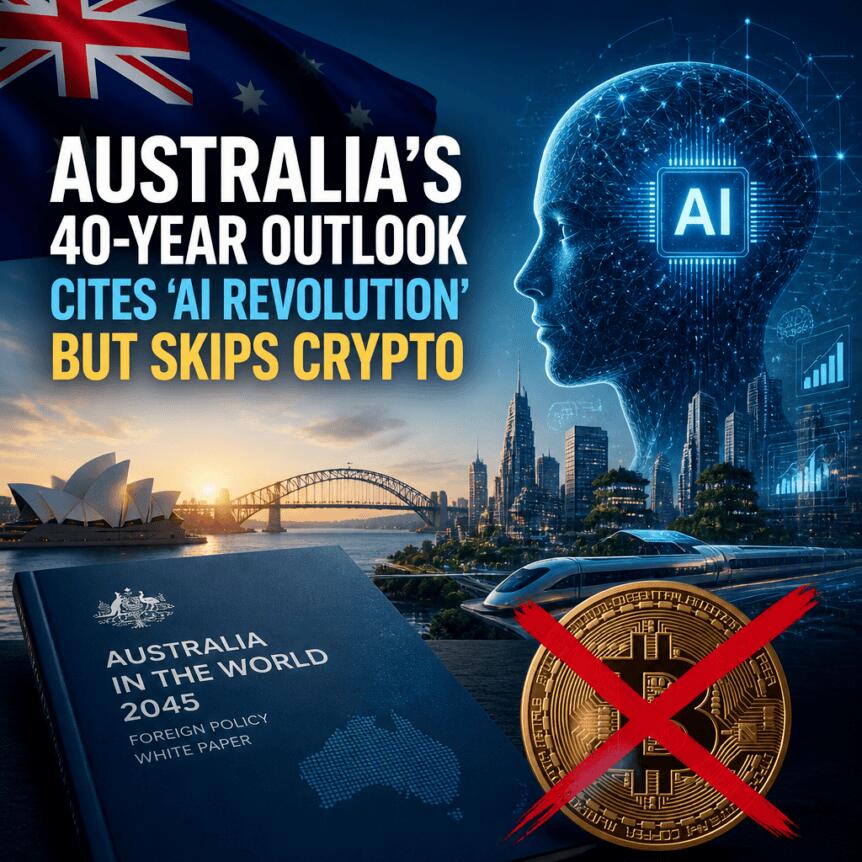
Australia’s new 40-year Intergenerational Report—released by the Australian Treasury—spotlights artificial intelligence as one of the major forces expected to reshape the economy. Yet the document does not mention crypto or digital assets, even as separate government work in recent months has pointed toward tokenization and upgrades to financial infrastructure.
In the report published Monday, Treasury says agentic AI systems have become “significantly” more capable, more autonomous, and widely adopted, including surpassing human-level performance on some benchmarks. The Intergenerational Report frames technology adoption and productivity gains as critical to Australia’s prosperity over the next four decades, alongside four other transitions: geopolitical conflicts, an aging population, the shift to clean energy, and an industrial transformation toward services.
Key takeaways
- Australia’s Intergenerational Report names agentic AI as a core economic transition but omits crypto and digital assets entirely.
- Treasury’s related “Financial Innovation Strategy” links AI-driven machine-to-machine activity to demand for real-time, interoperable, programmable payment systems.
- Coinbase Australia’s John O’Loghlen argues the government focus on AI misses the financial “rails” that tokenized and stablecoin-based infrastructure could provide.
- The omission stands out against earlier central-bank and research discussions about tokenized finance and potential digital finance gains.
AI as the headline transition—without a digital-assets mention
The Intergenerational Report’s framing is broad and forward-looking. It portrays AI adoption—especially agentic systems that can act with a degree of autonomy—as a productivity driver that could affect how economic activity is organized across industries. Treasury’s report also stresses that Australia’s ability to incorporate new technologies will determine long-term economic outcomes.
However, the report’s silence on crypto stands in contrast to how tokenization has increasingly moved from niche experimentation toward mainstream policy discussion. The article notes that earlier Intergenerational Reports also did not address digital assets, and this new omission arrives despite other public-sector work emphasizing tokenized finance and financial infrastructure upgrades.
Why “financial rails” matter for agentic AI
Agentic AI is often described as technology that can coordinate tasks, including transactions, with reduced human involvement. Treasury’s separate publication—the “Financial Innovation Strategy,” released on Sept. 3—addresses the operational implications of this shift more directly.
That strategy report states that agentic systems could increase automated and machine-to-machine transactions, which would raise demand for real-time, interoperable, and programmable payment mechanisms. In other words, the document connects AI automation to the need for payment infrastructure that can be integrated, scaled, and updated more quickly than traditional models.
Coinbase Australia country director John O’Loghlen, responding by email to the Intergenerational Report, argued that the broader AI focus misses a central piece of the puzzle: the “financial infrastructure those agents will need.” He suggested that policies should extend beyond AI itself to the rules and frameworks that enable digital finance to function as the underlying system layer for automated agents.
Regulatory groundwork exists—but stablecoin rails are next
O’Loghlen pointed to regulatory progress already achieved in Australia, referencing the Digital Asset Platform framework as having provided the “necessary regulatory clarity.” In his view, the policy challenge now is to apply similar focus to additional infrastructure that could support digital finance at scale.
Specifically, he argued that policymakers should turn attention to the tokenized stored-value facility framework for stablecoins and to clear rules for tokenized markets. His framing suggests a sequencing problem: if agentic finance will depend on programmable, interoperable settlement and value transfer, Australia needs well-defined frameworks for stablecoins and tokenized market structures to serve as the rails for that activity.
While the Intergenerational Report itself does not go into these details, the accompanying policy direction in the Financial Innovation Strategy provides a rationale for why such frameworks could become more important as automation increases—particularly if machine-driven transaction flows require payments infrastructure designed for interoperability and programmability.
The broader context: tokenized finance is already on the policy radar
The contrast between the Intergenerational Report’s AI emphasis and its lack of crypto coverage is sharpened by other references highlighted in the source material. It notes that the Reserve Bank of Australia has increased its focus on tokenized finance and financial infrastructure upgrades earlier this year, reflecting growing attention to how tokenization could improve settlement and economic activity.
It also cites a Digital Finance Cooperative Research Centre estimate suggesting digital finance innovations could generate AU$24 billion (about $17.1 billion) in annual economic gains. Taken together, these points indicate that Australia’s policy ecosystem is already engaging with the potential economic impact of digitized financial systems—even if that engagement is not reflected in the Intergenerational Report’s technology-transition shortlist.
For investors and builders, the implication is less about whether crypto is “included” in a long-range economic narrative and more about whether regulatory and infrastructure planning is keeping pace with the transaction demands that agentic AI could accelerate. Treasury’s own mention of real-time, interoperable and programmable payment systems in the Financial Innovation Strategy suggests that the government recognizes how automation changes transaction patterns, even if it does not explicitly name digital assets in the Intergenerational Report.
As Australia moves from strategy language toward operational rules, readers should watch for whether stablecoin-related frameworks and tokenized market regulations receive the same level of prioritization that AI adoption and productivity are given in the Intergenerational outlook—especially given the growing likelihood that automated agents will intensify demand for programmable, interoperable payment “rails.”
https://www.cryptobreaking.com/australias-40-year-outlook-cites/?utm_source=blogger%20&utm_medium=social_auto&utm_campaign=Australia’s%2040-Year%20Outlook%20Cites%20‘AI%20Revolution’%20but%20Skips%20Crypto%20
Comments
Post a Comment