
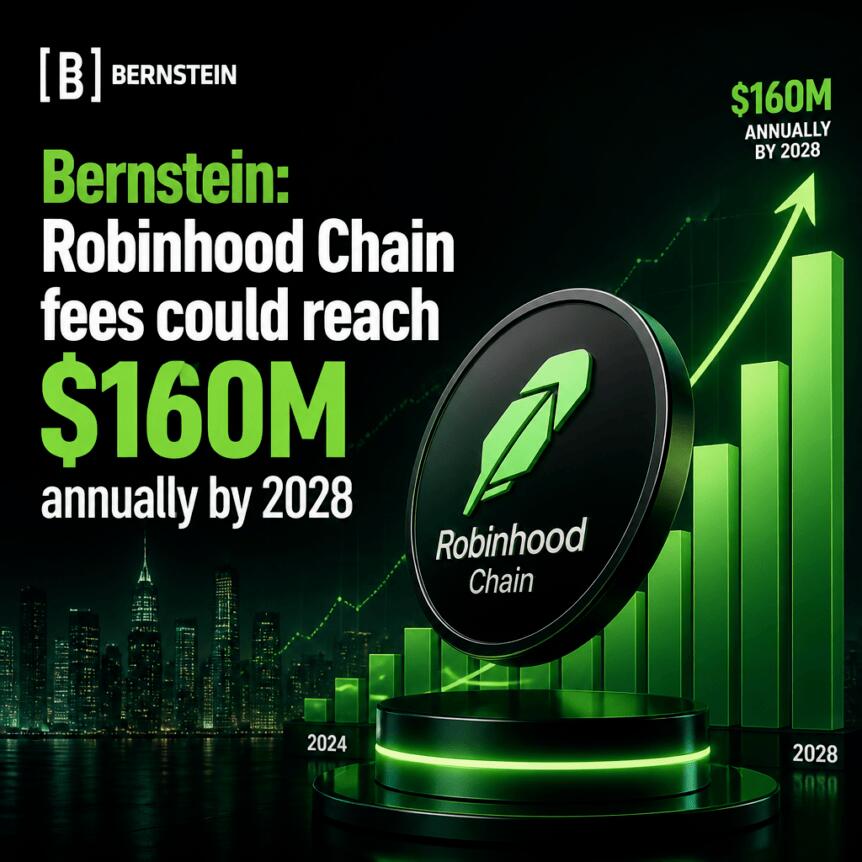
Robinhood’s blockchain network could become a major fee generator, with Bernstein analysts forecasting up to $160 million in annual fees by 2028. In a report shared with Cointelegraph on Tuesday, the firm pointed to a shift in trading activity on the chain toward tokenized stocks—an activity mix the analysts believe is becoming self-reinforcing.
Within the short window since the network’s launch on July 1, Bernstein said tokenized stock trading has grown to roughly 27% of total volume, while native memecoin pairs have fallen to 36% of network activity from about 100% at launch. The change has helped the chain rise quickly in overall revenue rankings.
Key takeaways
- Bernstein expects Robinhood’s blockchain network to reach as much as $160 million in annual fees by 2028.
- Tokenized stocks now represent about 27% of the chain’s trading volume, up from memecoin-dominated activity at launch.
- DefiLlama data shows the chain generated $2.13 million in fees in the past 24 hours and is currently leading by daily fees.
- Bernstein links the growth in tokenized stocks to liquidity and “reflexive demand” created by Uniswap automated market-making pools pairing memecoins with stock tokens.
- AMC’s CEO criticized Robinhood’s tokenized-stock offering as unrelated to AMC, signaling potential reputational and regulatory sensitivity.
Tokenized equities become a bigger share of Robinhood chain activity
Bernstein’s outlook centers on how trading demand is evolving on the Robinhood network. According to the report, tokenized stock trading has expanded to around 27% of total volume, while memecoin trading has declined in relative importance.
The analysts described the movement as more than just a temporary rotation in retail preferences. They argue the underlying market structure encourages both sides of the token pair to attract attention and liquidity—particularly when memecoins are used alongside stock tokens within the same automated trading venues.
Why “reflexive demand” may be strengthening trading volume
In Bernstein’s framing, Uniswap automated market-making (AMM) pools are a key mechanism. The firm said these pools pair memecoins with stock tokens and can generate “reflexive demand” for both assets. In practice, this means activity connected to one side of a pairing—whether due to trader interest in memecoins or exposure to tokenized equities—can spill over into demand for the other side.
That distinction matters for investors because it suggests Robinhood’s fee engine may depend less on a single category of token activity and more on a broader loop linking different user motivations. While memecoin trading can be volatile, paired liquidity and cross-asset engagement can help stabilize volumes—at least in the early stages—if the pool design sustains repeat activity.
Fee leadership so far: DefiLlama shows $2.13 million in a day
Early monetization performance has also supported the bullish narrative. In just over two months after launch, the Robinhood chain has emerged as the leading network by daily fees, according to DefiLlama’s fees-by-chain dashboard. DefiLlama data cited by Cointelegraph places the chain at $2.13 million in fees over the past 24 hours.
That “leader” status is especially relevant because transaction fees are one of the most direct ways a network’s usage becomes measurable revenue. Bernstein’s 2028 estimate builds on the premise that current fee momentum can scale as tokenized stock trading becomes a bigger component of activity.
Company valuation optimism meets renewed scrutiny around tokenized stocks
Bernstein’s comments arrive after the firm previously adjusted its stance on Robinhood shares. On July 20, Bernstein raised its price target on Robinhood (HOOD) stock to $160 from $130 and kept an Outperform rating, forecasting growth in the company’s prediction market business alongside tokenized equities.
In Tuesday’s premarket trading, Yahoo Finance data indicated Robinhood shares were little changed at last look. Yet tokenized stocks have not been without controversy. Cointelegraph previously reported that Adam Aron, CEO of AMC Entertainment Holdings, criticized Robinhood’s blockchain-based equities as lacking any affiliation with AMC. Aron called the offering “outrageous” and said AMC would request an investigation from its outside securities counsel.
While Bernstein’s model emphasizes demand-side growth from tokenization, AMC’s remarks highlight a separate risk dimension: how tokenized “economic exposure” to a company’s stock token is perceived by issuers and how that perception may intersect with legal or regulatory obligations. Even if trading continues to rise, controversy can change the trajectory of future partnerships, product approvals, or public sentiment.
What to watch next for the Robinhood chain
Traders and investors should watch whether tokenized stock volume continues to expand beyond the early post-launch period and whether daily fees remain resilient as the mix shifts away from memecoin dominance. At the same time, developments following AMC’s planned investigation could become a factor in how tokenized equities evolve on public networks.
https://www.cryptobreaking.com/bernstein-robinhood-chain-fees-could/?utm_source=blogger%20&utm_medium=social_auto&utm_campaign=Bernstein:%20Robinhood%20Chain%20fees%20could%20reach%20$160M%20annually%20by%202028%20
Comments
Post a Comment