
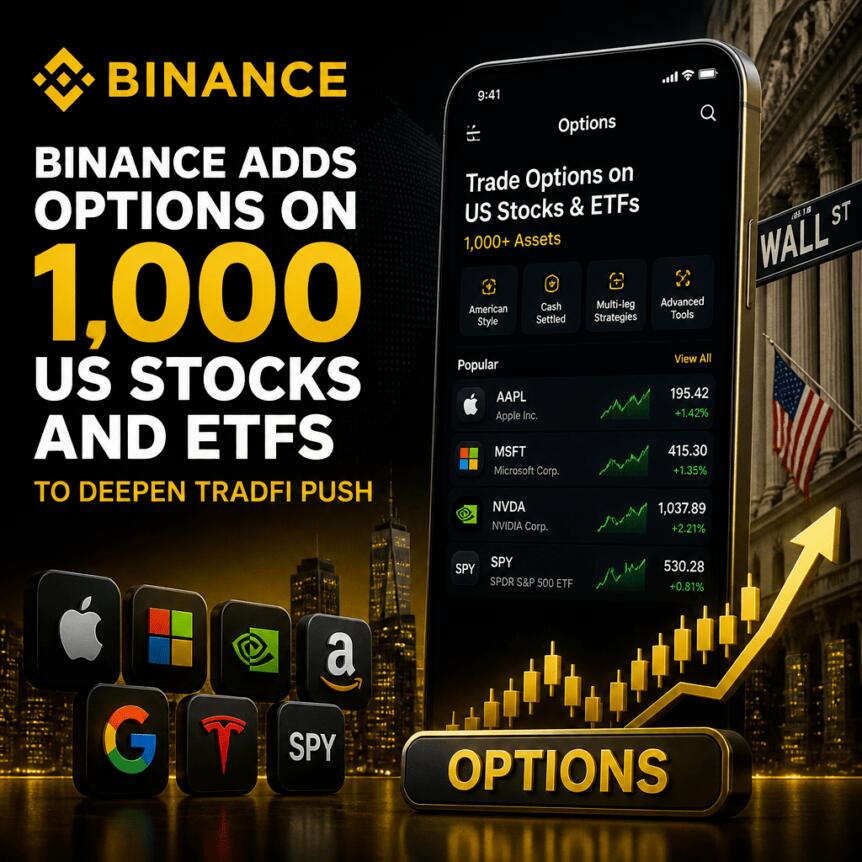
Binance is widening its push into traditional markets by adding options trading tied to more than 1,000 US stocks and exchange-traded funds (ETFs) for eligible users located outside the United States. The rollout uses Binance’s Abu Dhabi-regulated broker-dealer, Nest Trading, while trades are routed to US-registered Alpaca Securities for execution, clearing, settlement, and custody.
The move extends Binance’s existing equities offering, which already covers over 7,000 US stocks and ETFs. Importantly for users comparing products, Binance says the options are physically settled—meaning exercising the contracts results in delivery of the underlying shares, rather than cash or equity-linked perpetual exposure.
Key takeaways
- Binance will offer options on more than 1,000 US stocks and ETFs to eligible non-US users, expanding beyond its current equities lineup.
- Execution, clearing, settlement, and custody are handled via US-registered Alpaca Securities, with product distribution through Nest Trading in Abu Dhabi.
- The options are physically settled, delivering or receiving underlying shares upon exercise.
- Binance points to a sharp rise in traditional-finance derivatives activity on its platform, citing August volume of about $433 billion for TradFi perpetual futures.
- The broader “tokenized securities” trend continues to grow, with RWA.xyz data showing tokenized stocks at about $2.6 billion in distributed value.
Binance adds physically settled options for eligible users outside the US
Binance’s latest expansion targets a segment of traders and hedgers who want listed equity exposure with options’ payoff structure. The company’s announcement frames the update as part of an accelerating shift toward traditional finance tools on crypto exchanges, while also emphasizing operational routing through regulated entities.
Under the plan described by Binance, Nest Trading—licensed as a broker-dealer in Abu Dhabi—will provide the options offering. Orders then go to Alpaca Securities for the steps that typically require local market infrastructure: execution, clearing, settlement, and custody.
That structure matters because options trading is operationally complex and heavily dependent on established market plumbing. Binance’s approach effectively bridges its platform access with US securities-market processes, at least for how orders are finalized and where custody is maintained.
Binance also highlighted that, unlike equity-linked perpetual futures, these options are physically settled. For users, that difference is not cosmetic: physically settled contracts tie the end result to actual share delivery, which can affect strategy design, capital planning, and how positions are managed around exercise and settlement.
Traditional derivatives activity on Binance continues to climb
Alongside the product announcement, Binance cited demand signals from its existing derivatives suite. The company said trading in traditional financial products has increased, pointing specifically to TradFi perpetual futures volume of about $433 billion in August—roughly 15 times January’s total.
While the update is about options availability, Binance’s volume comparison is relevant to investors and traders because it suggests that the platform’s traditional-finance expansion is already pulling meaningful participation. The company’s decision to add options can be interpreted as a response to that engagement: if perpetual exposure is drawing liquidity and usage, adding options may offer more hedging and risk-management capabilities without asking users to leave the exchange ecosystem.
Still, traders should keep expectations grounded. The cited volume figures refer to TradFi perpetual futures, not options volume. The options rollout may attract different behavior—especially for participants who prioritize exercise outcomes and settlement mechanics—so it may take time before Binance’s options markets display the same liquidity profile as its perpetual products.
Tokenized equities keep gaining traction across major exchanges
Binance’s expansion lands amid a wider push by crypto-native firms and traditional brokers into tokenized securities infrastructure. According to RWA.xyz data, tokenized stocks now have about $2.6 billion in distributed value, up from roughly $346 million in the same period a year earlier. The same dataset shows monthly transfer volume rising 93% over the past 30 days to $25.1 billion, alongside a 157% jump in the number of holders to nearly 2.5 million.
These indicators are meaningful because they reflect both growth in asset representation onchain and increased network activity around transfers. In practice, that can improve the usability of tokenized equities—supporting more frequent settlement and more participants accessing the same onchain assets.
Binance’s options addition also fits a broader pattern: multiple venues have been moving toward tokenized equities access for non-US markets, expanding the number of tradable symbols and improving availability windows.
Recent competition: Coinbase, Kraken, and Robinhood expand tokenized equities access
Last week, Coinbase introduced its B20 tokenized equities offering on Base, aiming to give eligible non-US users around-the-clock access to onchain versions of major US companies including Apple, Nvidia, Meta, and Alphabet. Coinbase’s framing also emphasizes interoperability, noting that tokenized assets can be used in DeFi protocols for functions such as trading and collateralized borrowing—an area where onchain distribution can differ from conventional brokerage settlement.
Separately, Kraken expanded its equities reach in August by opening access to more than 7,000 US-listed stocks for eligible European customers, pairing the new offering with its existing lineup of tokenized xStocks. The emphasis here, like other tokenized equities strategies, is scale: more symbols, more customers, and more continuous access can raise the utility of onchain wrappers for traditional assets.
Earlier in the year, Robinhood launched Robinhood Chain and introduced a new generation of Stock Tokens, positioning the effort for eligible users across more than 120 countries. That move underscored the growing interest from consumer- and broker-style platforms in building their own onchain securities rails rather than relying only on existing tokenization partnerships.
Together, these developments highlight a key industry tension: while crypto exchanges and tokenization providers talk about 24/7 access and broader composability with DeFi, the underlying regulatory and settlement requirements still constrain where certain products can be offered and how they settle. Binance’s physically settled options structure—paired with routing to US-registered execution and custody infrastructure—illustrates how that balance is being managed in practice.
For market participants, the next things to watch are practical: how quickly Binance’s new options markets attract liquidity, whether physically settled mechanics influence user onboarding compared with equity offerings alone, and how fast onchain equities activity continues to grow given the RWA.xyz indicators. As more venues add traditional instruments to crypto-adjacent platforms, the competitive edge may increasingly hinge on execution quality, settlement reliability, and access for the right jurisdictions rather than on product announcements alone.
https://www.cryptobreaking.com/binance-adds-options-on-1000/?utm_source=blogger%20&utm_medium=social_auto&utm_campaign=Binance%20adds%20options%20on%201,000%20US%20stocks%20and%20ETFs%20to%20deepen%20TradFi%20push%20
Comments
Post a Comment