
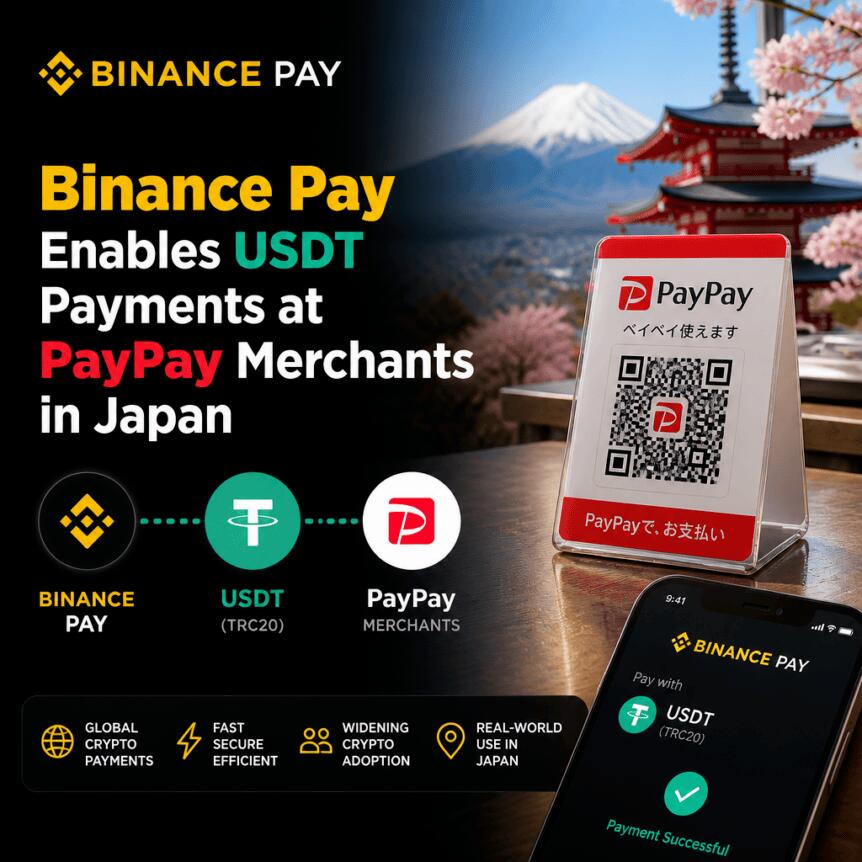
Binance Pay is expanding its reach in Japan by enabling eligible overseas visitors to use Tether USDt (USDT) at a wide range of merchants that already accept PayPay. The update rolls out starting Wednesday and targets PayPay-supported locations using an interoperability layer run through HIVEX.
According to Binance, the company is the first crypto payments provider to connect to PayPay merchants via HIVEX. Merchants will not need to complete a separate opt-in process for the new USDT spending option, and settlement for merchant payouts will continue in Japanese yen.
Key takeaways
- Binance Pay will let qualifying overseas users in Japan pay with USDT at most PayPay-supported merchants starting Wednesday.
- The integration is routed through HIVEX, which links overseas QR payment services to PayPay’s merchant network.
- Merchants will receive settlement in yen, while customers spend using USDT.
- Binance says it is the first crypto payments service to reach PayPay merchants through HIVEX.
- PayPay lists multiple overseas payment services supported via HIVEX, with the new crypto option joining that set.
Why Binance Pay’s HIVEX connection matters
Interoperability platforms like HIVEX are designed to reduce the friction between international payment methods and local merchant ecosystems. In practical terms for visitors, it means they can arrive in Japan and still pay at established PayPay locations using a QR-based flow supported through Binance Pay—without requiring each merchant to tailor its systems for a new foreign payment rail.
Binance told Cointelegraph that its service is the first crypto payment provider to access PayPay merchants in this way. That distinction is important because it signals a shift from one-off pilots or limited merchant deployments toward using an intermediary infrastructure to scale across a broader base of acceptance.
Binance also emphasized that merchants will not need to opt in separately. For investors and payment operators, that potentially lowers the operational barriers for adoption: merchant networks can extend payment choice without redoing onboarding steps for each new external partner.
USDT spending alongside Japan’s existing PayPay footprint
PayPay is one of Japan’s largest cashless payment services, supported across a wide range of venues. The service is accepted at millions of locations nationwide, including major retail chains, smaller merchants, vending machines, taxis, and public transportation.
PayPay also publishes documentation indicating support for overseas payment services through HIVEX. In its merchant help materials, PayPay lists nine other overseas payment services supported via HIVEX, primarily from China, Hong Kong, and Taiwan. Binance’s rollout adds USDT from eligible overseas visitors to that existing set of cross-border options.
For users, the core operational shift is that spending is performed with USDT, while merchant settlement remains denominated in yen. That separation matters because it reduces currency complexity for merchants—an often-cited challenge when integrating non-local payment instruments into local accounting systems.
Japan tourism backdrop adds urgency to payments expansion
The timing of the expansion aligns with Japan’s continued focus on international travel and the growth in inbound traffic. The Japan Tourism Agency reported that Japan welcomed a record 42.7 million international visitors in 2025. In a comparable global ranking based on 2024 data, Japan was ninth worldwide and first in Asia.
Recent monthly figures show that momentum continues, even with some fluctuations. The Japan National Tourism Organization recorded 3.1 million visitor arrivals in August, down 9.6% year over year, while total arrivals for the first eight months of 2026 reached 27.6 million, down 2.7% compared with the same period previously.
For payment providers, these numbers matter because the value proposition of frictionless, visit-friendly payments is tied directly to how many travelers rely on cashless services while navigating local merchant networks. A crypto-enabled option delivered through an existing QR merchant ecosystem can appeal to visitors who already hold stablecoins for payments or exchange convenience.
What to watch next
While Binance’s announcement clarifies the merchant connectivity and settlement approach, the key open questions for users are which visitor eligibility requirements apply and how quickly the option rolls out across supported merchant categories. Traders and developers in the payments space will also be watching whether the integration model through HIVEX becomes a template for additional stablecoin and cross-border services inside Japan’s dominant QR networks.
https://www.cryptobreaking.com/binance-pay-enables-usdt-payments-2/?utm_source=blogger%20&utm_medium=social_auto&utm_campaign=Binance%20Pay%20Enables%20USDT%20Payments%20at%20PayPay%20Merchants%20in%20Japan%20
Comments
Post a Comment