
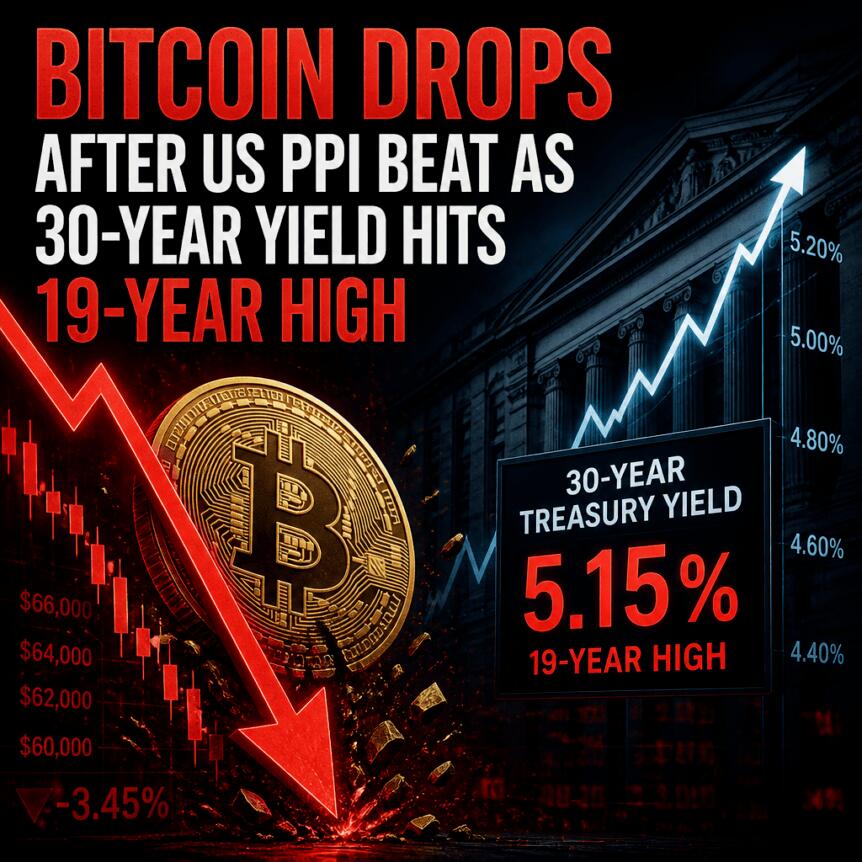
Bitcoin slipped below $77,000 around the start of Thursday’s Wall Street session, dragged down by a sharp reversal in broader risk sentiment. Macro pressure intensified as fresh US inflation data and a surge in oil prices pushed yields higher, tightening the conditions that typically support non-yielding assets like BTC.
Market pricing also reflected renewed concern over Federal Reserve policy. The US 30-year bond yield climbed to 5.353%, the highest level since June 2007, even after the Treasury repurchased $6 billion in Treasurys as part of stepped-up debt buyback operations.
Key takeaways
- Bitcoin’s move below $77,000 coincided with risk assets weakening after US PPI printed hotter than expected.
- August US Producer Price Index rose 5.4% year-on-year, reinforcing expectations of tighter financial conditions.
- WTI crude broke above $100 per barrel for the first time since May 21, lifting inflation sensitivity across markets.
- Long-dated US yields rose despite a $6 billion Treasury buyback, with the 30-year yield reaching 5.353%.
- CME Group FedWatch showed the probability of a 0.25% Fed hike at the September 16 meeting increasing to 69.8%.
Hot inflation and oil spill into crypto’s risk trade
According to TradingView, BTC/USD was on track for roughly 2% losses on the day as equities weakened and macro variables tightened. While Bitcoin’s short-term trading is often driven by liquidity and broader risk appetite, Thursday’s catalyst mix was hard to ignore: hotter inflation expectations and renewed energy-driven price pressure.
Earlier in the session, escalation in the Middle East pushed crude higher. WTI crude moved above $100 per barrel for the first time since May 21, while Brent crude topped $105, approaching a 16-week high. Higher energy prices can quickly filter into inflation expectations, which then feed into bond yields and interest-rate forecasts—key inputs for investors rotating between growth and defensive assets.
That link is especially relevant for crypto markets because higher real yields and expectations of firmer central bank policy typically reduce the relative attractiveness of risk assets. With no cash flows or coupon to offset discount-rate moves, Bitcoin often trades as a high-beta proxy for global liquidity conditions.
Yields press higher despite Treasury intervention
The bond market’s momentum was central to the risk-off tone. The US 30-year yield rose to 5.353%, a level last seen in June 2007, while the 10-year yield hit its highest levels since November 2023 at 4.924%. Notably, this came even after the Treasury carried out the first of its stepped-up debt buyback operations, repurchasing $6 billion worth of Treasurys on Wednesday.
The contrast matters: if intervention doesn’t dampen yield pressure, investors can interpret that as a sign that underlying demand for long-duration risk is weakening—or that inflation and rate expectations are dominating the narrative. In other words, the “help” from buybacks was outweighed by macro forces.
Trading-focused commentary echoed the idea that markets were fighting the Treasury. The Kobeissi Letter, commenting on X, warned that “the bond market is quite literally fighting the US Treasury.”
PPI reinforces Fed hike odds as markets look to CPI
US inflation data added another layer of pressure. The August Producer Price Index came in at 5.4% year-on-year, exceeding expectations by 0.1 percentage points. The Bureau of Labor Statistics said July’s headline PPI print was also revised higher.
In the BLS release, the agency highlighted that the index for final demand less foods, energy, and trade services rose 0.3% in August after moving up 0.4% in July. Over the 12 months ending in August, prices for that measure advanced 4.7%, according to the same official news release from the US Bureau of Labor Statistics: https://www.bls.gov/news.release/ppi.nr0.htm.
Markets responded quickly. CME Group’s FedWatch Tool showed expectations for a 0.25% rate hike at the Fed’s Sept. 16 meeting rising to 69.8% at the time of writing, up from 61.2% the previous day. That shift underscores how sensitive risk assets can be when inflation prints keep pushing the central bank path toward additional tightening.
Earlier coverage from Cointelegraph had already pointed to rising concerns over Fed policy after stronger-than-expected nonfarm payrolls data sent Bitcoin back below $80,000. Thursday’s PPI adds to that same tightening narrative rather than easing it.
What to watch into the next inflation report and central bank moves
Friday is set to bring another major US inflation release: the Consumer Price Index (CPI). As Cointelegraph noted in earlier coverage, CPI is expected to be the last major inflation print before the Fed rate decision. For Bitcoin traders and investors, that matters because CPI can either validate the market’s “higher-for-longer” fears or introduce enough cooling to shift expectations back toward easing.
Meanwhile, policy tightening is not limited to the US. On Thursday, the European Central Bank approved a 0.25% rate hike, its second such move in 2026. While the ECB’s rate actions don’t directly determine US Fed policy, additional tightening outside the US can reinforce a global “less liquidity” backdrop, which generally weighs on high-duration, risk-sensitive markets.
Bitcoin’s drop below $77,000 therefore looks less like a single-coin story and more like the outcome of a broader macro re-pricing: oil-driven inflation concerns, accelerating bond yields, and a Fed path that investors are increasingly pricing as restrictive.
Going forward, the key uncertainty for crypto is whether the next CPI reading cools the inflation picture enough to stabilize yields—or whether oil and producer-price momentum keep expectations for Fed hikes elevated. Until that becomes clearer, BTC is likely to remain highly responsive to macro headlines rather than crypto-specific catalysts.
https://www.cryptobreaking.com/bitcoin-drops-after-us-ppi/?utm_source=blogger%20&utm_medium=social_auto&utm_campaign=Bitcoin%20Drops%20After%20US%20PPI%20Beat%20as%2030-Year%20Yield%20Hits%2019-Year%20High%20
Comments
Post a Comment