
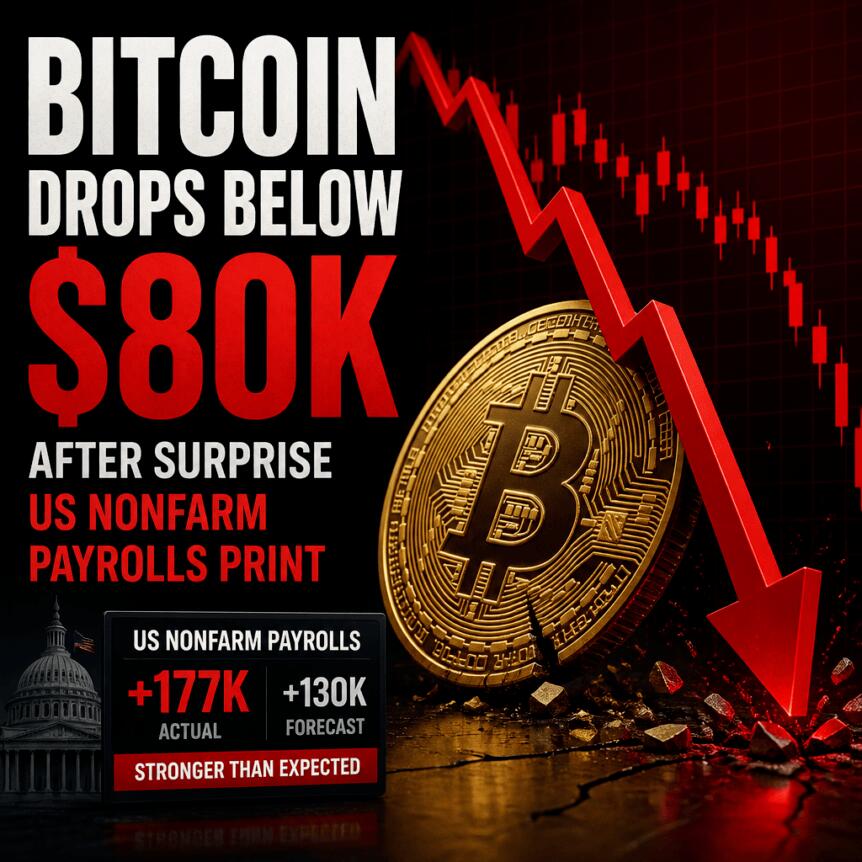
The US jobs report landed hotter than many economists expected in August, and the immediate ripple was felt across risk assets—including Bitcoin. According to figures released on Friday, the US economy added 162,000 nonfarm payroll jobs, roughly three times the consensus estimate of about 56,000. Bitcoin initially slid from around $81,300 to local lows near $78,600 before recovering to about $79,500 by the time of writing.
The stronger labor market also injected fresh volatility into expectations for the next Federal Open Market Committee (FOMC) decision on Sept. 15–16. With the Fed’s path still being debated, traders appeared to reprice the odds of a pause versus a rate hike after the payroll release, even as parts of the political debate around interest rates intensified.
Key takeaways
- US nonfarm payrolls rose to 162,000 in August—well above the ~56,000 economist consensus.
- Bitcoin reacted with a selloff from $81,300 to $78,600, then rebounded to roughly $79,500.
- Polymarket’s implied probabilities for the Sept. 16 FOMC rate decision swung back toward a 50/50 split after the data.
- A Blake2b-based Bitcoin fork (continuation of the BIP-110 chain) recorded early spot activity, with coins trading on Neoxa around $350 versus USDC.
Hotter payrolls shift FOMC expectations again
Labor market strength tends to matter for central-bank policy because it can influence whether inflation pressures persist and how quickly—if at all—the Fed can comfortably ease rates. This latest set of numbers landed decisively above forecast, and traders reacted in real time.
Earlier in the week, sentiment around the upcoming FOMC meeting had already been unstable. In particular, Fed Governor Christopher Waller signaled on Thursday that he would favor a pause pending upcoming inflation data. That comment helped move market-implied odds: Polymarket reportedly shifted probabilities to 60% for a pause and 40% for a 25 basis-point rate hike.
Friday’s labor data changed the picture. After the payrolls beat expectations, implied probabilities returned to a roughly even split, with Polymarket showing a 50/50 division between the pause and a 25 basis-point hike.
Beyond the markets, political pressure on the Fed’s policy direction also became part of the narrative. US President Donald Trump used Truth Social to demand further rate cuts, arguing that high interest rates put the US at a disadvantage and saying he would not allow it. The post also framed the debate as a change in stance from previous leadership—after Trump had criticized former Chair Jerome Powell for not cutting rates, though he waited until Friday to make a similar demand aimed at the then-newer Fed leadership context.
Why Bitcoin sold off after a jobs beat
Bitcoin’s drop immediately after the payroll release followed a pattern investors have seen in many rate-sensitive environments: stronger economic prints can increase expectations that borrowing costs will remain higher for longer. That can translate into tighter financial conditions and reduced appetite for high-volatility assets.
In this case, the chart response was clear. Bitcoin moved off roughly $81,300 to local lows around $78,600 following the data, then partially recovered to about $79,500. While that rebound suggests traders were not fully committed to a sustained risk-off trajectory, the initial selloff highlights how quickly macro data can overpower other narratives when the policy path feels uncertain.
With the next FOMC meeting approaching, this jobs report adds another data point traders can use to calibrate their view of the Fed’s reaction function. What remains uncertain is not only the direction of policy, but also whether committee members ultimately align behind a single approach—especially as forward guidance has been viewed by many traders as less anchored than it was during prior eras of clearer signaling.
Blake2b Bitcoin fork finds its first thin liquidity
Separate from the macro-driven market moves, a technical development inside the “Bitcoin fork” ecosystem drew attention. After the BIP-110 soft fork activated on Aug. 7, the network temporarily split between a chain enforcing BIP-110 rules and another chain continuing under the previous ruleset.
Supporters of BIP-110 argued the branch struggled because miners did not allocate enough computational power to continue extending it. In response, they have pointed to this outcome as evidence—at least in their view—of how concentrated influence can be within the mining layer. Their criticism centers on the fact that only a small number of mining pools control the majority of Bitcoin’s hashrate, meaning the same entities can strongly affect which chain progresses and which transactions make it into blocks.
From there, a subset of BIP-110 supporters pursued a different approach. Led by LukeDashjr, they continued the BIP-110 chain while changing the proof-of-work algorithm to Blake2b, aiming—according to the proponents’ rationale—to make it easier for a different set of miners to participate using DATUM gateway technology. The relevant hard fork was initiated on Aug. 30.
A key practical implication is that holders of SHA-256 Bitcoin balances were mapped 1:1 into the Blake2b version: every address holding SHA-256 Bitcoin before Aug. 7 (and possibly after) is reported to hold an equivalent amount on the Blake2b chain.
At the moment, liquidity is still limited. The only exchange listing Blake2b Bitcoin is Neoxa. Even so, early trading is visible: Blake2b coins are trading at about $350 against USDC, with an approximately 1.1% spread, based on Neoxa’s order book for the pair BTCB2/USDC.
What to watch next: macro volatility and fork liquidity
Going forward, the immediate driver of Bitcoin’s near-term mood is likely to remain macro—especially around the Fed meeting on Sept. 15–16, where fresh labor and inflation data can still reweight the market’s odds. At the same time, the Blake2b fork story is a separate but related reminder that “Bitcoin ecosystem” developments are increasingly moving in parallel paths—where token availability on exchanges and liquidity depth may determine whether these narratives can move beyond niche trading.
https://www.cryptobreaking.com/bitcoin-drops-below-80k-after/?utm_source=blogger%20&utm_medium=social_auto&utm_campaign=Bitcoin%20Drops%20Below%20$80K%20After%20Surprise%20US%20Nonfarm%20Payrolls%20Print%20
Comments
Post a Comment