
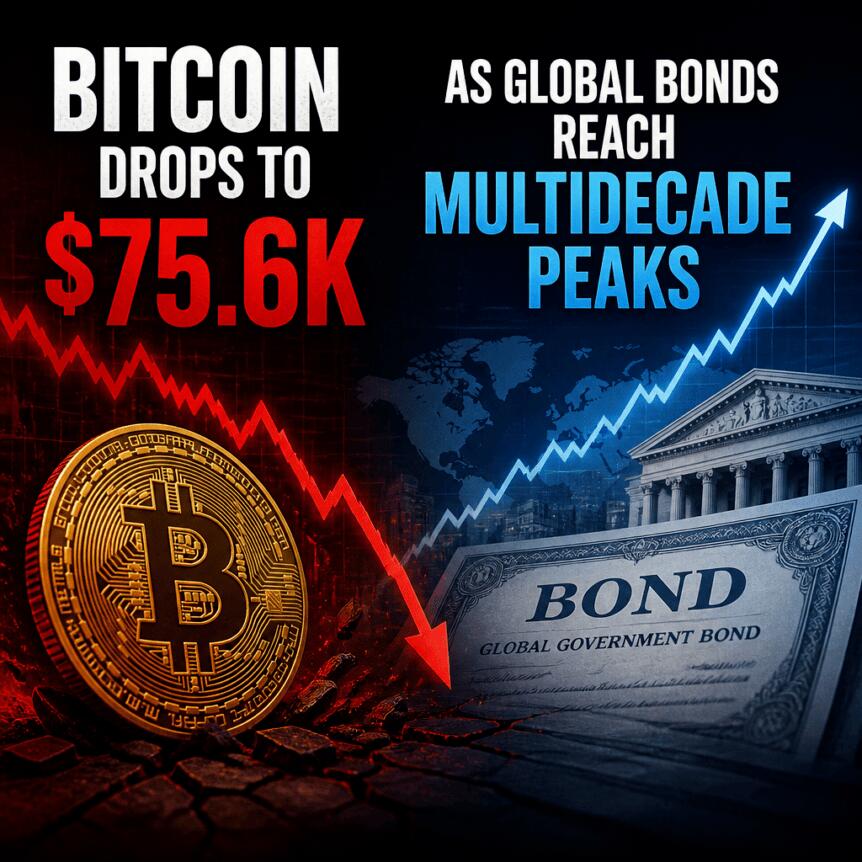
Bitcoin slid to its lowest level so far in September during Tuesday’s Wall Street open, with pressure coming from a sharp jump in global bond yields and a market that remains focused on US legislative risk. At the same time, oil prices stayed elevated, adding to concerns that inflation could remain stubborn and keep central banks on a tighter path.
According to TradingView data cited by Cointelegraph, BTC/USD dipped under $76,000, wiping out the prior day’s move toward $79,600. The slide unfolded as traders looked ahead to a key procedural vote on the proposed CLARITY Act in the US Senate at 2:15pm Eastern time—an event that could shape expectations for how crypto regulation is ultimately carved up between the SEC and CFTC.
Key takeaways
- Bitcoin fell to $75,560, its lowest level in September at the Wall Street open, as BTC/USD slipped below $76,000.
- Global bond yields reached multi-year highs, with the US 10-year yield pushing above 5% for the first time since November 2023.
- Oil prices around $100+ remained a factor behind “higher-for-longer” inflation fears, weighing on risk assets including crypto.
- Market participants expect central banks to keep interest rates higher, a traditional headwind for speculative assets like bitcoin.
- The CLARITY Act procedural vote is seen as only one hurdle; even passage would not automatically guarantee final law.
CLARITY Act vote keeps traders on the defensive
Even with crypto already reflecting a complicated regulatory backdrop, Tuesday’s scheduled procedural vote kept traders from taking aggressive risk. The legislation is designed to advance to a Senate-floor debate if it secures the necessary 60 votes, turning a procedural milestone into a focal point for sentiment.
Earlier coverage from Cointelegraph highlighted that consensus expectations for success were low despite some pockets of optimism. Cointelegraph also pointed to Polymarket odds indicating only about 14% probability that the CLARITY Act becomes law in 2026 as of Tuesday.
Trading firm QCP Capital argued that the Tuesday procedural step—if it clears—would likely be only part of the story. In an analysis published Monday, QCP Capital noted that passage would “clarify the respective regulatory roles of the SEC and CFTC,” a change that could strengthen the medium-term case for institutional participation by reducing uncertainty. However, QCP stressed that procedural progress does not equal final adoption, and the timing of subsequent legislative stages would be what ultimately determines any immediate market impact.
Bond selloff spreads as yields hit fresh highs
While legislative headlines can sway sentiment quickly, Tuesday’s dominant macro driver appeared to be the surge in bond yields across major economies. Cointelegraph reported that US stocks turned lower as yields climbed back toward levels last seen during earlier cycles of monetary tightening.
According to the article, the US 10-year yield rose above 5% for the first time since November 2023, reaching 5.041%—a level last seen in June 2007. Reuters also reported that the average 10-year yield for the world’s seven largest economies hit 4.285%, the highest since mid-2008 around the Global Financial Crisis.
Beyond the US, other government bond benchmarks moved sharply as well. Cointelegraph cited that the UK 30-year yield reached 5.95% for the first time since March 1998, while Japan’s 10-year yield climbed to 3.04%, its highest in roughly three decades.
Why yields and oil matter more for crypto than headlines suggest
For crypto markets, higher yields are not just a “risk-off” signal—they directly affect the broader financial conditions under which non-yielding assets are priced. As bond yields rise, investors often demand greater returns elsewhere, which can reduce the attractiveness of speculative exposures like bitcoin, especially when traders expect central banks to remain restrictive.
Cointelegraph attributed the continued rise in yields to inflation risk fueled by elevated oil prices and heightened geopolitical concerns. WTI crude neared $105 per barrel on Tuesday, according to the report, tracking toward its highest levels since early May. The article also framed the situation around the risk of supply disruptions linked to a widening Middle East conflict, reinforcing the idea that energy-linked inflation pressures could persist.
Those dynamics feed directly into expectations for policy. The Kobeissi Letter argued that monetary policy is shifting and that rate hikes are “returning,” adding that intervention may become necessary as yields move to “unsustainable” levels. Cointelegraph also noted market expectations that the US Federal Reserve would raise its benchmark rate by 0.25% on Wednesday and that the Bank of Japan was expected to follow suit at its Friday meeting.
What to watch after Tuesday’s close
Bitcoin’s reaction to Tuesday’s macro backdrop suggests traders may be treating this week as a test of how sensitive crypto remains to higher-for-longer rate expectations. The next question is whether the CLARITY Act procedural vote changes the regulatory conversation enough to counterbalance the tightening signal from yields—or whether macro conditions continue to dominate near-term price action.
https://www.cryptobreaking.com/bitcoin-drops-to-75-6k/?utm_source=blogger%20&utm_medium=social_auto&utm_campaign=Bitcoin%20Drops%20to%20$75.6K%20as%20Global%20Bonds%20Reach%20Multidecade%20Peaks%20
Comments
Post a Comment