
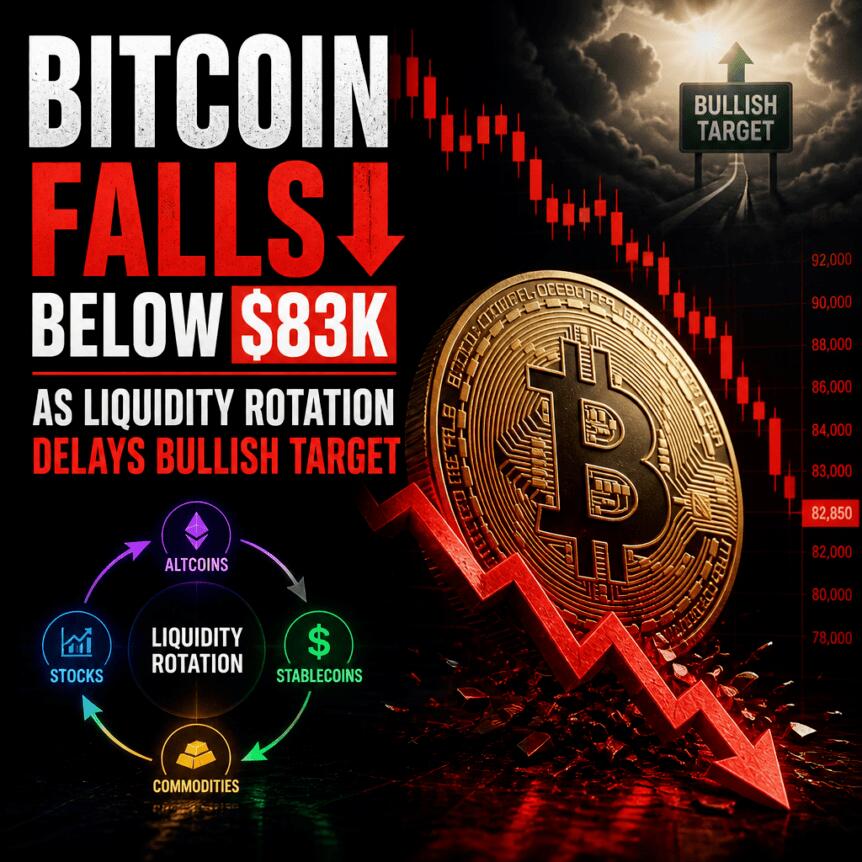
Bitcoin slid to weekly lows on Monday after earlier upside momentum faded, with traders pointing to a sudden buildup of sell-side orders on exchange books around $85,700. The move triggered notable liquidations, while broader risk sentiment also weakened as US markets reacted to renewed uncertainty over the Iran situation.
TradingView data showed BTC/USD dropping below $82,700 for the first time since Sept. 21, following a strong run that included the pair’s highest weekly close since late January near $84,450. Instead of pushing toward last week’s highs above $87,000, price encountered a concentrated pocket of resistance.
Key takeaways
- BTC/USD fell below $82,700 after failing to retest the prior week’s above-$87,000 highs.
- About $30 million in ask liquidity appeared around $85,700, coinciding with the reversal from higher levels.
- CoinGlass data indicated roughly $70 million of liquidations over 24 hours, primarily cutting into nearby long positions.
- US stock-market futures weakened alongside crude oil strength after President Donald Trump declined to rule out further strikes on Iran.
- Analyst Aksel Kibar warned Bitcoin could revisit the sub-$80,000 area if momentum doesn’t quickly stabilize.
Why order-book liquidity can flip momentum
According to TradingView, BTC/USD turned lower after a decisive attempt at consolidation above $84,450 failed to extend. The most cited microstructure signal was the appearance of a large, clearly defined layer of sell-side liquidity on exchanges around $85,700, with over $30 million clustered near that price.
In practical terms, these “liquidity walls” can matter because they concentrate sell interest at a specific level. If buying demand can’t absorb those resting orders, price may struggle to advance and can even accelerate downward as traders reassess the likelihood of a breakout. The reported timing—after Bitcoin failed to move back toward eight-month highs above $87,000—suggests the market’s attempt at continuation met a predictable obstacle.
Market participants also noted that this kind of conspicuous order-book change often draws attention from larger traders, including those managing hedges or positioning for future moves. Whether the liquidity layer represents genuine long-term supply or more tactical order placement remains difficult to confirm from order-book snapshots alone, but the impact on near-term price action was clear.
Liquidations underscore the speed of the downturn
While order-book data explains the “why” behind resistance, liquidation statistics help show the “how” behind the move. CoinGlass liquidation data, as referenced in the report, recorded liquidations of nearby long positions totaling around $70 million over 24 hours at the time of writing.
When price breaks through key intraday levels, leveraged traders who are positioned on the long side can be forced out quickly. That fast unwinding can compound selling pressure, turning a stalled breakout attempt into a sharper downside move, especially when liquidity is already strained by the presence of a heavy sell wall.
For investors and traders, these figures are less about day-to-day drama and more about confirming that the decline wasn’t purely slow drifting—there was enough leverage in the market to produce liquidation cascades.
Risk-off pressure from US geopolitics and oil
Bitcoin’s weakness also lined up with a deterioration in broader risk sentiment. The report linked the move in crypto to downside in US stock-market futures after President Donald Trump refused to rule out additional strikes on Iran.
In remarks reported by Fox News during the PGA Tour Presidents Cup on Sunday, Trump said: “I don’t want to say that. I don’t want to say that. I mean, it’s possible, but I just don’t want to say that.”
At the time of writing, Nasdaq futures were down about 0.9%, while WTI crude oil moved above $95 per barrel for the first time since Sept. 24. Rising oil prices often feed into wider concerns about inflation, economic activity, and risk appetite—factors that can spill over into crypto even when the immediate catalysts are order-book driven.
For traders monitoring correlations, the takeaway is that Monday’s drop wasn’t isolated to crypto microstructure alone; macro headlines appeared to reinforce a shift toward caution.
What to watch around $85,700 and next support zones
The $85,700 level is now central to the near-term debate. The report described it as the barrier that blocked another attempt to reach the 2026 year-open level at $88,700, where Bitcoin stalled last week.
Even with a strong weekly close previously, the failure to reclaim the path back toward $88,700 suggests bulls still need a clearer sequence of higher highs and higher lows rather than just intermittent pushes. As the price moves, the market will likely treat earlier resistance areas as potential pivot points—turning them into either launchpads or magnets for further selling depending on how quickly Bitcoin can recover.
Analyst Aksel Kibar warned that Bitcoin’s current behavior did not resemble a decisive breakout. In a post on X, he cautioned that hesitant price action can lead to returning inside the familiar range from $60,000 to $80,000—an area the report frames as where BTC/USD spent much of 2026.
The immediate risk highlighted by that commentary is a scenario where the market fails to hold above the recent breakdown area and instead revisits sub-$80,000 territory. In the short term, that means traders should watch for whether downside continues to attract liquidations or whether support reasserts itself quickly enough to prevent a deeper retracement.
Going forward, the key uncertainty is whether the $85,700 order-book pressure dissolves and allows price to rebuild toward $88,700, or whether liquidation-driven weakness and macro jitters keep pulling BTC back toward the $80,000 zone; monitoring both the exchange liquidity changes and broader US risk headlines may offer the most practical signal for the next move.
https://www.cryptobreaking.com/bitcoin-falls-below-83k-as/?utm_source=blogger%20&utm_medium=social_auto&utm_campaign=Bitcoin%20Falls%20Below%20$83K%20as%20Liquidity%20Rotation%20Delays%20Bullish%20Target%20
Comments
Post a Comment