
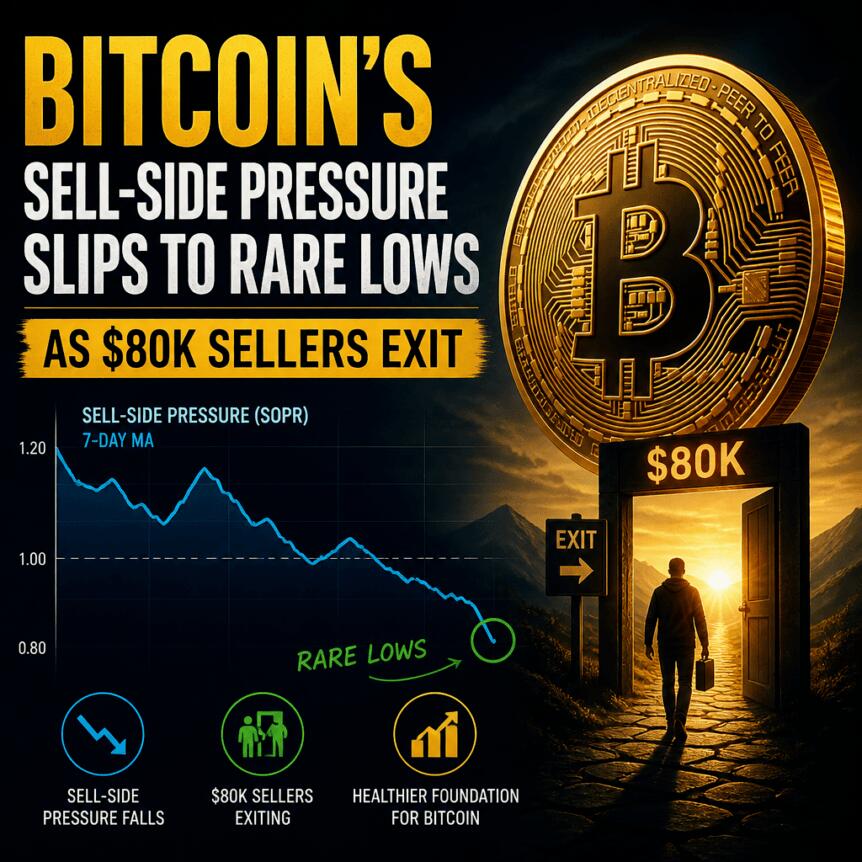
Bitcoin’s near-term sell pressure has eased sharply, with onchain data pointing to a “low sell-side risk” environment as August profit-taking fades into September. Glassnode’s latest weekly onchain report shows Bitcoin’s sell-side risk ratio has fallen to 7—down from 16 in September—an improvement that can matter for traders who watch realized profits as a trigger for faster, more emotional selling.
The same Glassnode update also highlights how long-term holders are realizing profits more selectively, while US spot Bitcoin ETF investors remain deeply underwater on an aggregate basis relative to their breakeven level near $86,000.
Key takeaways
- Glassnode reports Bitcoin’s sell-side risk ratio reset lower, dropping to 7—among the lowest readings recorded.
- Lower selling pressure coincides with Bitcoin holding most of its roughly 25% August gains.
- Long-term holders’ share of realized profit fell to 47% from 88% at the August peak.
- US spot Bitcoin ETF investors have spent 229 sessions below the aggregate breakeven point near $86,000, with paper losses around $3.9 billion.
Why the sell-side risk ratio matters
Glassnode frames its sell-side risk ratio (SSRR) as a measure of “realized” pressure rather than just price movement. The metric takes the total value of onchain realized profits and losses and divides it by Bitcoin’s realized market capitalization. In other words, it aims to capture how much US-dollar value has actually changed hands versus the size of the realized coin base for the period in question.
In the report, Glassnode says lower SSRR values typically align with conditions such as “macro market bottoms, accumulation phases and relatively low sell-side risk environments.” That interpretation is particularly relevant for markets that have recently rallied, because periods of heavy realized profit can increase the likelihood that holders decide to lock gains if price momentum stalls.
September cooling after August’s rebound
Glassnode ties the SSRR decline to a post-rebound shift in realized behavior. The company noted that SSRR reached 16 when Bitcoin surged to multimonth highs above $80,000 in late August. As of this week, the ratio has more than halved to 7, which Glassnode characterizes as one of the lowest readings on record.
The onchain analytics platform argues that the August price rebound “drawn little supply,” referring to an absence of meaningful supply emergence in onchain activity. Glassnode also contextualizes how unusual this is versus other periods: it pointed out that similar “supply draw” conditions were not observed in the same way at later points in the year, and that only a small share of days across the past year have posted readings lower than today.
That matters because a low SSRR environment can reduce the probability that even a relatively modest pullback immediately triggers aggressive selling. It doesn’t eliminate downside risk—price can still move on macro factors or liquidity—but it can change the balance between who is likely to sell and how much profit exists to be realized.
Profit-taking shifts: long-term holders selling less
Beyond aggregate sell pressure, Glassnode also focused on who is realizing profits onchain. The report defines long-term holders as wallet entities that hold a UTXO without spending it for at least six months. According to Glassnode, these holders are realizing profits at a lower rate this month.
Specifically, Glassnode says long-term holders’ share of realized profit has fallen to 47% from 88% at the August peak. It also notes that September’s realized profit spike on September 3, 2026 was under half the size of August’s. The combined message is that the “profit who sells” dynamic appears to be shifting away from the most patient holders.
“The sellers this month are recent buyers, and even they are selling less.”
For investors, that distinction can be meaningful: recent entrants are often more sensitive to near-term price changes, while long-term holders typically respond differently. If the selling impulse is increasingly concentrated among newer holders—and even they are moderating—it can help explain why SSRR is trending down even after a strong month.
ETF breakevens remain a key reference point
Even with improving sell-side risk, the report underscores that ETF positioning is still a notable overhang. Glassnode says US spot Bitcoin ETF investors would return to aggregate profit at roughly $86,000. According to the report, Bitcoin has closed below that level for the past 229 sessions, and ETF investors’ paper losses are currently around $3.9 billion.
This doesn’t necessarily mean ETF holders are selling aggressively—paper losses can persist through drawdowns when investors maintain exposure through continued inflows or hold through volatility. But from a behavioral perspective, breakeven levels often become a psychological and institutional reference point. If prices revisit $86,000, ETF investors may face pressure to reassess risk, while the opposite scenario (further declines) could intensify the temptation to reduce exposure.
The SSRR decline may therefore help temper fears that a correction automatically forces a cascade of realized selling. At the same time, ETF breakeven dynamics serve as a reminder that a large cohort is still sitting on losses, and that sentiment could change quickly if price action approaches or moves away from that threshold.
Readers should watch whether SSRR stays near these low levels as Bitcoin’s price continues to trade relative to the $80,000 area and whether ETF performance moves ETF investors closer to—or further from—aggregate breakeven near $86,000. The key question is whether September’s “lower sell-side risk” environment persists as realized profit levels evolve.
https://www.cryptobreaking.com/bitcoins-sell-side-pressure-slips/?utm_source=blogger%20&utm_medium=social_auto&utm_campaign=Bitcoin’s%20sell-side%20pressure%20slips%20to%20rare%20lows%20as%20$80K%20sellers%20exit%20
Comments
Post a Comment