
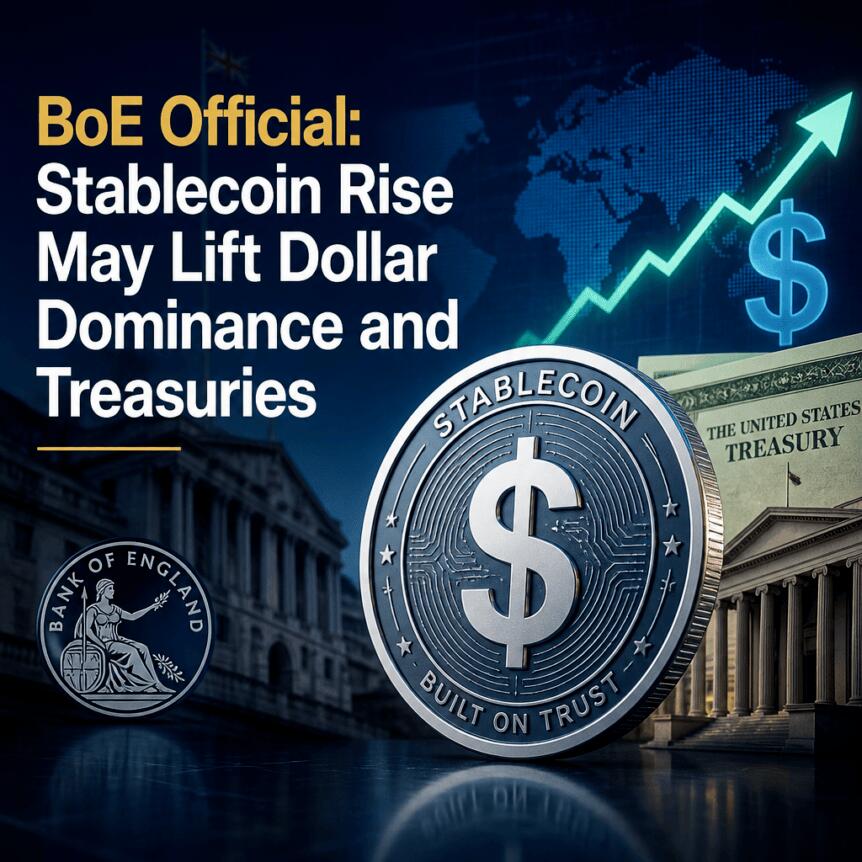
Stablecoins are increasingly shaping the plumbing of global finance—and not just inside crypto. In remarks delivered at Queen’s University Belfast on Tuesday, Carolyn Wilkins, a member of the Bank of England’s Financial Policy Committee, warned that the fastest-growing “digital dollar” products could strengthen the US dollar’s international role while also creating new stresses for US Treasury markets.
Wilkins’ core message was straightforward: dollar-denominated stablecoins make cross-border settlement easier and widen access to dollar-linked instruments outside the United States. That, she argued, can translate into higher demand for US Treasury bills held by stablecoin issuers and, at larger scale, potentially amplify liquidity pressure if redemptions accelerate.
Key takeaways
- Wilkins said dollar-linked stablecoins could reinforce US dollar dominance by improving cross-border settlement and access to dollar assets.
- Data cited by the Bank of England suggests major issuers already hold large Treasury positions, tying stablecoin growth to government debt demand.
- At scale, large stablecoin redemptions could force issuers to sell Treasuries, potentially increasing volatility in stressed market conditions.
- The stablecoin market remains overwhelmingly tied to the US dollar, giving it a “first-mover advantage,” even as other currencies pursue their own products.
- In the UK, regulators are moving more deliberately but have shifted toward enabling frameworks for stablecoin issuance alongside experimentation from the central bank.
Dollar stablecoins and the US Treasury linkage
Wilkins’ comments focused on how stablecoins operate as a bridge between crypto activity and traditional dollar assets. According to figures referenced in her speech, Tether’s USDt (USDT) and Circle’s USDC (USDC) held nearly $150 billion in Treasury bills at the end of 2025, and together bought roughly $33 billion during 2025. The implication is that stablecoin reserves are not just idle cash: they are actively positioned in US government securities.
That matters for investors and market participants because it links stablecoin flows to a key part of the global risk-free asset complex. When stablecoin issuance and redemption cycles accelerate, reserve management becomes more dynamic—potentially affecting demand and, under certain conditions, sell-side liquidity.
Wilkins also emphasized a two-way channel. While stablecoin growth can support Treasury demand, she cautioned that the same mechanism could work in reverse. If redemptions become large and widespread enough, issuers may need to raise liquidity by selling Treasury bills. In an already strained market, those sales could worsen volatility.
Why “digital dollars” could spread beyond crypto
The Bank of England committee member framed dollar stablecoins as an enabler for non-US users. Dollar-denominated stablecoins, she said, can broaden access to dollar-linked assets and streamline settlement across borders—features that can be particularly attractive for institutions and users operating in jurisdictions where access to dollar rails is more complex or expensive.
Wilkins pointed to the market’s current structure: stablecoins remain heavily concentrated in the US dollar. According to context cited in her speech, the US dollar accounts for 98% of stablecoin value. She described this as conferring a “considerable first-mover advantage,” reflecting how early issuance, liquidity, and integration have made dollar stablecoins the default reference point for most digital dollar activity.
Outside the central banks’ own research, broader market reporting also signals strong momentum. The article that references Wilkins’ remarks notes that stablecoin circulation has surpassed more than $300 billion, underscoring how quickly “digital dollar” instruments have moved from niche usage to a large, globally referenced market. While the precise effect on Treasuries depends on reserve composition and redemption behavior, the size of the sector increases the relevance of central-bank monitoring.
UK’s push for stablecoin development—without waiting for adoption
Wilkins’ remarks also implicitly contrast the US-dominated stablecoin landscape with the UK’s efforts to build a credible local framework. Pound-denominated stablecoins have been slower to gain traction, she said, but UK regulators have taken steps to make issuance possible under clearer oversight.
The Financial Conduct Authority has taken a structured approach. It began testing prospective stablecoin issuers via a dedicated regulatory sandbox and finalized rules for UK stablecoin issuance in June, according to a policy document published by the FCA (PS26/10). The Bank of England, meanwhile, has continued experimenting with digital money concepts, including a test of whether stablecoins and a simulated digital pound could operate together for cross-border trade payments (as covered in earlier reporting by Cointelegraph: interoperability for cross-border payments).
Just as importantly, Wilkins’ message aligns with a broader regulatory pivot. The Bank of England has been perceived as moving toward a more accommodating posture after industry criticism that earlier proposals might restrict innovation (reported previously by Cointelegraph: softer UK stablecoin regime). For market participants, this shift matters because stablecoin issuance tends to move quickly when legal pathways are clear—and slowly when they are uncertain.
That UK strategy also reflects the wider challenge of fragmentation in global stablecoin regulation. Earlier coverage highlighted how inconsistent rules across countries can constrain adoption for international finance, with reference to commentary from a WTO director (Cointelegraph: fragmented regulations). While Wilkins’ speech is focused on dollar effects, it implicitly raises the question of whether non-dollar stablecoins can become structurally viable without similar clarity and integration.
What to watch next: redemption stress and currency concentration
Wilkins’ warning is less about stablecoins being “good” or “bad,” and more about how their scale could change the behavior of traditional markets during periods of stress. Investors, traders, and issuers should watch how redemption dynamics evolve at larger sizes—especially the extent to which stablecoin reserve management relies on Treasury bills—alongside whether stablecoin value remains as concentrated in the US dollar as it is today.
https://www.cryptobreaking.com/boe-official-stablecoin-rise-may/?utm_source=blogger%20&utm_medium=social_auto&utm_campaign=BoE%20Official:%20Stablecoin%20Rise%20May%20Lift%20Dollar%20Dominance%20and%20Treasuries%20
Comments
Post a Comment