
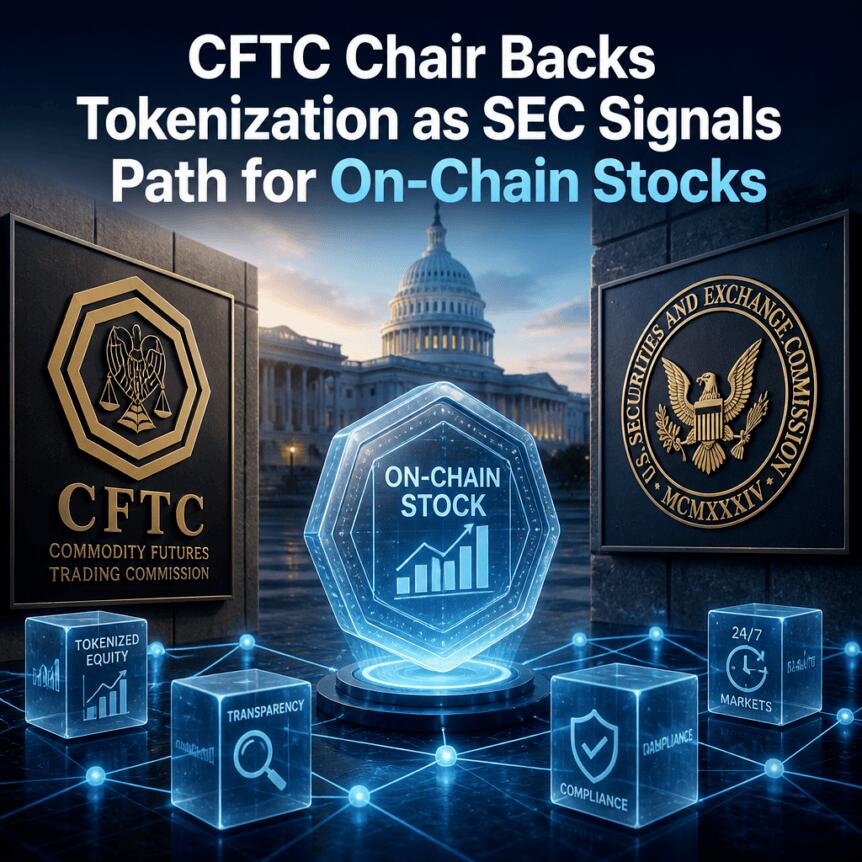
The US CFTC is signaling that regulators may have to rethink how markets function as tokenization spreads beyond crypto-native assets and into traditional finance. In remarks delivered Tuesday at the US Treasury Market Conference, CFTC Chair Michael Selig argued that “mass tokenization” could become a foundation for a more efficient financial system, driven by existing regulatory frameworks being adapted for blockchain-based settlement, collateral flows, and onchain market infrastructure.
Selig’s comments landed amid ongoing legislative uncertainty around crypto regulation, and alongside parallel efforts by the SEC to create regulated pathways for tokenized securities trading. Together, the two agencies’ messaging suggests US regulators are converging on the idea that tokenized markets will expand regardless of the pace of broader statutory reform.
Key takeaways
- CFTC Chair Michael Selig said financial markets should prepare for “mass tokenization,” with regulators updating existing frameworks for onchain finance.
- Selig framed tokenization of real-world assets as a potential shift toward near-instant settlement and real-time collateral movement across market participants.
- The CFTC’s latest crypto regulatory filing for White House review is still at the “prerule” stage and does not yet specify proposed rules.
- On the SEC side, tokenized US stock trading has advanced via a temporary “Innovation Exemption,” reflecting a step-by-step regulatory approach.
CFTC prepares for tokenized finance across asset classes
At the Treasury Market Conference, Selig drew an analogy between earlier market modernization—moving from “hand signals to electronic trading”—and the potential of tokenization to accelerate processing across asset classes. He said tokenization of real-world assets (RWAs) could support a more efficient system by enabling near-instant settlement and real-time collateral transfer between clearinghouses, intermediaries, and end users.
Importantly, Selig also described the CFTC’s regulatory posture as “principles-based.” That signals an approach focused on outcomes and risk controls rather than prescriptive technology rules, a stance that matters for builders because it may allow multiple tokenization architectures to fit within a common regulatory logic—as long as market conduct and compliance expectations are met.
Legislation stalled, but regulators keep moving
Selig’s remarks come after the CFTC had indicated it could proceed with crypto-related rulemaking under its existing authority if Congress did not enact the CLARITY Act. According to earlier coverage referenced in the article, the Senate failed to advance the bill on Sept. 15, leaving the question of comprehensive statutory clarity unresolved.
Since then, the CFTC continued its process. On Sept. 17, the CFTC submitted a regulatory action covering crypto asset transactions and markets for White House review, according to the filing described in earlier reporting. The filing is reportedly still at the “prerule” stage, meaning it does not yet detail the specific regulations the CFTC intends to pursue.
For market participants, the key takeaway is that regulatory work is progressing even without final legislative momentum. However, the lack of detail in the “prerule” stage also implies that traders, exchanges, custodians, and tokenization providers should expect ongoing uncertainty as proposals are drafted and reviewed.
SEC also pushes tokenized market infrastructure
While the CFTC is discussing tokenization in the context of a broader shift in market plumbing, the SEC has been taking steps focused on securities trading. The article notes that Jamie Selway, Director of the SEC’s Division of Trading and Markets, told Bloomberg TV that tokenization and crypto have recently become politicized, but that they are “not naturally a politicized function.” Selway also argued that US success in developing these markets should receive bipartisan support.
The agency’s practical pathway has included temporary regulatory allowances. On Sept. 17, the SEC granted a temporary “Innovation Exemption” for tokenized US stock trading. As described in the source, the exemption allows certain platforms to trade digital versions of US-listed stocks under specified conditions.
This matters because it represents a concrete mechanism for compliance testing—allowing limited market activity while longer-term rules are developed. It also reflects the SEC’s preference for incremental regulatory frameworks that can be refined based on observed market behavior and risk outcomes.
What to watch: convergence, but not synchronization
Taken together, the CFTC’s “mass tokenization” framing and the SEC’s temporary securities trading exemption point to a shared view: tokenization is likely to move from experimentation toward mainstream market infrastructure. Yet the agencies are not necessarily moving in lockstep. The CFTC’s position is rooted in adapting existing authority and establishing principles-based rules as onchain markets evolve, while the SEC’s approach—at least in the securities segment cited here—has emphasized targeted exemptions to manage regulatory transition.
Readers should watch for what emerges once the CFTC’s “prerule” filing advances beyond White House review and begins to outline more concrete rulemaking goals. At the same time, attention will likely remain on whether the SEC’s Innovation Exemption becomes a template for broader or longer-lasting tokenized securities permissions, and what conditions regulators ultimately consider essential for investor protection and market integrity.
https://www.cryptobreaking.com/cftc-chair-backs-tokenization-as/?utm_source=blogger%20&utm_medium=social_auto&utm_campaign=CFTC%20Chair%20Backs%20Tokenization%20as%20SEC%20Signals%20Path%20for%20On-Chain%20Stocks%20
Comments
Post a Comment