
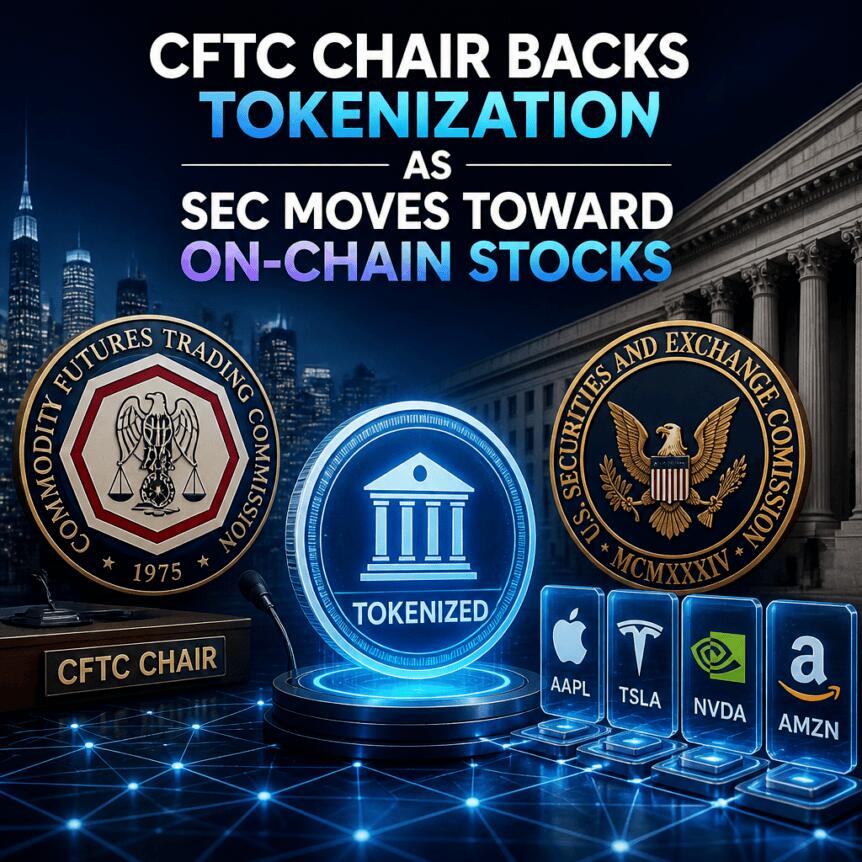
US regulators are increasingly signaling that tokenization of real-world assets (RWAs) and broader “onchain” market infrastructure may become the next major shift in financial plumbing. CFTC Chair Michael Selig used remarks at the US Treasury Market Conference to argue that markets should prepare for “mass tokenization,” as regulators seek to adapt existing rules to blockchain, AI and onchain finance.
Selig’s comments frame tokenization not as a niche experiment, but as an evolution comparable to the move from manual signals to electronic trading. At the same time, the CFTC and SEC are both taking separate but related steps—working through existing authorities and limited regulatory pathways—while broader legislative efforts remain in limbo.
Key takeaways
- CFTC Chair Michael Selig said markets should prepare for “mass tokenization,” positioning RWAs as a foundation for faster settlement and real-time collateral movement.
- Selig emphasized a “principles-based” approach as tokenization and onchain finance mature under the CFTC’s remit.
- The CFTC has submitted a crypto market regulatory action for White House review, but it is currently at the “prerule” stage.
- The SEC is also pushing on tokenized markets, including granting a temporary “Innovation Exemption” for tokenized US stock trading.
- Regulatory momentum is building even as the CLARITY Act has failed to advance in the US Senate.
CFTC Chair: tokenization as the next infrastructure upgrade
Speaking Tuesday at the US Treasury Market Conference, Selig argued that tokenization of real-world assets could help create a more efficient financial system. His remarks highlighted potential operational benefits such as near-instant settlement and the ability to move collateral in real time across clearinghouses, intermediaries and end users.
In his comparison to past market modernization, Selig said, “Just as the transition from hand signals to electronic trading advanced our financial system, I believe tokenization can do the same for all asset classes.” He added that the CFTC intends to pursue principles-based rules as tokenization and onchain finance evolve.
This matters for market participants because “principles-based” frameworks can affect how quickly issuers, exchanges, clearing firms and custody providers can build products and integrate them into existing market structures. Rather than requiring everything to fit a single prescriptive model, the approach can leave room for different tokenization architectures—though it also increases the importance of interpretation and compliance guidance as new cases emerge.
Legislation stalled; CFTC moves using existing authority
Selig’s remarks come amid an ongoing legislative backdrop. Earlier in August, he said the CFTC would move ahead with crypto rules under its existing authority if Congress did not pass the CLARITY Act. Cointelegraph previously reported that the Senate failed to advance the bill on Sept. 15.
That pressure point appears to be part of why the CFTC is leaning into regulatory action without waiting for a comprehensive statute. On Sept. 17, the CFTC submitted a regulatory action covering crypto asset transactions and markets for White House review. According to the description of the filing, it remains in the “prerule” stage and does not yet outline the planned regulations.
For traders and builders, the “prerule” status is a reminder that timelines may stretch while proposals circulate through internal and executive review processes. However, the submission itself signals that the CFTC is treating crypto market oversight as an active, ongoing process rather than a wait-and-see posture.
SEC’s onchain push: tokenized stocks under a temporary exemption
The CFTC’s focus on tokenization of RWAs is not the only regulatory thread. The SEC has also been advancing tokenized market mechanisms, including through targeted permission structures rather than waiting for broad, future rulemaking.
In a Bloomberg TV interview, Jamie Selway, the SEC’s Division of Trading and Markets Director, said tokenization and crypto have recently become politicized, but are “not naturally a politicized function.” Selway argued that the US should receive bipartisan support for building markets that function effectively in this new environment.
Following that general push, the SEC on Sept. 17 granted a temporary “Innovation Exemption” for tokenized US stock trading. The exemption allows certain platforms to trade digital versions of US-listed stocks under specified conditions.
The SEC’s use of an exemption framework is significant because it creates a controlled channel for experimentation. It can reduce friction for participants willing to comply with narrow restrictions while regulators develop longer-term standards. The SEC Chair Paul Atkins previously said in February that such an exemption could facilitate onchain trading while longer-term rules are developed.
Read alongside the CFTC’s remarks, the pattern suggests regulators are converging on the idea that onchain functionality—settlement efficiency, programmability, and potentially real-time collateral flows—should be approached through enforceable guardrails rather than outright delay.
What to watch next: principles-based rules and the shape of “tokenized markets”
Between the CFTC’s principles-based posture and its “prerule” submission for White House review, and the SEC’s temporary exemption approach for tokenized equities, the near-term question is less whether tokenization will expand and more how regulators will define the boundaries of compliant onchain trading and settlement.
Investors, traders, and developers should watch for two things next: any movement from “prerule” toward more detailed CFTC proposals, and the conditions or duration attached to the SEC’s Innovation Exemption—both of which will likely signal how far and how fast tokenized markets can grow within current regulatory frameworks.
https://www.cryptobreaking.com/cftc-chair-backs-tokenization-as-2/?utm_source=blogger%20&utm_medium=social_auto&utm_campaign=CFTC%20Chair%20Backs%20Tokenization%20as%20SEC%20Moves%20Toward%20On-Chain%20Stocks%20
Comments
Post a Comment