
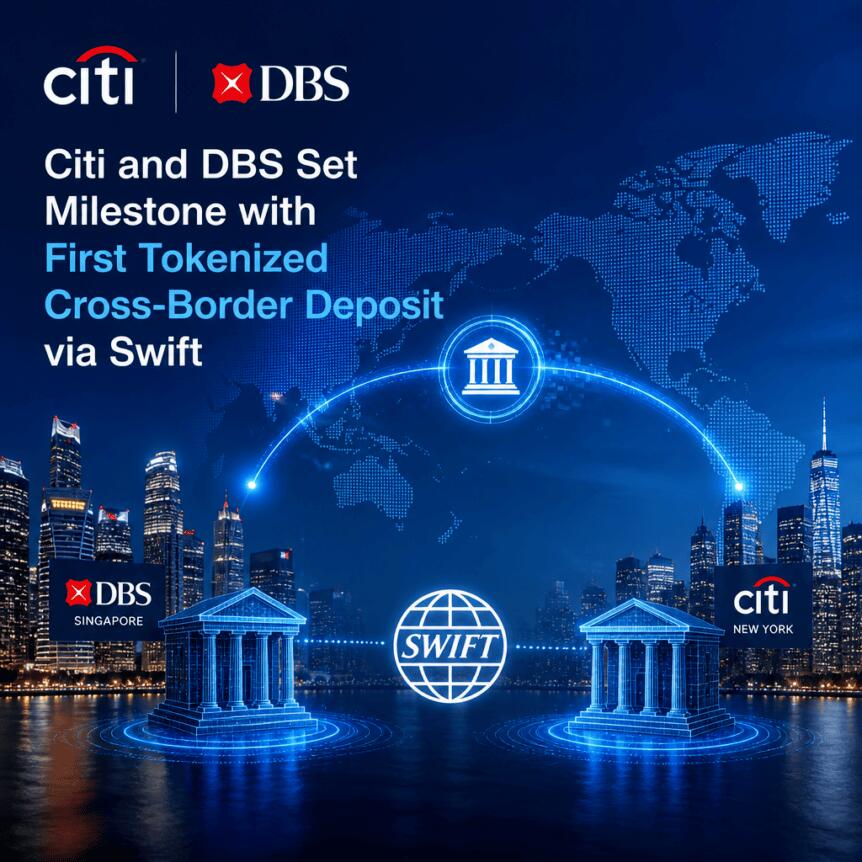
DBS and Citi have completed the first tokenized cross-border payment between Singapore and the United States over a blockchain-based settlement rail, marking a concrete step in banks’ shift from traditional transfer timelines toward near-instant processing.
The transaction was executed on Saturday using tokenized deposits via the Swift Digital Ledger, according to DBS, which said the deposit was finalized in minutes—an improvement over the “as long as two business days” timeline typical of conventional cross-border transfers. DBS made the announcement on Monday.
Key takeaways
- DBS and Citi completed a Singapore-to-US cross-border payment using tokenized deposits on the Swift Digital Ledger.
- DBS said the deposit was settled in minutes, contrasting with traditional cross-border transfers that can take up to two business days.
- The experiment highlights how major banks are testing blockchain rails while still operating within banking deposit structures.
- Swift’s blockchain ledger work is moving from pilots toward broader operational use, following earlier live demonstrations.
Tokenized deposits on Swift’s digital ledger go live
DBS described the weekend transfer as a landmark milestone for cross-border payments, not only because it used the Swift Digital Ledger, but also because it relied on tokenized deposits rather than switching to a fully crypto-native model.
Under this approach, banks can represent deposit value as tokens while keeping the transaction rooted in regulated banking balance sheets. DBS framed the speed of finalization as a key differentiator: settling within minutes rather than waiting through banking-day cutoffs and correspondent processes that often slow down international payments.
A shift from pilots to operational momentum
This development sits within a longer sequence of Swift blockchain efforts. In August, Standard Chartered and HSBC became the first banks to complete a live tokenized cross-border transaction using Swift’s blockchain ledger—showing that the concept could work outside a closed test environment.
Earlier, Swift said its blockchain-based ledger was ready for initial use and that it was preparing to pilot tokenized cross-border payments with 17 major banks. The pilot group included Citi, DBS, HSBC, BNP Paribas, UBS, ANZ, and Standard Chartered, as noted in reporting on Swift’s preparations.
With DBS and Citi now completing the Singapore-US leg using the ledger, the focus appears to be moving from feasibility and interbank coordination toward repeatable processing that can be integrated into existing banking workflows.
Why keeping deposits “inside” banking matters
While blockchain rails are often discussed in the context of digital assets, the direction implied by DBS’s framing is different: tokenization here is being used to streamline settlement while preserving familiar deposit mechanics.
That matters for multiple reasons. First, it can reduce friction for counterparties that are more comfortable with the compliance and operational controls already embedded in deposit-based systems. Second, it provides a path to faster settlement without necessarily requiring participants to hold or transfer tokens as their primary payment method for everyday banking.
In other words, these transactions suggest a hybrid model: blockchain for settlement efficiency, traditional deposits for value custody and regulated banking integration.
Plans for broader tokenized deposit networks
The weekend result also fits into plans for future deposit token infrastructure in the United States. In June, The Wall Street Journal reported that Citi and other large US banks plan to launch a separate tokenized deposit network in the first half of 2027, operated by The Clearing House. The WSJ report cites David Watson, CEO of the bank-owned payments operator, in connection with the initiative.
Separately, DBS and JPMorgan have also outlined longer-term work. In November 2025, Cointelegraph reported that the two banks revealed plans to develop a blockchain-based tokenization framework aimed at enabling onchain transfers between their respective deposit token ecosystems and potentially setting an industry standard for cross-bank payments.
Taken together, these efforts point toward an emerging competitive and collaborative landscape: banks testing tokenized rails in production while simultaneously planning next-generation network designs that could expand interoperability beyond individual bilateral relationships.
Looking ahead, market participants will likely watch whether speed improvements translate into consistent, scalable settlement performance across more corridors, and whether Swift-led ledger usage broadens beyond early pairs like DBS-Citi—especially as parallel tokenized deposit network plans move from announcements toward delivery.
https://www.cryptobreaking.com/citi-and-dbs-set-milestone/?utm_source=blogger%20&utm_medium=social_auto&utm_campaign=Citi%20and%20DBS%20Set%20Milestone%20with%20First%20Tokenized%20Cross-Border%20Deposit%20via%20Swift%20
Comments
Post a Comment