
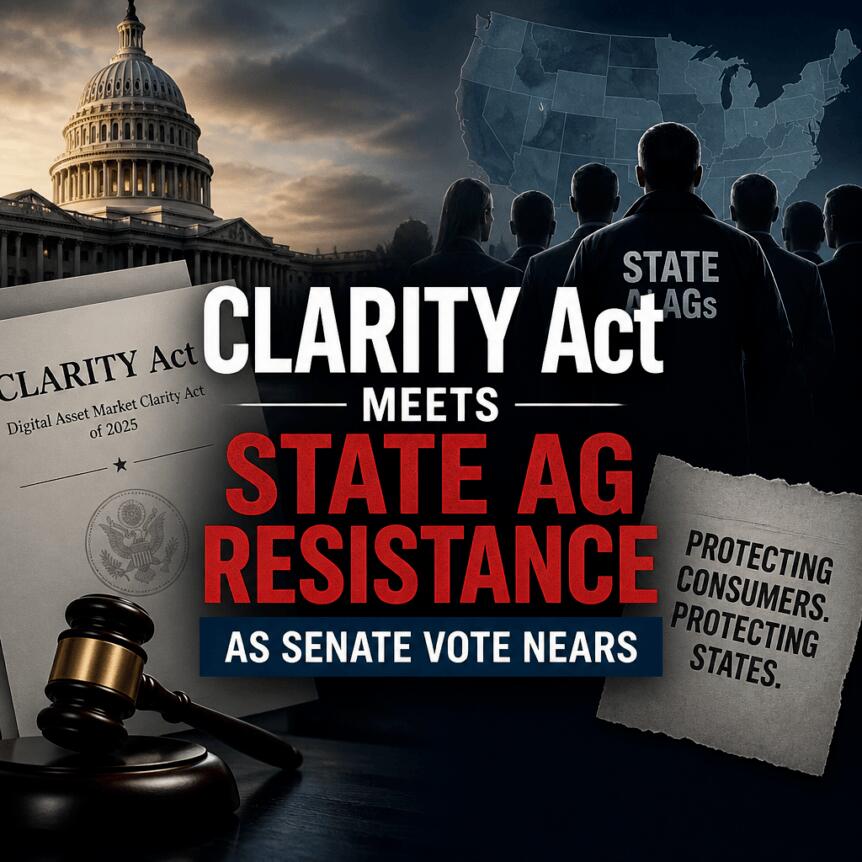
The U.S. Senate is set to hold a crucial procedural vote Tuesday on the CLARITY Act, a major piece of proposed legislation aimed at reshaping how the federal government regulates digital assets and clarifying how crypto fits within existing securities and commodities frameworks.
While recent talks around ethics restrictions for public officials appear to have moved the bill closer to action—after President Donald Trump agreed to much of a bipartisan proposal—opposition from a coalition of state attorneys general is threatening to complicate momentum. In a letter led by New York Attorney General Letitia James, 18 state AGs urged senators to reject the bill, arguing that the compromise does not fully address concerns about undermining state oversight of crypto-related misconduct.
Key takeaways
- The CLARITY Act faces a Senate procedural vote Tuesday that will decide whether it advances to full Senate debate.
- Trump’s reported agreement to roughly “80%” of a bipartisan ethics proposal would tighten disclosure and divestment rules for officials with significant crypto interests.
- A coalition of 18 state attorneys general, led by Letitia James, says the bill’s language could weaken states’ ability to pursue crypto fraud and misconduct.
- Despite changes that would include state AG involvement in enforcement of ethics restrictions, the AGs contend other provisions may still restrict state police powers.
A Senate procedural hurdle looms
Tuesday’s vote is not a final decision on the merits of the CLARITY Act, but it is an important gatekeeping step. As reported by Cointelegraph, Senate Majority Leader John Thune filed a cloture motion on the bill last month after lawmakers did not move it forward before leaving Washington for the August recess.
In practical terms, the procedural vote will determine whether senators can proceed to debate. For market participants and legal stakeholders, that matters because the CLARITY Act is designed to establish a clearer federal structure for digital asset regulation—especially by delineating when assets are treated under securities law versus commodities law—and by defining the roles of the SEC and the CFTC.
Trump’s reported ethics deal reshapes the bill
The latest complication comes from the intersection of ethics rules and enforcement authority. According to the Associated Press, Trump agreed to about “80%” of a proposal from Republican Senator Thom Tillis and Democratic Senator Ruben Gallego, citing a senior GOP aide.
The bill already barred federally elected officials, their spouses, and federal judges from issuing digital assets. The reported compromise would increase the requirements for officials with a “significant” financial interest in a crypto issuer—requiring divestment or placement of that interest into a blind trust.
It also expands the practical enforcement footprint by giving state attorneys general a role in enforcing the new ethics restrictions. The changes are intended to address concerns raised by Democrats and Tillis, who argued earlier provisions were not stringent enough to handle potential conflicts involving Trump’s crypto holdings and business interests.
Crypto in America, a publication co-hosted by Eleanor Terrett, described the weekend developments as sparking renewed optimism in parts of the industry, framing the revised package as Republicans’ effort to move Democrats toward agreement ahead of Tuesday’s procedural vote.
State attorneys general oppose—citing enforcement and federal-state tension
Even as ethics provisions appear to have gained ground, a coordinated state-level challenge has emerged. In a letter to Senate Banking Committee leaders, 18 state attorneys general—led by Letitia James—argued that the CLARITY Act could make it harder for states to take action against crypto companies accused of fraud or other misconduct.
The AG coalition warned that while the bill reserves “certain powers” for states to prosecute fraud, the letter claims the language is ambiguous and unclear in ways that could allow challenges to states’ police powers or limit states’ ability to combat what the signatories characterize as a “scam epidemic.”
They also argue the structure of enforcement is not balanced. Although the updated bill would give state attorneys general a role in enforcing the new ethics restrictions, the AGs contend other provisions could still weaken their broader authority over crypto-related wrongdoing.
For legislators and watchers of U.S. regulatory federalism, this is the core tension: a bill designed to bring order to federal oversight and define agency responsibilities may still be perceived as constraining state prosecutors. The AG letter suggests that even modest statutory adjustments can create new litigation risks or narrowing interpretations—issues that can materially affect how quickly and effectively states can pursue alleged misconduct.
The letter is the clearest signal so far that the opposition is not only political but also legal and jurisdictional, setting up a potential debate over where responsibility should sit when both federal agencies and state officials can pursue different—but sometimes overlapping—enforcement theories.
The letter from the AG coalition
Why the CLARITY Act matters beyond the ethics fight
While Tuesday’s vote will be heavily discussed through the lens of ethics rules, the CLARITY Act’s significance extends well beyond that. The bill is widely described as a landmark effort to set a federal market structure for digital assets, including clearer guidance on the SEC versus CFTC divide.
That regulatory clarity is a key reason the legislation has been closely watched by market participants. For exchanges, custodians, token issuers, and financial institutions, regulatory uncertainty can directly translate into compliance costs, delayed product launches, and increased legal risk. For consumers, clearer rules are also intended to reduce the gray area that can be exploited by bad actors.
However, the state AGs’ concerns highlight a practical reality: even when federal law aims to coordinate oversight, states still play a crucial role in enforcing fraud and consumer protection. If the CLARITY Act’s drafting leaves room for arguments that states’ enforcement authority is curtailed or constrained, it could create a parallel track of legal fights—potentially slowing enforcement even if the bill ultimately advances.
As a result, investors and builders should not interpret Tuesday’s procedural vote as only a referendum on ethics provisions. It is also a test of whether senators are willing to move forward on a comprehensive framework while leaving unresolved questions about federal-state enforcement boundaries.
What to watch next is whether the Senate procedural vote clears Tuesday and, if it does, whether state AG objections shape the debate during full chamber consideration—particularly around how the bill’s provisions could affect states’ ability to pursue crypto fraud cases while the SEC and CFTC roles are being clarified.
https://www.cryptobreaking.com/clarity-act-meets-state-ag/?utm_source=blogger%20&utm_medium=social_auto&utm_campaign=CLARITY%20Act%20Meets%20State%20AG%20Resistance%20as%20Senate%20Vote%20Nears%20
Comments
Post a Comment